Digital menu board software: what it has to do, and what it costs
A buyer's guide to digital menu board software — the five jobs it has to do (price edits, dayparting, multi-screen, offline resilience, no design skill), what the price actually covers, and how to compare vendors honestly.
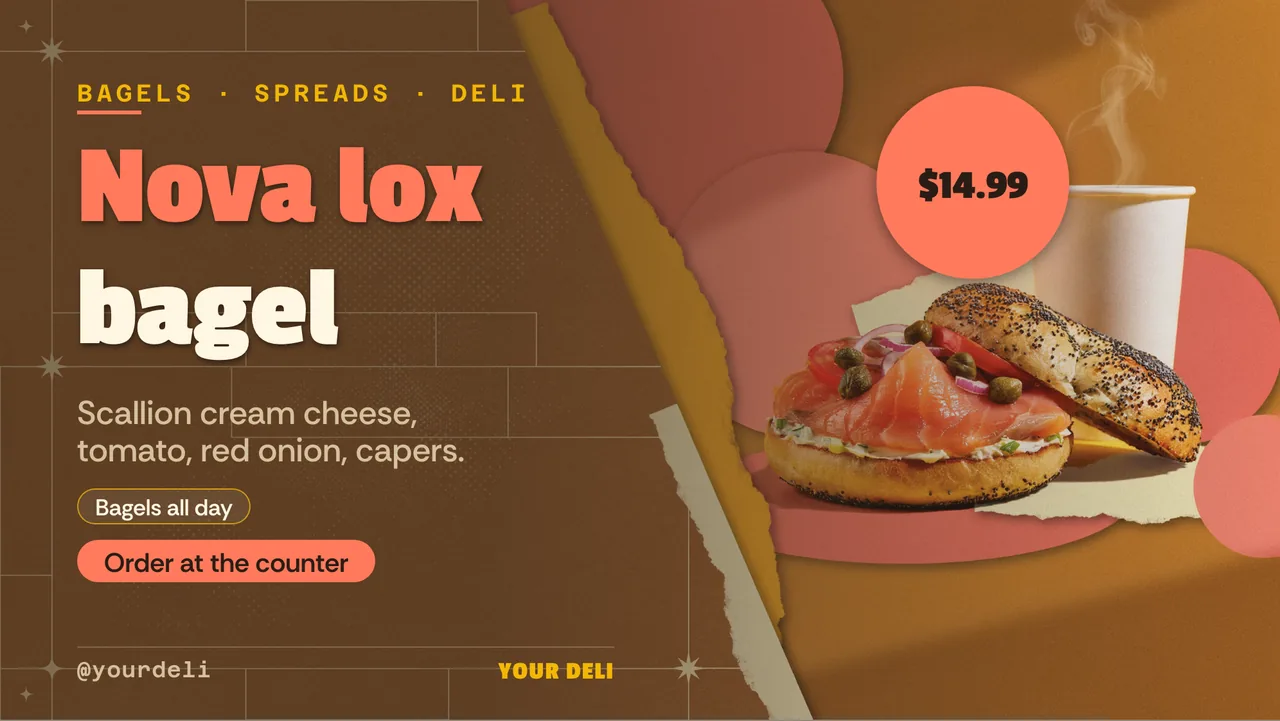
Digital menu board software is the part of the setup nobody demos properly. The screen is easy to picture and the design is easy to admire; what decides whether the board is still correct at four o’clock on a wet Tuesday is the software behind it — how fast an edit reaches the screen, what plays at 3pm without anyone deciding, and whether the person who has to change a price can do it from the floor.
This is a buyer’s guide to that layer: five jobs the software has to do, what it costs in practice, and the questions worth asking any vendor.
What digital menu board software actually has to do
Feature lists are long and mostly identical. In a working kitchen, digital menu board software gets judged on five things, and a platform can be excellent at four and still fail you on the fifth.
1. A price edit has to land everywhere, immediately
This is the whole reason to leave printed boards, so start here. Ask any vendor: after I change a price, how does that reach the screen, and how long does it take?
There are two answers in the market. Traditional player-based systems ask you to edit, then publish, then wait while each device syncs the files down. It works, and usually takes minutes, but it is a step you can forget — and a forgotten publish is how one screen ends up three weeks behind the others.
The other answer is derivation: the screen works out what to show from the schedule in real time, so there is no publish-and-wait step to skip. ChannelOS is built this way — edit once, airs everywhere. Fix a wrong price on the lunch board and every screen showing it corrects itself in seconds.
What to test on a trial: change one price and stand in front of two screens. Time it.
2. Dayparting by hour and by weekday
A menu board is not one board. It is a breakfast board, a lunch board and an evening board, and the moment each one should change is the moment the floor is busiest — which is exactly why nobody remembers to swap it.
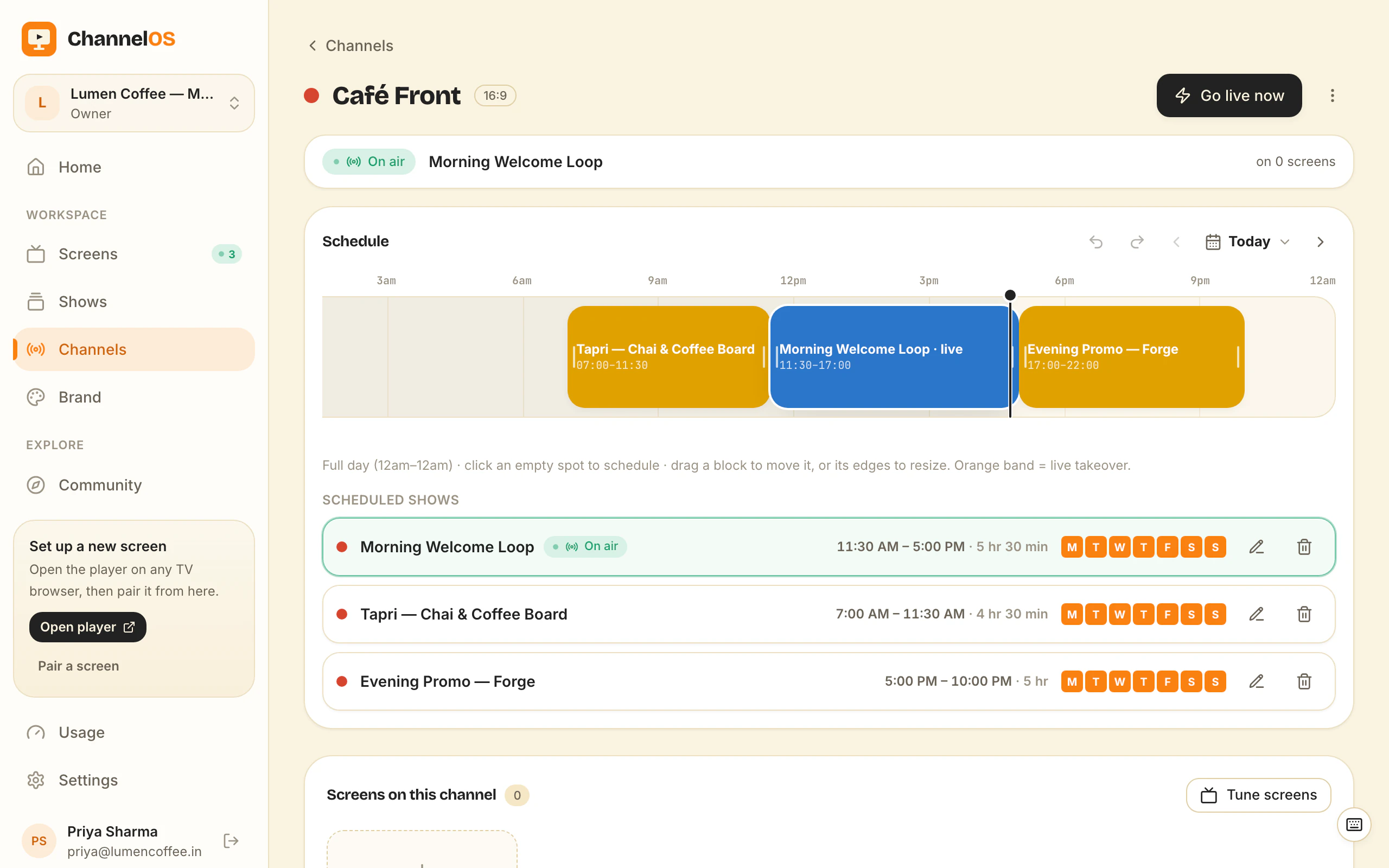
Real dayparting means setting the day once and never touching it: a coffee board from 07:00, a midday loop until 17:00, the evening promo after that. Weekends need their own answer too, because brunch is not breakfast. In ChannelOS this lives on a channel — a named feed with a real daily timeline that screens tune into — plus a live takeover for the unplanned moments, when the soup is off and you need it gone from every screen now rather than at the next scheduled change.
What to test: build a weekday schedule and a different Saturday, then check the screen on Saturday. Plenty of tools do hours but not weekdays.
3. More than one screen, without doing the work twice
One board is a document. Three boards is an operation, and the difference shows up as duplicated effort: the same drinks list rebuilt for the counter screen, the drive-thru and the room upstairs, each drifting out of step with the others.
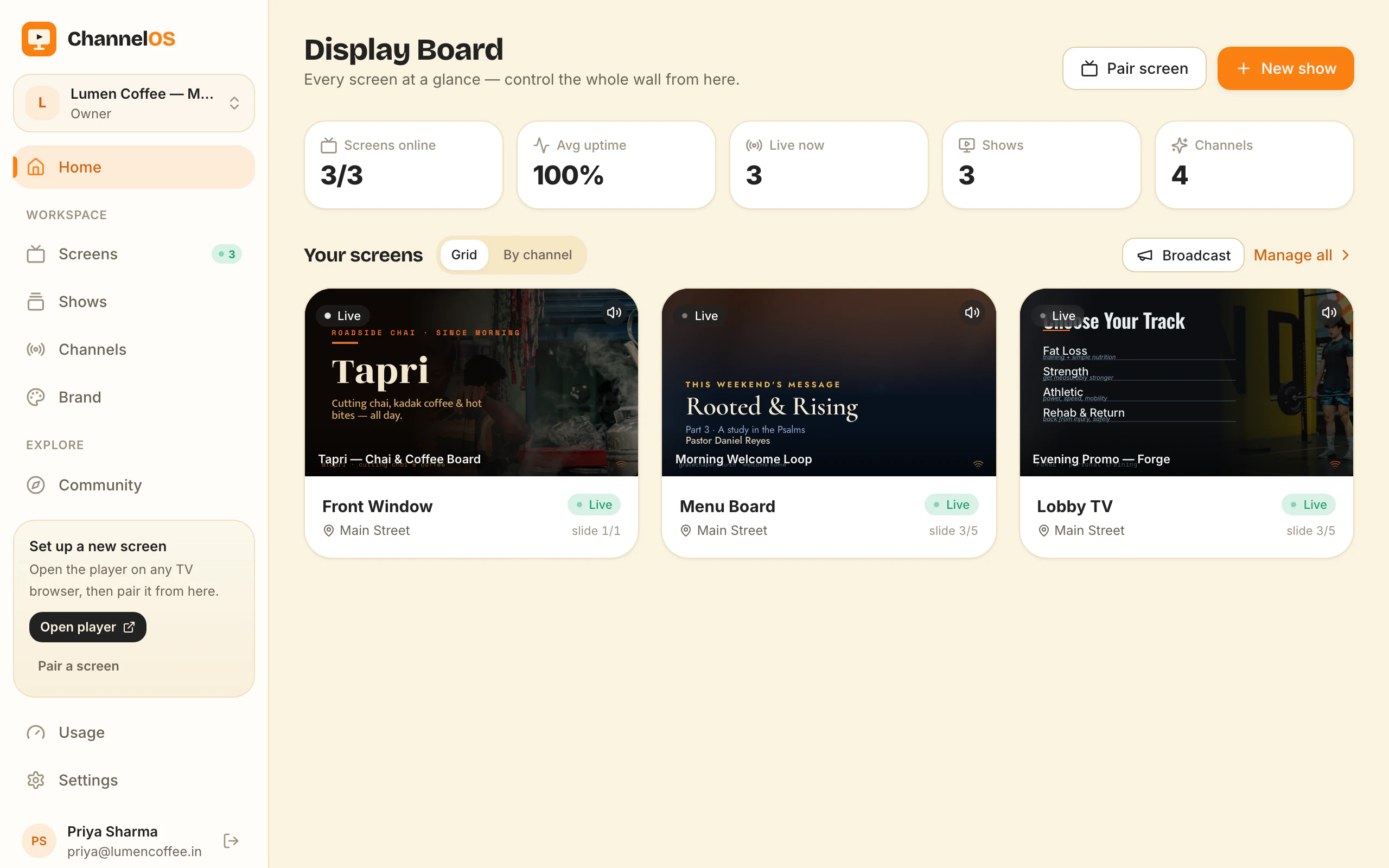
What you want is screens grouped onto a feed, so one change moves all of them, and one place to see the wall. ChannelOS calls that place the live board: every paired screen as a real rendered preview with live status and one-tap controls — play, pause, blank, mute, next, hold. The point is not the buttons. It is that the screen in the function room nobody has walked past since lunch is visible from your phone.
What to test: ask how a second site gets set up. If the answer is “rebuild it”, that is your future every time you open a branch. ChannelOS exports shows and channels as portable files another workspace imports.
4. What happens when the internet drops
The honest section. Menu-board software divides on this line and there is no universally right side.
Platforms built around a dedicated player box — Yodeck, OptiSigns and most of the traditional field — download media to local storage. A dropped connection does not stop the screen; it keeps playing what it last received. That is a genuine strength, and if your site’s connection is unreliable it outweighs everything else on this page.
Browser-based platforms, ChannelOS included, trade that for having no hardware to buy, provision, mount or licence. A short drop is survivable; an afternoon-long outage is not. We would rather write that down than let you discover it — no media player required covers the trade in full.
What to ask: how long does a screen keep playing with the network unplugged? Anything vaguer than a number is a no.
5. Somebody with no design skill has to be able to build the board
Most menu boards are maintained by whoever is free, not by a designer. The real usability test is not the editor — it is what you are looking at in the first thirty seconds. A blank canvas is where menu boards go to die.
Three starting points work, and ChannelOS ships all three: a guided maker (the free menu board maker has layouts for 14 cuisines — pizzeria, sushi, burgers, bbq, chinese, thai, italian, mexican, cafe, bakery, bar-pub, indian, food-truck and dessert), a template gallery you can remix, and an AI draft: describe the board in one sentence, or hand over the PDF menu you already have, and AI drafts a complete, on-brand, multi-slide show you then correct.
The output has to stay editable, though. A flat image export is a dead end — you want items, prices and photos to remain selectable elements you can fix in ten seconds.
What digital menu boards software costs
Nearly all digital menu boards software is sold per screen per month. That is the number on the pricing page, and rarely the number you end up paying, because three other lines ride along with it.
The player. A dedicated media-player box is one box per TV — a purchase, a power outlet behind a wall-hung display, a provisioning step before pixel one, a spare on a shelf for the night one dies, and eventually a fleet old enough to be a support ticket. It quietly outgrows the software line as screen count rises.
The per-device licence. Some platforms charge for the subscription and attach a licence to each device. Read the pricing page for whether “per screen” and “per device” are the same money or two lots of it.
The human. Design time, yours or bought in. Invisible on a quote, expensive in practice, and the line that AI drafting and templates actually reduce.
ChannelOS removes the first two by design. The TV’s own browser is the player — Android TV, Google TV, webOS, Fire TV, a Chromebox, a laptop in kiosk mode — so there is no box and no per-device licence. The first screen is free forever; after that it is per screen per month, with current rates on the pricing page.
Digital menu boards price: how to compare it honestly
People searching for a digital menu boards price want one number, and there isn’t one — so build the comparison in four lines instead, over a realistic term. Three screens, three years.
| Line | Player-based platform | Browser-based (ChannelOS) |
|---|---|---|
| Display | A TV per board, either way | A TV per board, either way |
| Playback device | A media-player box per TV | None — the TV’s browser is the player |
| Software | Per screen per month, sometimes plus a per-device licence | Per screen per month, first screen free forever |
| Build and upkeep | Design time per board, plus a publish step per change | AI draft or template, edits derive to every screen live |
Two honest notes on that table. The player line buys you something real (offline playback and hardware-level control), so it is a cost with a return, not waste. And “free” always has a shape: ChannelOS’s free screen is one screen, permanently, with a ChannelOS banner along the bottom of the screen that any paid plan removes, and the paid tier starts at screen two.
One thing we will not claim is that a digital board is cheaper than printing. For a shop that reprints twice a year it probably isn’t, and the buyer will do that sum at the counter faster than any marketer. What a digital board removes is the trip to the printer, the design charge, the two-day wait, and the three weeks spent with the wrong rate on the wall.
Where the specialist platforms still win
Two categories beat general menu-board software at specific jobs, and both are worth naming.
POS-integrated hospitality platforms. If prices must flow automatically from Toast, Square or Clover into the board, a dedicated hospitality product does that and ChannelOS does not integrate with a POS today. For a menu that changes weekly, typing it is a non-issue; for one that changes hourly from the till, it is decisive.
Player-based enterprise CMSs. Proof-of-play reporting, remote reboot, panel power scheduling, per-device telemetry. If you sell advertising slots and have to evidence them, or run a fleet big enough to need device-level control, buy that product class instead.
Everyone else — the café, the pizzeria, the bakery, the bar with three screens and no AV department — is buying speed of change, not fleet control.
The five questions to ask before you buy
- After I change a price, what exactly happens, and how long until every screen shows it?
- Can I schedule by hour and by weekday, and can I override it live when something sells out?
- What does adding the fourth screen cost me — in money and in rebuild time?
- How long does a screen keep playing with the network unplugged?
- What am I looking at in the first thirty seconds: a blank canvas, or a finished board to edit?
Those five answers separate the field faster than any feature matrix. For build steps rather than buying criteria, the digital menu board guide walks through pairing a screen and building the first board, and digital signage for restaurants covers the other screens in the room.
Try it on the screen you already have
The cheapest way to evaluate digital menu board software is to run one real board on one real TV for a week and watch what happens when a price changes. Open the player link on the TV, scan the code from your phone, start from the menu board maker or an AI draft, and let dayparting swap breakfast, lunch and dinner on the clock.
No player box, no per-device licence — and your first screen is free forever.
Frequently asked questions
- What is digital menu board software?
- Digital menu board software is the tool you use to build your menu boards, decide when each one plays, and push changes to the screens showing them. It usually has three parts: an editor for designing the board, a scheduler that decides what plays when, and a way of getting that content onto a TV — either a media player box or, with ChannelOS, the browser already built into the TV.
- What should digital menu board software be able to do?
- Five things. Change a price once and have every screen show it without a manual re-publish. Daypart by hour and weekday so breakfast, lunch and dinner swap themselves. Run several screens without rebuilding the same board for each one. Behave predictably when the internet drops. And let someone with no design training produce a board that looks deliberate — through templates, a guided maker, or an AI draft.
- How much does digital menu board software cost?
- Menu board software is normally billed per screen per month, and that subscription is only part of the bill. Add a media player box per TV if the platform needs one, a per-device licence if it charges one, installation, and whatever design help you buy. ChannelOS removes the player and per-device licence lines because the TV's own browser is the player, and the first screen is free forever — see the pricing page for the per-screen rate after that. Free screens show a ChannelOS banner along the bottom of the screen, and any paid plan removes it.
- What is the price of digital menu boards?
- Price the whole setup, not the software line. A digital menu board is a display, something to drive it, the software subscription, and the time it takes somebody to build and maintain the board. If the TV already hangs on your wall and the software runs in its browser, the marginal cost of one more board is the subscription and, at most, a cheap HDMI stick. If the platform requires a dedicated player and a licence per device, both scale with every screen you add.
- Do digital menu boards work without an internet connection?
- It depends on the architecture. Platforms built around a dedicated player box cache media locally, so a screen keeps playing what it last downloaded through an outage — that is the strongest argument for player-based systems. Browser-based menu boards like ChannelOS need a working connection, and ride out short drops rather than long ones. If your kitchen Wi-Fi genuinely dies for hours, that single difference should decide your choice.
- Can I make a digital menu board without design skills?
- Yes, provided the software gives you a starting point that is not a blank canvas. ChannelOS offers three: a free menu board maker with layouts for 14 cuisines, an AI draft built from one sentence or from your existing PDF menu, and a template gallery you can remix. Each one hands you a finished board to correct, which is a far easier job than designing one.
Your screen is two minutes away.
Open the player on a TV, scan the code, publish a show. Your first screen is free.
Free screens show a ChannelOS banner along the bottom of the screen, and any paid plan removes it.