Warehouses & distribution

Pair every TV in the facility, and let the schedule run your shifts.

A warehouse rarely has one screen. It has a break room, a dock office and a floor TV, each needing to show the right board for whoever's on shift right now. ChannelOS pairs every one of them from your phone and swaps what they show automatically when day shift hands off to night shift, no player box, no walking the floor to update a sign.

No card · no box to buy · pairs in about two minutes

The short answer

The problem is pairing more than one screen and keeping each one right for the shift that's on. A break room, a dock office and a floor TV each need their own board, and those boards need to change at shift change, not whenever someone remembers. ChannelOS pairs every screen in the facility from one phone, groups them onto a channel, and schedules that channel's daily timeline so the day-shift board swaps to the night-shift one on its own at the hour you set. What goes up is typed in by a shift lead at handover: the incident-free count, today's priorities, pick rate, dock status. It reads no WMS, no andon line and no sensor feed. If the job is a live production pull, buy a system built for that integration and run this for everything your floor already repeats by hand.

Built from this page's own templates

The three boards most warehouses actually run.

Real templates, drawn by the same renderer a paired TV runs. Remix any one of them in a click and swap in your own numbers.

The problem this solves

Pair every screen once. Let shifts schedule themselves.

A single screen is easy. A facility with several is where a laminated sheet and a walk-the-floor update fall apart, because nobody has time to swap three boards at every shift change. A channel is the fix: build a day-shift show and a night-shift show, put both on the same channel, and the channel's own clock swaps between them. Every paired screen on that channel follows it, with no one touching a TV.
  • Pair the break room, the dock office and the floor TV from one phone, a couple of minutes each
  • Group them onto one channel, a named feed with a real daily timeline
  • Daypart by hour: the day-shift board swaps to the night-shift board on its own at your shift-change time
  • A live takeover pushes an urgent message over whatever's airing, then hands back to the schedule
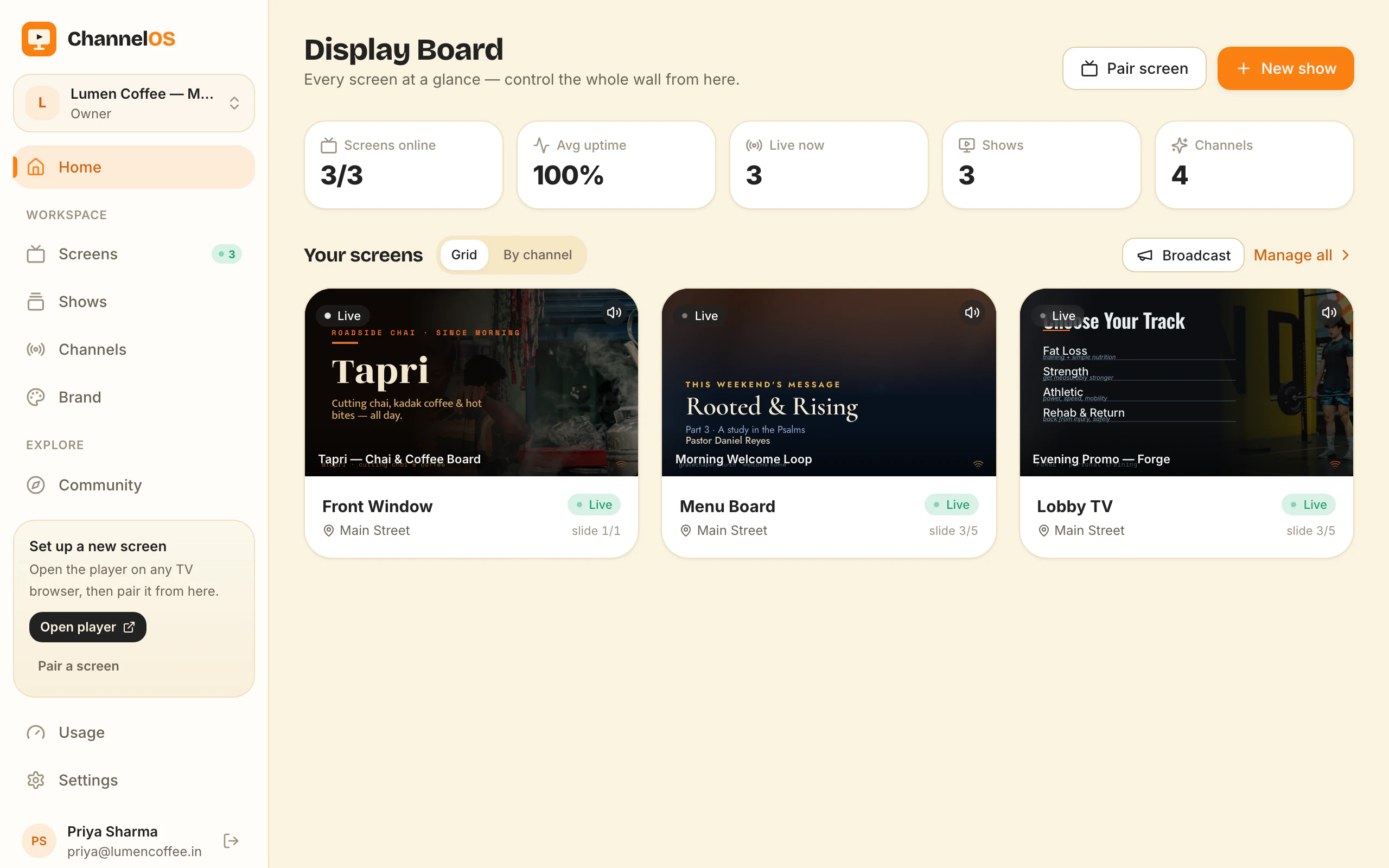
channelos.tv/app/board
The ChannelOS live board showing every paired warehouse screen at once with per-screen controls

No player box

The TV in the break room is already the player.

Most warehouse signage stalls on procurement: somebody has to source a player box, get it approved and wire it in before a single screen lights up. Here the install is a URL typed into the TV remote and a code scanned from a phone. No box on the shelf, no cable run, no engineer visit, and that's true whether it's the first screen or the fifth.
  • Open play.channelos.tv on the TV and pair it by scanning the code with your phone
  • Describe the board in one sentence: AI drafts a complete, on-brand, editable show, not one slide
  • First screen free forever, so a safety board can go up before anyone signs off a budget
  • A cheap HDMI browser stick covers a wall that has power but no smart TV yet
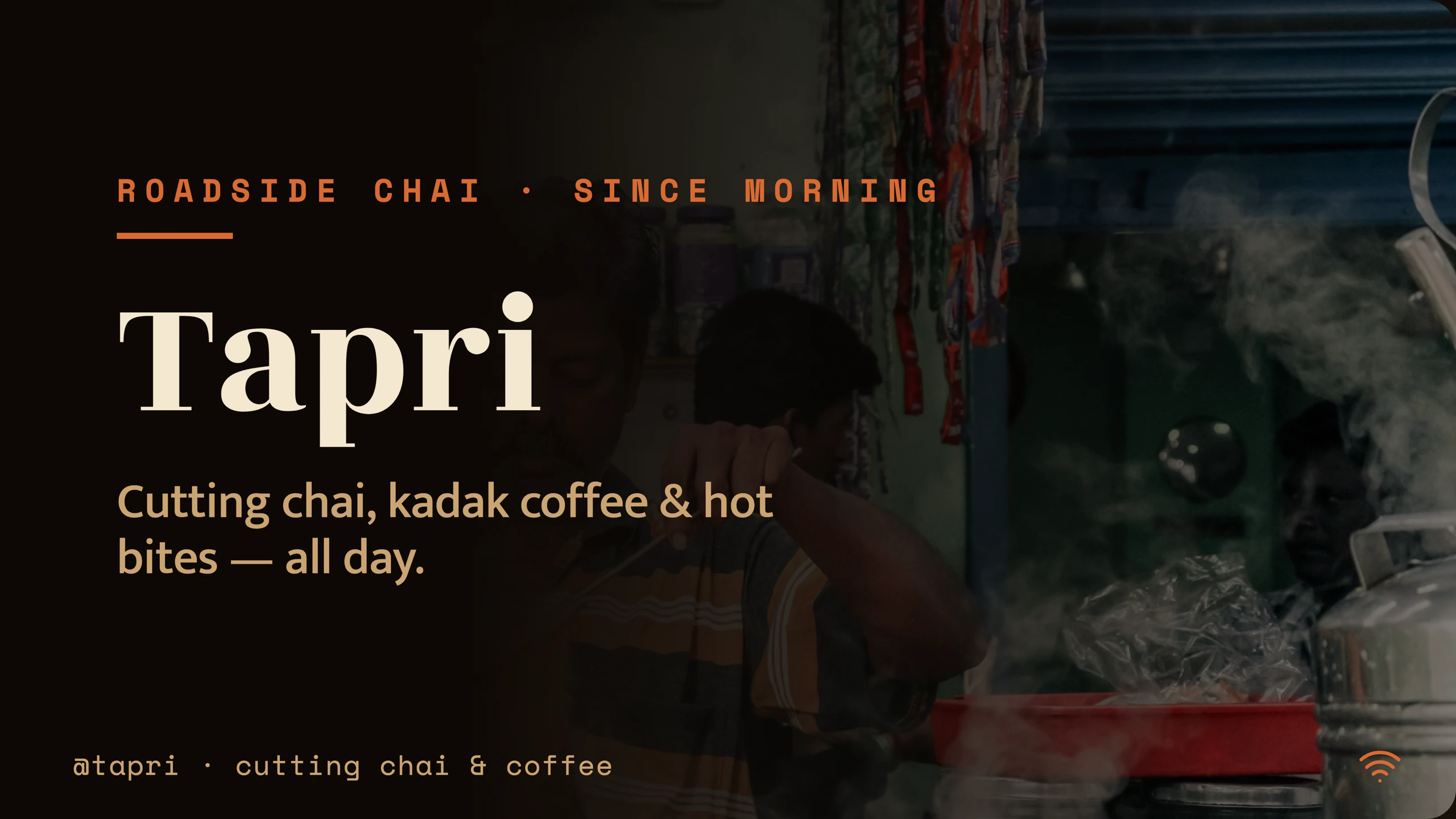
A ChannelOS show playing full-screen on a paired TV, as a warehouse break-room screen would run it

Shift handover

A changed number is an edit, not a reprint.

A laminated safety sheet or a whiteboard dies the day the numbers go stale, because fixing it means finding a marker or a printer. Here the incident-free count, the dock status and the week's priorities are text and table cells you edit in the browser, so updating them at shift change takes the same two minutes as reading them out loud, on whichever of the day-shift or night-shift shows is up next.
  • A Canva-style editor: drag, resize, rotate, group, keyboard shortcuts
  • A table for dock status or a stat row for pick rate, so the number a shift lead types is the number the floor sees
  • Free Pexels photo for a background, plus live widgets like a clock
  • Edit from a phone at handover, so nobody has to be at a desk
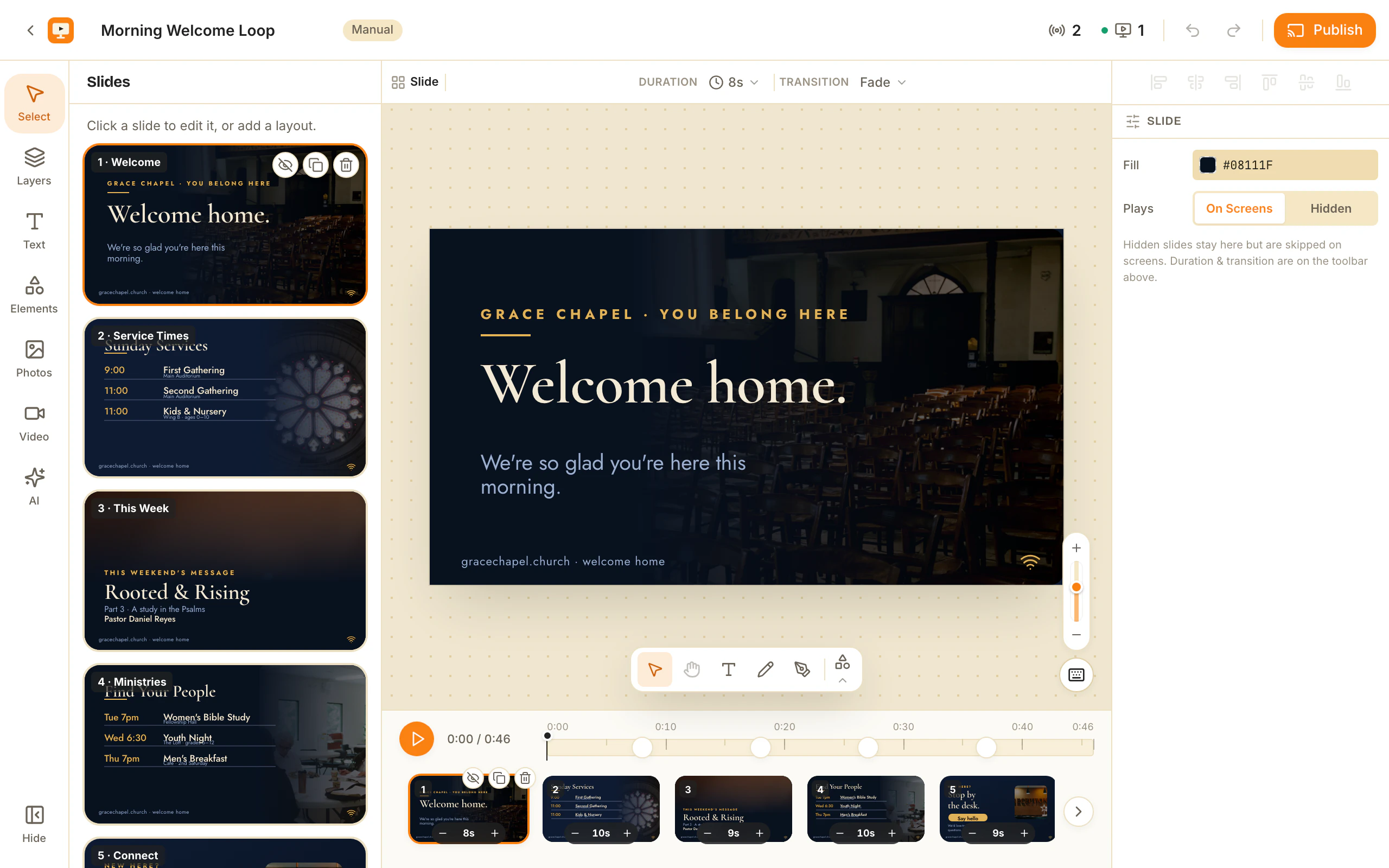
channelos.tv/app/shows/·/edit
The ChannelOS slide editor with a warehouse board slide selected and its properties open

What this is not

Should a plant that wants a live andon pull buy this?

No. ChannelOS reads no warehouse management system, no PLC, no andon line and no sensor of any kind. Every number on a board is typed in by a person at handover. It is also not a certified mass-notification system: there's no alarm feed, no PA integration, and nothing fires on its own. A live takeover still needs a person to send it. If the job is a real-time production pull or a life-safety alerting system, buy the system built for that integration, and run ChannelOS for everything your floor already says out loud at shift change instead.

The screens you already have

What warehouse digital signage actually runs on.

If the screen has a browser, it's already a player. No stick to buy, no per-device license.

Warehouse screen questions, answered.

Who should use digital signage for a warehouse?
A warehouse, distribution center or plant running more than one screen and more than one shift: a break room, a dock office and a floor TV that each need to show the right thing, and need it to change on its own at shift change. It fits a facility manager or operations lead currently updating several boards by hand, or verbally passing shift notes that half the next crew never hears.
What problem does this actually solve?
Pairing more than one TV across a facility, and keeping each one showing the right content for whichever shift is currently on, without someone walking the floor to swap boards at every shift change. A single screen is easy to keep current; three screens across two or three shifts is where a laminated sheet and a whiteboard fall apart.
How does ChannelOS solve it?
Two mechanisms. Pairing: open play.channelos.tv on each TV and scan a code from your phone, so every screen in the facility is paired from one account in a couple of minutes each. Scheduling: group those screens onto a channel, a named feed with a real daily timeline you daypart by hour, so the day-shift board swaps to the night-shift one automatically at the hour you set, with no one touching a TV.
How do I change what's on a board?
Open the show in the editor from a phone or a computer and edit it like a document: tap a number or a line of text, type the new one, done. There's no redesign and no reprint. A shift lead typically edits at handover, the same two minutes it takes to read a priority list out loud, except it reaches every paired screen on that channel at once.
Is this connected to our WMS, andon system or forklift fleet?
No, and we won't claim otherwise. ChannelOS reads no warehouse management system, no andon line and no live sensor feed. Every number on a board (units picked, on-time percentage, dock status) is typed in by a shift lead or supervisor at handover, the same way a whiteboard is updated today, just faster to change and visible on more than one screen at once. If the job is a live andon pull from your line, buy a system built for that integration.
Can the board show our safety record or near-miss count?
Yes, as a number someone types once a shift, not a live count. A good pattern is one safety board per facility with the incident-free days, this month's near-miss reports and audits passed, updated by the shift safety lead at close. It's the same discipline as a physical safety board, just one you don't have to repaint.
Do I need a media player box behind every warehouse screen?
No. ChannelOS runs in the browser already built into the TV (Android TV, Google TV, webOS, Fire TV, a Chromebox, or a laptop in kiosk mode), so there is no player box to buy and no per-device license. You pair a screen by opening play.channelos.tv on the TV and scanning the code with your phone. Where offline resilience across many sites matters more than setup speed, a dedicated player with local storage is the right call instead.
Can a board swap itself automatically when the shift changes?
Yes, that's what a channel's daily timeline is for. Build the day-shift version of a board and the night-shift version as two shows, put both on the same channel, and daypart the channel so it switches from one to the other at your actual shift-change hour, every day, on its own. Every screen tuned to that channel follows it at the same moment.
What does ChannelOS actually do?
ChannelOS is digital signage software that runs in a TV's own browser instead of through a media player box. You build a show (a set of slides) in a Canva-style editor, pair a screen by scanning a code from your phone, and group screens onto channels that follow a daily schedule, so the right content airs on the right screen at the right hour, across as many TVs as the facility has. One edit reaches every paired screen on that channel. The first screen is free forever.
How much does digital signage for a warehouse cost with ChannelOS?
The first screen is free forever, and screens after that are priced per screen per month, no hardware and no per-device license. Free screens show a ChannelOS banner along the bottom; any paid plan removes it. Scheduling across screens, channels and live takeover start on the Solo plan. Current per-screen rates are on the ChannelOS pricing page.

Looking for a different kind of office board? Browse office & lobby templates →

More on the board people check every day: Read the notice-board answers →

Put the first floor screen up today.

Open the player on a TV you already own, scan the code, and pick one of the three warehouse boards to remix. The first screen is free forever.

Free screens show a ChannelOS banner along the bottom of the screen, and any paid plan removes it.

Sell it instead of buying it. The ChannelOS partner program pays 20% of what each business you refer pays us for their first 12 months, then 10% for as long as they stay. Free to join, nothing to stock.

See the partner program →