Digital Signage for Schools: Hallway Boards Without an IT Project
Digital signage for schools on the TVs already mounted in your corridors — no player box, no per-device licence. AI drafts the notices, dayparting follows the bell schedule, and cafeteria menus update themselves.
Digital signage for schools fails the same way in almost every building. The screen goes up in the corridor, somebody in the office builds the first slide deck in an afternoon, and then term starts and nobody has ten minutes a week to change it. Six weeks later the board outside the hall is still advertising a concert that already happened, and staff have stopped looking at it — which is the only metric that ever mattered.
Three things fix that specific failure: the notices get drafted for you, the schedule does the swapping, and the TV is the player, so putting up a second screen isn’t a project.
What digital signage for schools has to do
Strip out the marketing and a school screen has four jobs, and they are not the same job.
The corridor board carries what changes weekly: today’s notices, club sign-ups, trip deadlines, the sports fixtures, a celebration wall. The cafeteria board carries what changes daily and has to be legible from a queue. Reception carries what a visitor needs in the first thirty seconds: where to sign in, safeguarding notices, the Wi-Fi guest code, today’s events. The staffroom or department screen carries cover arrangements, room changes and exam logistics.
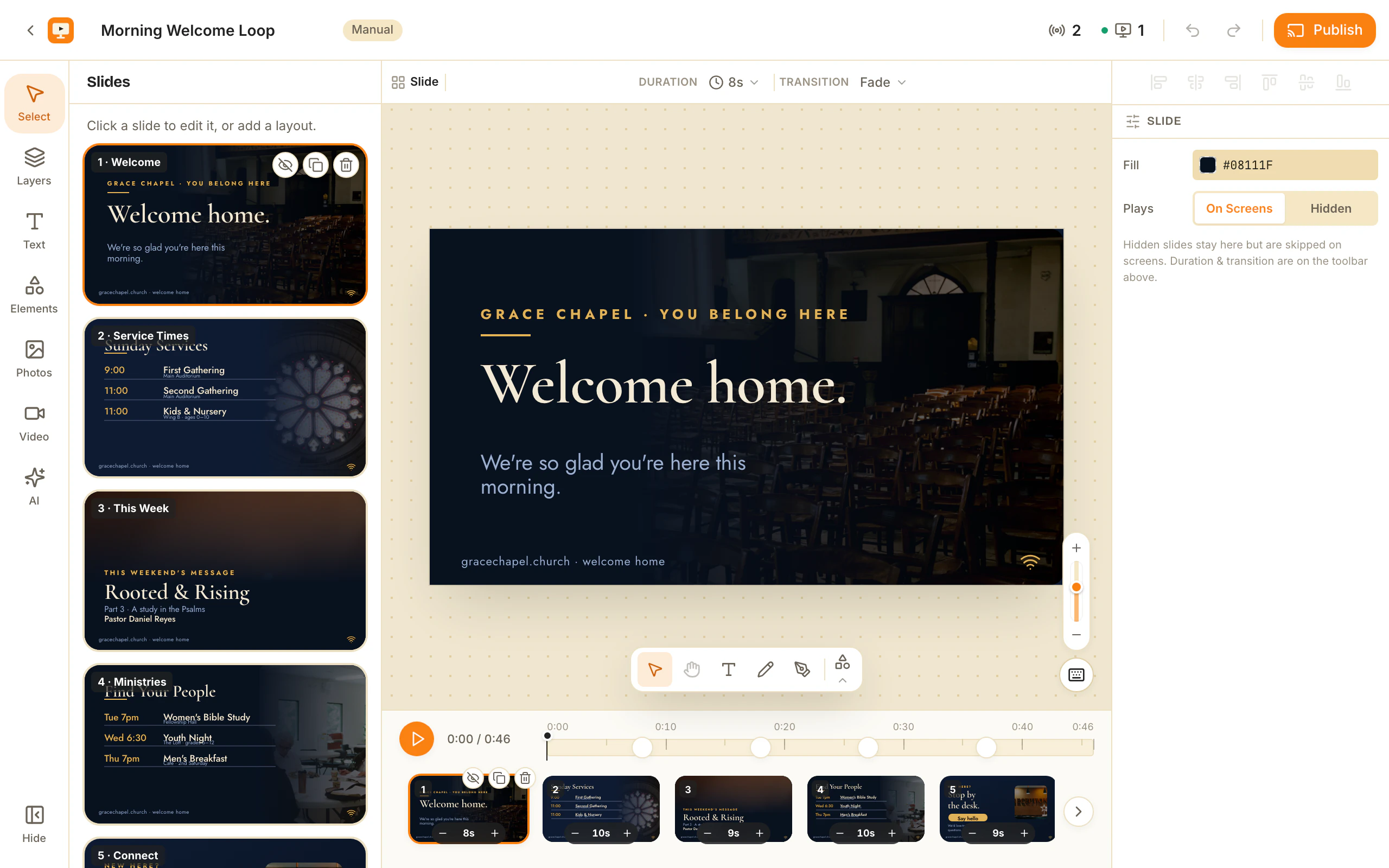
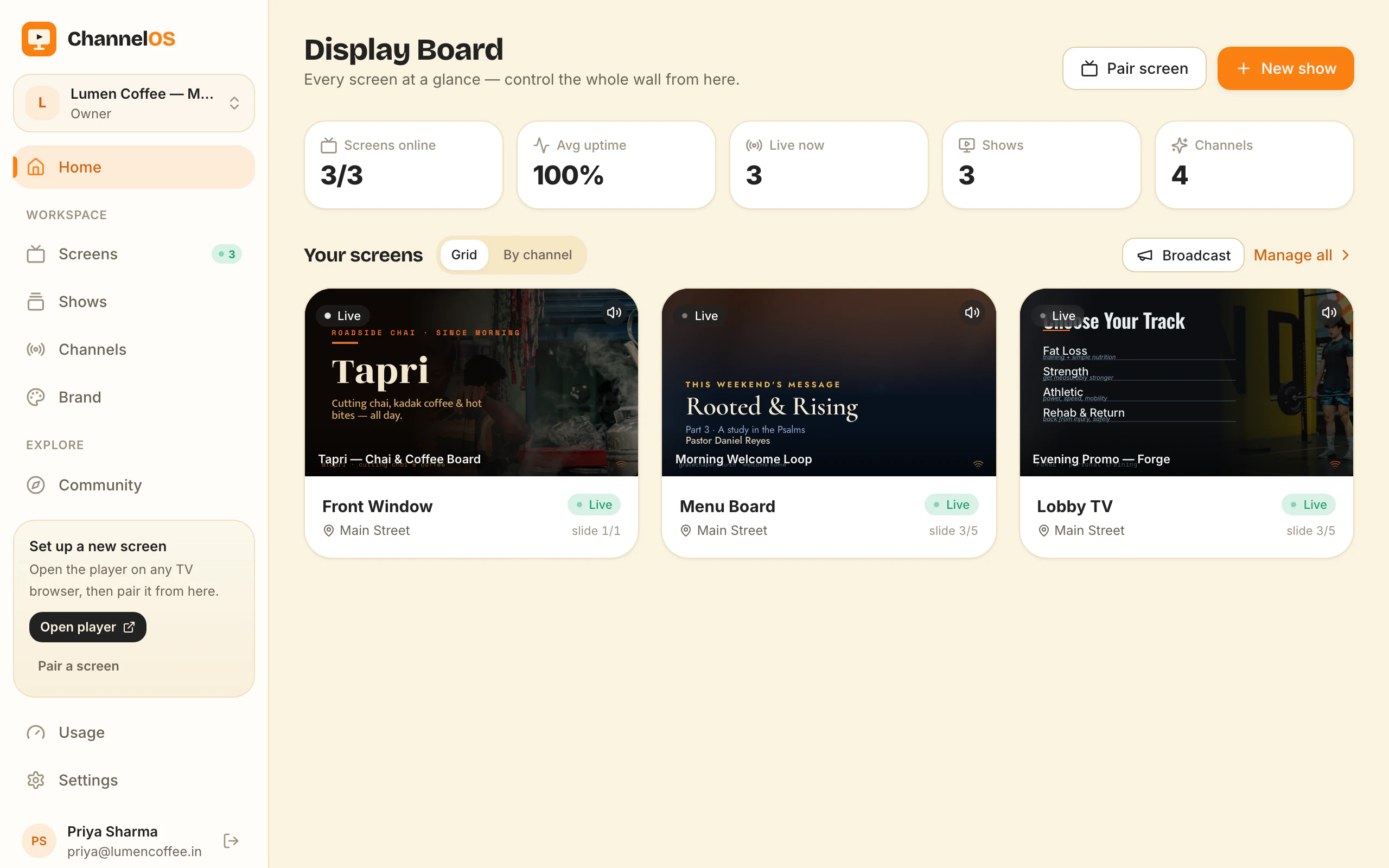
In ChannelOS each of those is a show — a real editable multi-slide deck, not a flat image export — and a channel decides which show is on which screen at which hour. Because a screen derives what it plays from the show plus the channel schedule plus the clock, there is no publish-and-wait step: correct a date in the show and the corridor screen is already correct.
Why it matters: the four jobs need four different boards. If putting up a board is expensive, you get one board doing all four badly.
The corridor board nobody has time to update
The reason the hallway screen goes stale isn’t laziness, it’s that building a weekly notice deck by hand is a design task, and schools do not have a designer sitting spare.
So describe it instead. Type a sentence — “week 3 notices: Year 9 parents’ evening Thursday, football trials Wednesday lunchtime, library open until 5” — and AI drafts a complete, on-brand, editable multi-slide show. Hand it the PDF newsletter that already went out to parents, or a photo of the paper noticeboard, or a URL from the school website, and it reads them for context rather than making you retype anything. You get slides, not a picture of slides: every heading, date and photo is a selectable element in a Canva-style editor.
Then the parts that stop a corridor board looking frozen. A live clock widget. A ticker running a line along the bottom for the small stuff. A QR widget pointing at the parents’ portal, a consent form or the trip payment page — it is a live widget, so change the URL and every screen regenerates the code. Exam timetables and fixture lists belong in a table, which is a first-class element you draw on the slide and edit cell by cell, because a fixture list reads properly as a table and badly as a text box. Free Pexels photos and videos are built in, and one-tap background removal lifts a photo of the winning team cleanly onto your school colour.
Why it matters: the weekly notice board only stays current if making next week’s takes minutes, not an afternoon.
Cafeteria menu boards that update themselves
The canteen is the one school screen with a genuinely daily job, and the one most likely to still show Monday’s menu on Thursday.
Upload the menu you already publish as a PDF and AI reads its sections, items and prices into a multi-slide board. Allergen and calorie columns go into a table. Then the schedule does the rest: a break-time board, a lunch board per sitting, and a different board on the days the kitchen runs a themed menu. If a dish runs out, fire a takeover from your phone to pull it off every screen in the hall immediately and let the normal board resume afterwards, rather than editing a permanent board to say a temporary thing.
If you want a running start rather than a blank sentence, the free menu board maker has layouts across 14 cuisines, and the templates gallery has boards you can remix.
Why it matters: nobody is going to walk to the canteen TV at 07:30 to change yesterday’s menu. Either it changes itself or it goes stale.
Bell-schedule dayparting: the timetable is the schedule
A school day is already a schedule, which makes dayparting the feature that fits schools best.
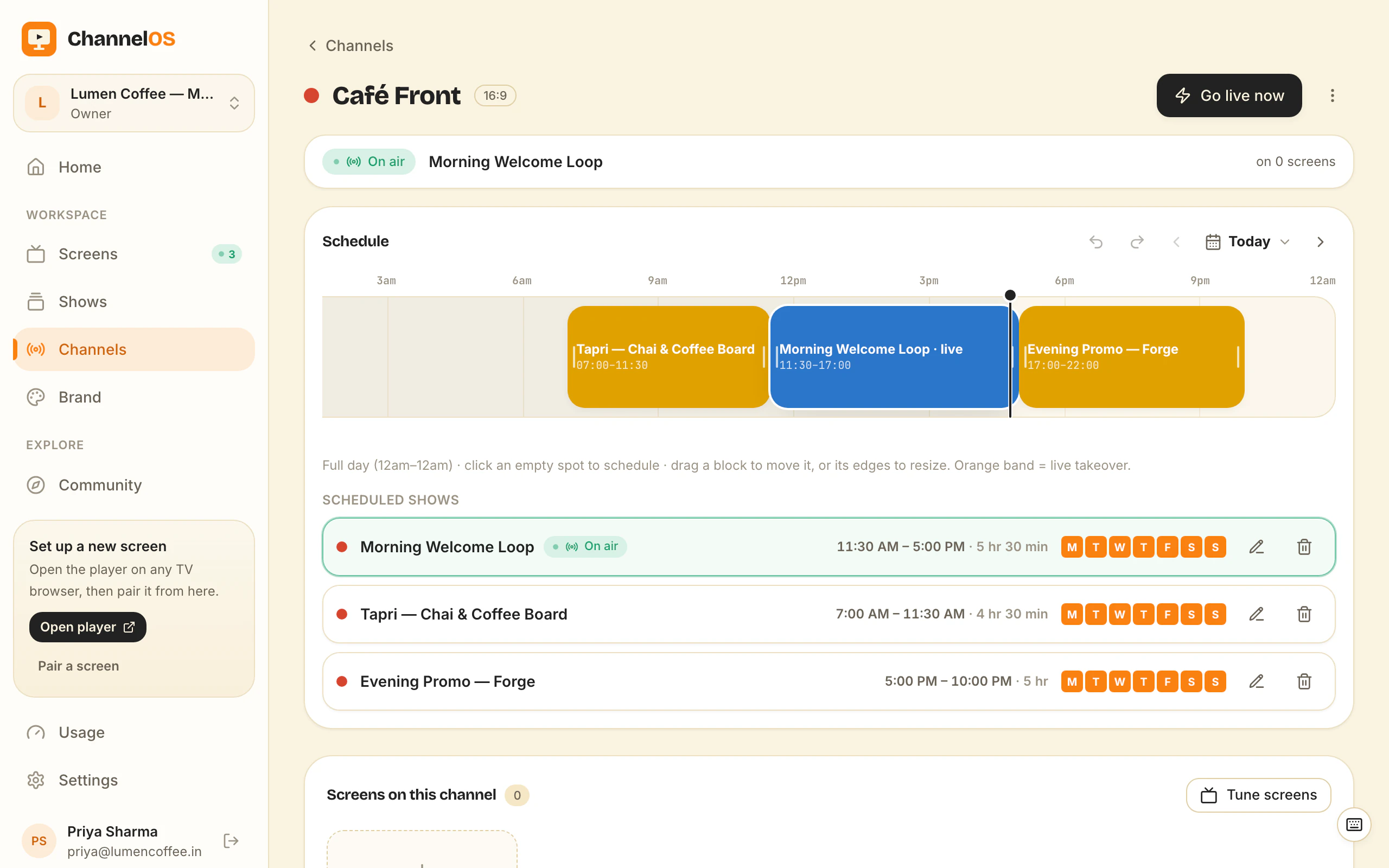
A channel in ChannelOS has a real daily timeline: you place shows into it by hour and by weekday. Morning notices run until first bell. The timetable and room-change board covers registration. The cafeteria boards take the lunch periods. Clubs, buses and pick-up information run the last half hour. INSET days, exam weeks and open evenings get their own scoped programmes over the top of the weekly plan, so you set the special day up in advance and it simply happens.
Screens tune into a channel rather than being fed files one at a time, which is what makes a second building manageable: the six corridor screens sit on one channel and change together, while reception and the sixth-form common room sit on their own. A whole channel exports as a portable file (.channel.channelos.tv) and imports into another workspace, so a second school in a trust starts from the first school’s finished boards and changes only what differs. A brand kit keeps the crest, fonts and colours identical across both.
Why it matters: the moment a school board should change is the moment everyone is moving between lessons. That is exactly when nobody can change it.
Emergency notices, and where the honest limit is
The mechanism is a live takeover: from your phone, you cut a message onto every screen on a channel immediately, and when you end it the normal schedule resumes with nothing permanently edited. There is also go-live-now for pushing a show onto screens straight away. For a lockdown drill, a fire-assembly change, a snow-day closure or a late bus, that is genuinely the fastest path from “we know” to “it is on every screen”.
Now the limit, because this is a category where vagueness is dishonest. ChannelOS is not a certified mass-notification system. It does not ingest CAP alert feeds, does not integrate with InformaCast, a PA system or a bell system, and nothing triggers automatically from another platform — a human fires the takeover. If your district’s safeguarding policy requires alerting driven automatically by a life-safety system, that job belongs to a dedicated alerting vendor, and ChannelOS should sit alongside it rather than replace it.
Why it matters: a signage tool that implies it is a life-safety system is a liability. A signage tool that broadcasts a message in ten seconds is genuinely useful. Only one of those is true here.
No IT project, no per-device licence
This is usually the real blocker in a school, and it is not a software problem. A traditional deployment needs a media player per screen: a device to specify, quote, order, image, licence, mount behind a wall-hung panel, add to the asset register, keep patched and eventually replace. In a school that means a purchase order, network approval and an IT technician’s time — for a noticeboard.
ChannelOS removes that layer. The browser already built into the TV is the player: Android TV, Google TV, webOS, Fire TV, a Chromebox, or an old laptop in kiosk mode. You open one URL on the screen, scan the code from your phone, and it is paired in about two minutes. no box behind the panel, no per-device licence to track and nothing new on the asset register. (No media player required covers the mechanism; digital signage without an Android player covers the older panels already on the wall.)
The trade-off is real and worth naming: a browser-based screen wants a working connection. A player with local storage rides out a network drop better than a web page does. School Wi-Fi in a far corridor is not always brilliant, and if a particular screen sits somewhere the network genuinely doesn’t reach, that one difference outweighs everything else here.
Rise Vision is the education incumbent, and it is good at it
If you have shortlisted anything for a school, Rise Vision is on the list, and it deserves to be. It is specialised in education in a way ChannelOS is not: a large K-12 template library, classroom and emergency alerting, screen sharing, 40+ integrations, and procurement built around how districts actually buy — purchase orders, tax-exempt paperwork, district-wide rollouts. It is also hardware-agnostic, so an existing fleet of players can be reused rather than binned.
Where the two genuinely diverge: Rise Vision runs an installed player app on a device on every screen, and its AI generates single design layouts. ChannelOS needs no device at all, and its AI drafts the whole multi-slide show from one sentence. The full side-by-side is in ChannelOS vs Rise Vision.
The honest split: a district rolling out hundreds of screens with an IT team and a procurement cycle should look hard at Rise Vision. A single school, one department, a small academy trust or an independent that wants the corridor board live this week without raising a PO is exactly who ChannelOS is built for.
What digital signage for schools costs
The first screen is free forever. After that it is per screen per month, with no per-device player licence, no setup fee and no seat charges — current rates are on the pricing page. Because the TV’s own browser is the player, the hardware side is a display the school likely already owns, plus at most a cheap browser stick for a panel whose built-in browser is too old.
The cheapest way to decide is to pair the corridor screen you already have, describe this week’s notices in a sentence, and see whether the board is still current in three weeks’ time. That is the only test that matters, and it costs nothing to run.
Frequently asked questions
- What is digital signage for schools?
- Digital signage for schools means running notices, timetables, cafeteria menus, exam information and celebration walls on TV screens instead of printed posters and noticeboards. With ChannelOS the TV itself is the player, so a corridor screen shows a channel that follows the school day, and an edit made once on a phone or laptop is reflected on every screen in seconds.
- Do schools need a media player or an app for digital signage?
- No. ChannelOS runs in the browser already built into the TV — Android TV, Google TV, webOS, Fire TV, a Chromebox or a laptop in kiosk mode. There is no media player box to mount behind the panel and no per-device licence, so no purchase order or imaging job is needed before the first screen goes live.
- Can school signage follow the bell schedule?
- Yes. A channel in ChannelOS has a real daily timeline, so you set morning notices until first bell, timetable and cafeteria boards over the lunch periods, and clubs or pick-up information at the end of the day. Weekdays can differ from weekends, and the screens follow their own clock, so nobody has to swap anything by hand.
- Can we push an emergency notice to every school screen at once?
- You can fire a live takeover from your phone, which cuts in on every screen on that channel immediately and drops back to the normal schedule when you end it. Be clear on the limit though: ChannelOS is not a certified mass-notification system and does not integrate with CAP feeds, InformaCast or a bell and PA system. If your district requires alerting that is triggered automatically by another system, use a dedicated alerting platform for that job.
- How much does digital signage for schools cost?
- The first screen is free forever and additional screens are priced per screen per month — current rates are on the pricing page. Free screens show a ChannelOS banner along the bottom of the screen, and any paid plan removes it. There is no player device to buy, no per-device licence and no seat charges, so a second or third corridor screen costs the subscription plus, at most, a cheap browser stick for a TV without a usable built-in browser.
- Is Rise Vision or ChannelOS better for a school?
- Rise Vision is purpose-built for education, with a large K-12 template library, classroom and emergency alerting, screen sharing, 40+ integrations and procurement that fits how districts buy — for a district-wide rollout it is hard to beat. ChannelOS is the faster path for a single school, a department or an academy trust that wants screens live without a hardware project: it needs no player device, AI drafts the whole multi-slide show, and the first screen is free. Free screens show a ChannelOS banner along the bottom of the screen, and any paid plan removes it.
Your screen is two minutes away.
Open the player on a TV, scan the code, publish a show. Your first screen is free.
Free screens show a ChannelOS banner along the bottom of the screen, and any paid plan removes it.