For restaurants

Digital signage for restaurants, on the TVs already on your wall.

Your menu board, your service-period switches and tonight's specials run as a web page in the TV's own browser. No player box to buy, no per-device licence — and the first screen is free forever.

No card · no box to buy · pairs in about two minutes

What it looks like on the wall.

Real boards from three kinds of kitchen, drawn by the same renderer a paired TV runs.

These are our own sample venues, not customers. We have not put words in anyone's mouth: the boards are real product output, the businesses are made up, and we will say so until there are real ones here to name. Type your own menu and watch this happen →

People run ChannelOS screens in cafés and restaurants, gyms and studios, clinics and waiting rooms, schools and colleges, events, hotels and shops. One TV or one standee is enough to start.

Two screens, two shapes, one place to change them. A TV on the wall, a standee by the counter. Each one is its own channel.

A café board on a TV, showing cutting chai, coffee and hot bitesA dental clinic waiting-room board on a TV, telling patients to check in at the front deskA gym board on a TV, showing the studio name and its personal-training lineA school board on a TV, showing that enrolment is open for the coming yearA festival board on a TV, showing three stages, two nights, the dates and the gate timeA boutique hotel welcome board on a TV
Tapri
Pouring today
Kadak Chai
₹20
Filter Coffee · ₹40
Bun Maska · ₹30
Counter open till 11 pm

For cafés · The drink list, with today's prices. Change one at the counter and the board changes.

Sign up with Google

One screen free for ever: 50 AI credits a month, no card.

Service periods

Dayparting, so the board is right at 7am and at 7pm.

A restaurant screen is wrong for most of the day if it only ever holds one board. Breakfast has to come down before the lunch rush, the bar list has no business on the wall at nine in the morning, and Sunday does not run the weekday plan.

Channels · Dayparting

Set the day once; the screens keep it.

What a screen shows is derived from the schedule in real time rather than pushed to it, so the boards swap themselves at the times you set. Set the plan on a Monday morning and the room runs it for the rest of the season.
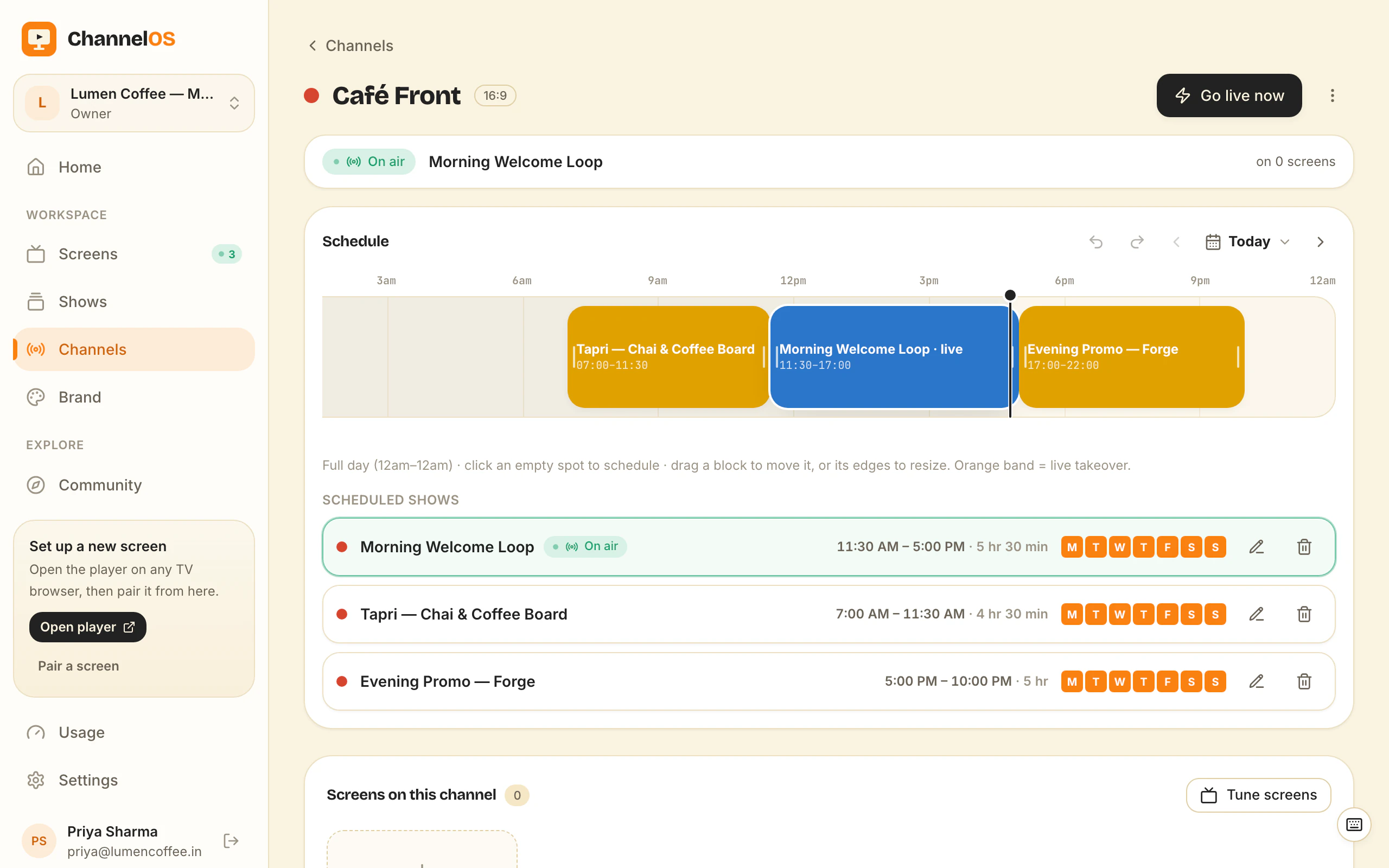
  • A channel is a named feed with a real daily timeline — you place each board on the hours it should air
  • Dayparting works by hour and by weekday, so Saturday brunch is not the same plan as Tuesday
  • Every screen tuned to the channel follows its own clock — nobody has to be on site at the changeover
  • Need it on now? Go live puts a board up immediately without touching the rest of the schedule
channelos.tv/app/channels
A ChannelOS channel timeline with separate breakfast, lunch and dinner boards scheduled across the day

Promos and specials

Tonight's special, and the thing you just ran out of.

The two edits a restaurant actually makes mid-service are opposites: putting something up in a hurry, and taking something down in a hurry. Both are one action here.

Editor · Takeover

Put it up, or pull it off, from the pass.

Soup is 86'd at half seven: you open the show on your phone, mark the line, and every board in the room is correct before the next order lands. A happy-hour board that only exists between five and seven is a scheduled slot, not something a member of staff has to remember to put up and take down.
  • Edit the item and it is already on air — the screens derive the show, so there is no publish-and-wait
  • A live takeover airs over the top of the schedule for as long as you want, then the normal plan resumes
  • Live widgets carry the moving parts: a clock, the weather, a QR code to the online menu, a ticker, a menu block
  • Tables, groups and keyboard shortcuts, so a whole section reprices without redrawing the board
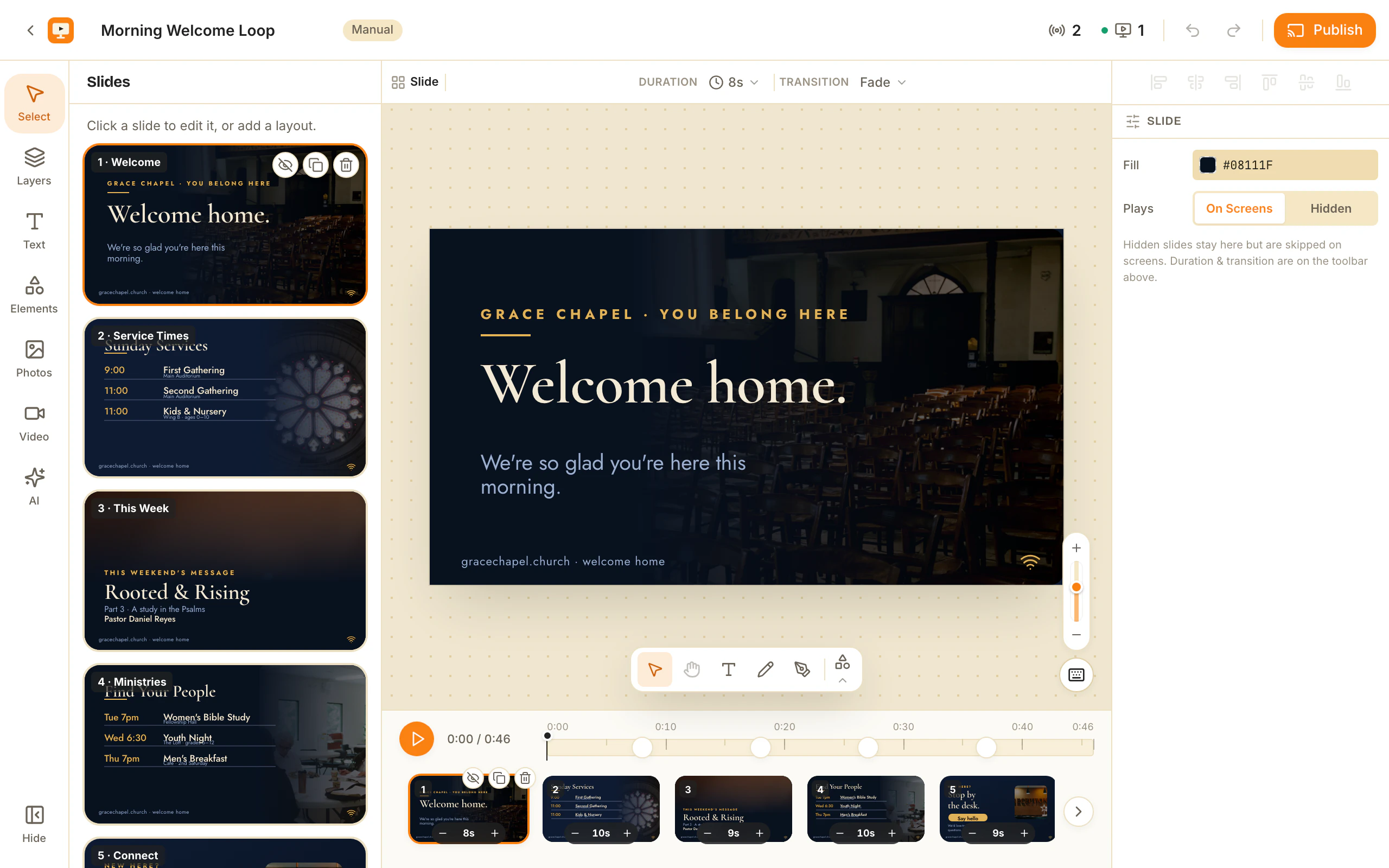
channelos.tv/app/shows/·/edit
The ChannelOS slide editor with a menu board open, each item and price a selectable element

Multi-location

Digital signage for restaurants with more than one room.

The work in a second site is never the screen — it is keeping the second site's screen saying the same thing as the first. Because screens tune into a channel instead of being loaded one at a time, the tenth screen costs you the same amount of work as the second: none.

One board, every screen

Edit once; it airs everywhere.

A price correction made in the office is on the wall at every site in seconds, with no per-screen push and nobody driving anywhere. Adding a location is opening the player URL on one more TV and pointing it at the channel that already exists.
  • Every screen on a channel shows what the schedule says is on right now, resolved against that channel's timezone
  • One board can serve every site, or each site can run its own channel with its own hours
  • The live board shows what is playing where, with play, pause, blank and reload per screen
  • Export and import a whole show or channel as a file, so a new franchise starts from the finished thing
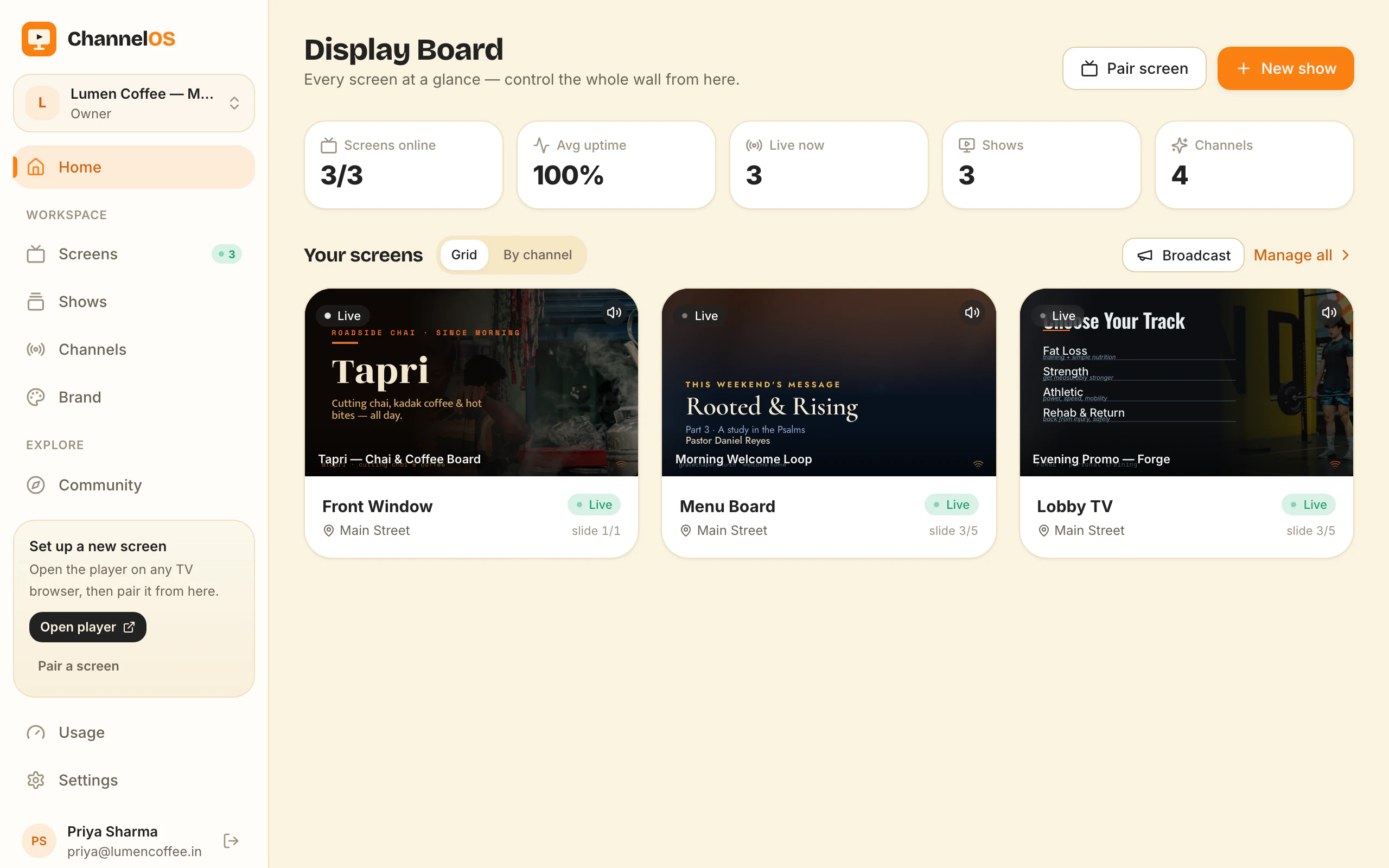
channelos.tv/app
The ChannelOS board showing several paired screens and what each one is currently playing

Hardware

The hardware you already have.

ChannelOS is a web page. Anything in the restaurant that can open one can be a screen, which takes the player box, the sideloaded app and the per-device licence out of the quote entirely. Honest caveat: a shared back-office laptop that someone closes at night is not a screen you should trust a lunch board to — a stick left plugged in is.

When a box is the right answer

A screen that is already playing keeps playing if the wifi drops, but it needs the connection back to come up again after a power cut, because nothing is cached on the television itself. If a screen has to survive a long outage entirely on its own, buy a player from a company that sells one and ask them about local storage. That is a real reason to pay for hardware. Ours is not one of them.

More on what that leaves you buying in signage without an Android player, and what a paid screen costs on the pricing page.

Keep reading

The restaurant guides.

Questions restaurants ask.

What is digital signage for restaurants?
Digital signage for restaurants means running your menu boards, daily specials and order-here prompts on TV screens instead of printed or chalk boards. In ChannelOS the board is a real editable show — every heading, item and price is its own selectable element — and the TV's own browser is what plays it, so correcting a price is an edit rather than a reprint.
Do I need a media player box behind each restaurant TV?
No. ChannelOS runs as a web page in the browser already built into the screen: Android TV, Google TV, webOS, Fire TV, a Chromebox, or a laptop in kiosk mode plugged into the HDMI port. There is nothing to sideload and no per-device licence. You open the player URL on the TV and pair it by scanning the code it shows with your phone.
How do I switch between a breakfast, lunch and dinner menu automatically?
Schedule each board onto a channel. A channel is a named feed with a real daily timeline, so you place the breakfast board on the morning hours, the lunch board through the afternoon and the dinner board at night, and every screen tuned to that channel follows its own clock. Weekday and weekend plans can differ, and once it is set nobody has to be in the restaurant for the switch to happen.
Can I run the same menu across several restaurant locations?
Yes. Screens tune into a channel rather than being loaded one at a time, so every screen pointed at that channel shows whatever the schedule says is on right now. What a screen displays is derived from the schedule in real time, which means you edit the show once and each site picks the change up in seconds — there is no publish-and-wait step and no walking a floor with a USB stick.
Does it connect to my POS for live prices?
Not today. ChannelOS has no POS integration, so if your menu prices have to sync automatically out of Toast, Square, Clover or a similar till, a hospitality-specific signage product is the better fit and you should buy that one. ChannelOS is faster when the job is getting good-looking, always-current boards onto screens: AI drafts them from your existing menu, and you change a price yourself from your phone.
How much does digital signage for restaurants cost?
The first screen is free forever, and additional screens are billed per screen per month — current rates are on the ChannelOS pricing page. There is no media player to buy and no per-device licence, so on the hardware side you need the TV you already have plus, at most, a cheap browser stick. Traditional signage products usually add a player device and a per-device licence on top of their software fee.

The ones that come up in the kitchen rather than the office, about sold-out items, power, burn-in and who sets it up, are on the answers page.
Put tonight's menu on the TV that's already there.

Open the player on the screen, scan the code from your phone, and the first board is up. First screen free forever.

Sell it instead of buying it. The ChannelOS partner program pays 20% of what each business you refer pays us for their first 12 months, then 10% for as long as they stay. Free to join, nothing to stock.

See the partner program →