Drive-Thru Digital Menu Boards: Pre-Sell, Order Point and the Breakfast Changeover
An honest guide to drive-thru digital menu boards — what the pre-sell board and the order-point board each have to do, how to make them legible at speed, how to daypart the breakfast changeover, and which hardware you still have to buy.
Drive-thru digital menu boards look like one product and are actually two jobs. The board before the speaker is read by a driver still rolling, in a few seconds, with one hand on the wheel. The board at the speaker is read by a driver who has stopped, is talking to a headset, and needs to find a price. Build both the same way and one of them fails.
This is a practical guide to the difference, to the legibility maths, to dayparting the breakfast changeover, and to the part most signage pages skip: the hardware you still have to buy.
What drive-thru digital menu boards actually do: pre-sell versus order point
The pre-sell board is the first screen in the lane, usually before the turn into the speaker. The car is moving and the driver has maybe five seconds of attention while watching the bumper in front. Its job is to narrow the decision, not to list the menu: a handful of items, headline-sized, plus whatever is new this month. Six items is generous. Twenty is a wall the eye slides off.
The order-point board sits at the speaker post where the car is stationary and the conversation has started. Now the driver needs to find something: categories, sizes, prices, meal upgrades, and — if the rule applies to your business — calorie or allergen detail. This board can be dense, because the reader has stopped and can scan it.
Some lanes add a third screen, the order-confirmation board, mirroring items as they are rung up. That one needs a live feed from the till, and the restaurant guide says the same thing we will say here: ChannelOS does not integrate with a point-of-sale system today. If order confirmation matters, buy that one screen from your POS vendor and let ChannelOS run the two beside it.
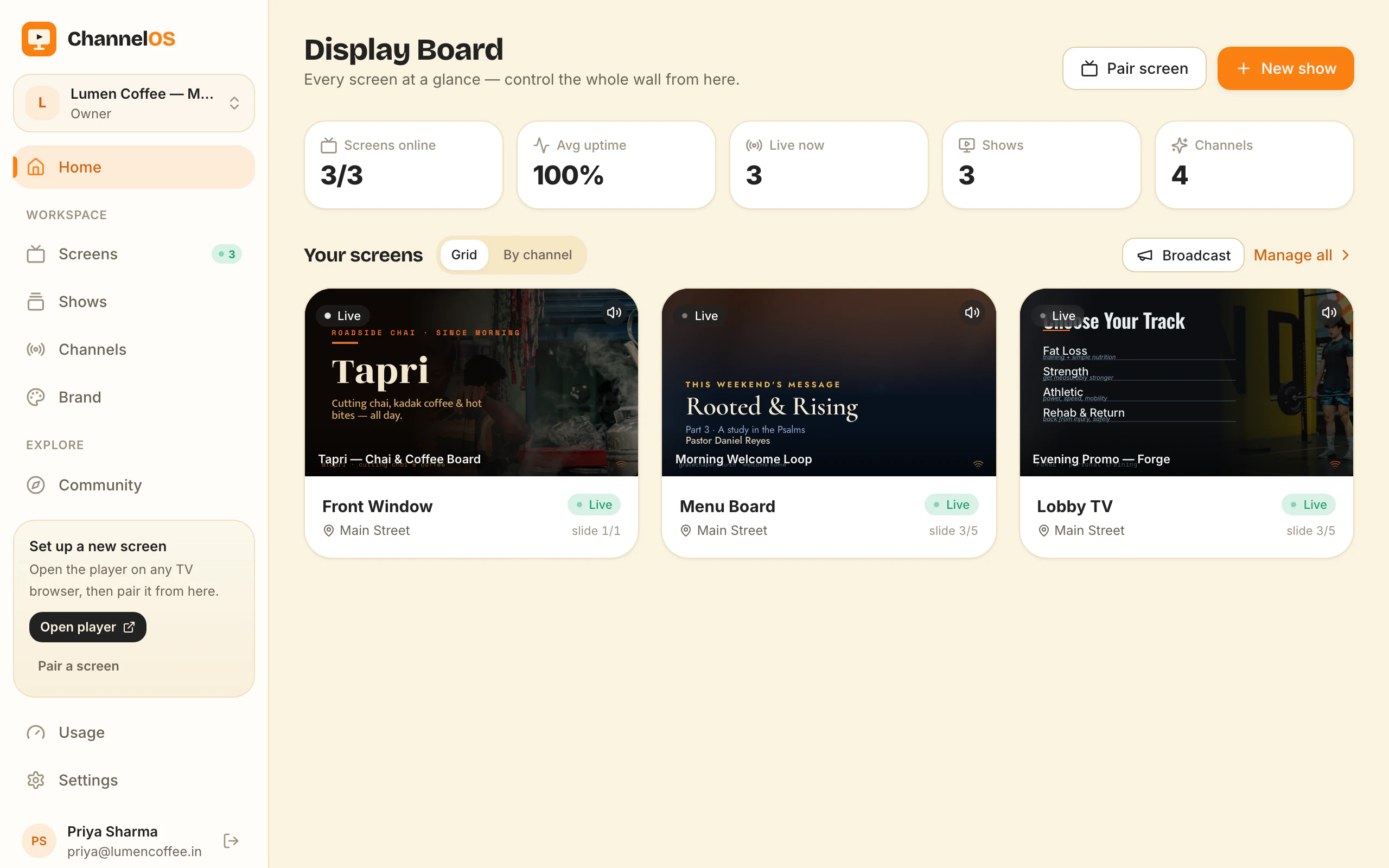
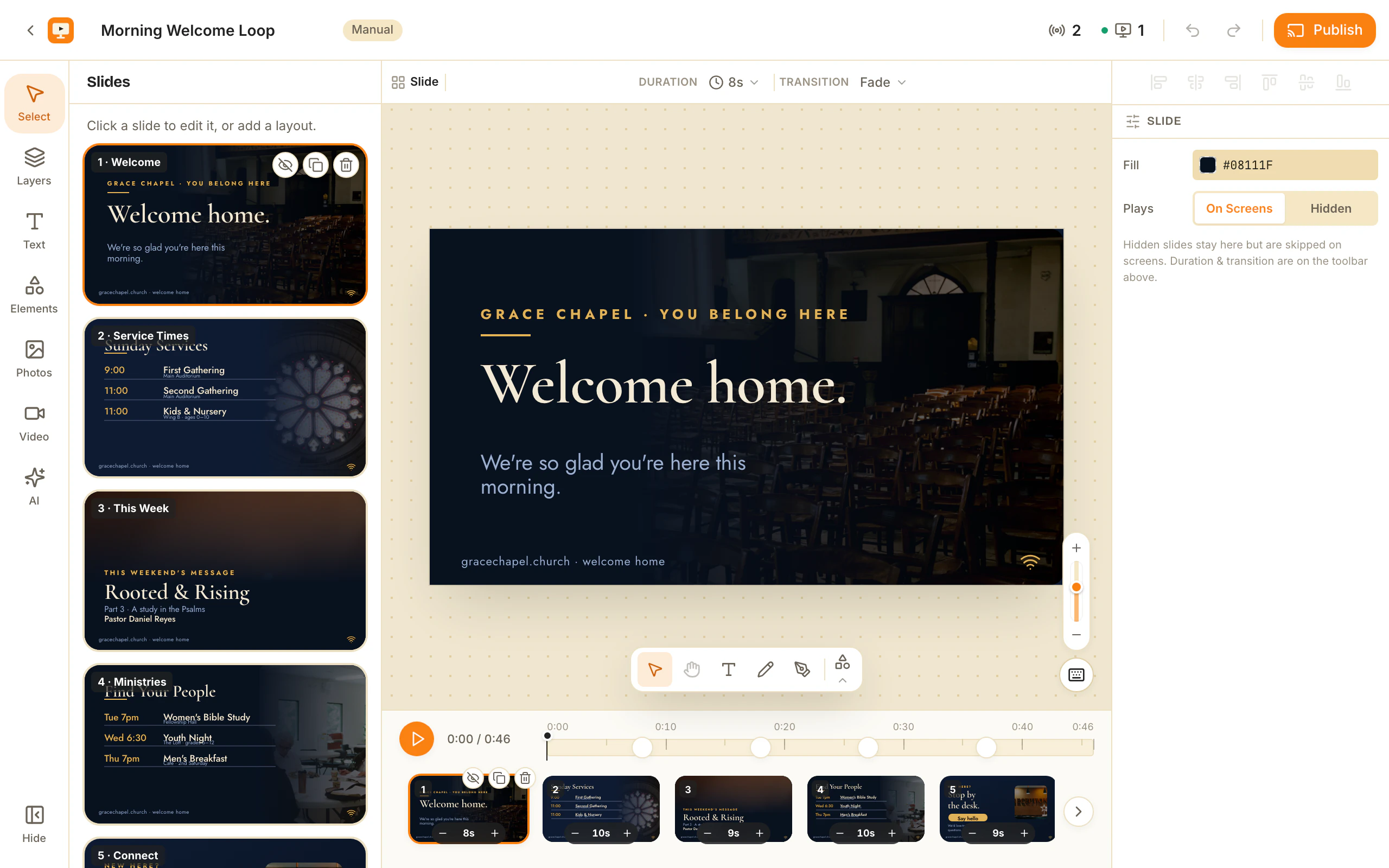
In ChannelOS each board is a show — a real editable multi-slide layout where every heading, item, price and photo is its own selectable element — and both shows can sit on the same channel, or on separate channels if you want them to change at different moments. More on why you might want that below.
Why it matters: the most common drive-thru board mistake is putting the full menu on the pre-sell screen. Same content, wrong reader.
Legibility at distance and speed
The sign trade’s working rule is about one inch of capital letter height per ten feet of viewing distance for comfortable reading. It is a rule of thumb, not a standard, but it is the right starting point.
Measure the real distances rather than trusting the site plan. A pre-sell board is commonly read from around 25 feet, which puts headline type near 3 inches — and because the car is moving, that headline also has to be short. Count words, not items.
An order-point board is typically read from 8 to 10 feet, so prices and descriptors can drop smaller, but item names should still clear an inch. The failure at the order point is almost never size — it is layout. Prices that wander, centred columns and three alignments in one panel make a stationary driver hunt.
Some specifics that hold up outdoors:
- Weight over size. A light font at 3 inches reads worse in glare than a semibold at 2.5. Hairline weights and low-contrast greys die first in daylight.
- Set the price list as a table, not a text box. Tables are a first-class element in the editor — draw one on the slide, drag the dividers to resize, edit cell by cell — so item and price stay in true columns instead of drifting apart when you change a word.
- Group what belongs together. An item, its descriptor and its price grouped once move as a unit forever after, which is what stops a board falling apart over a year of edits.
- Lock the type in a brand kit so a second lane, or a second site, cannot quietly use a different font.
- Go and stand where the car stops — at noon with the sun behind you, and again after dark. Half the legibility problems in a lane are angle and glare, and neither shows up on a laptop.
If you want a starting layout rather than a blank slide, the free menu board maker covers 14 cuisines, and the templates gallery has boards built by other operators that you can remix and re-price.
Why it matters: the pre-sell board is the only piece of signage in your business with a hard time limit measured in seconds.
Dayparting the breakfast changeover
The hardest sixty seconds in a drive-thru day is the breakfast cut-off. It lands mid-rush, it is the one moment the boards must change, and in most lanes it is a person with a remote who is currently doing something more urgent.
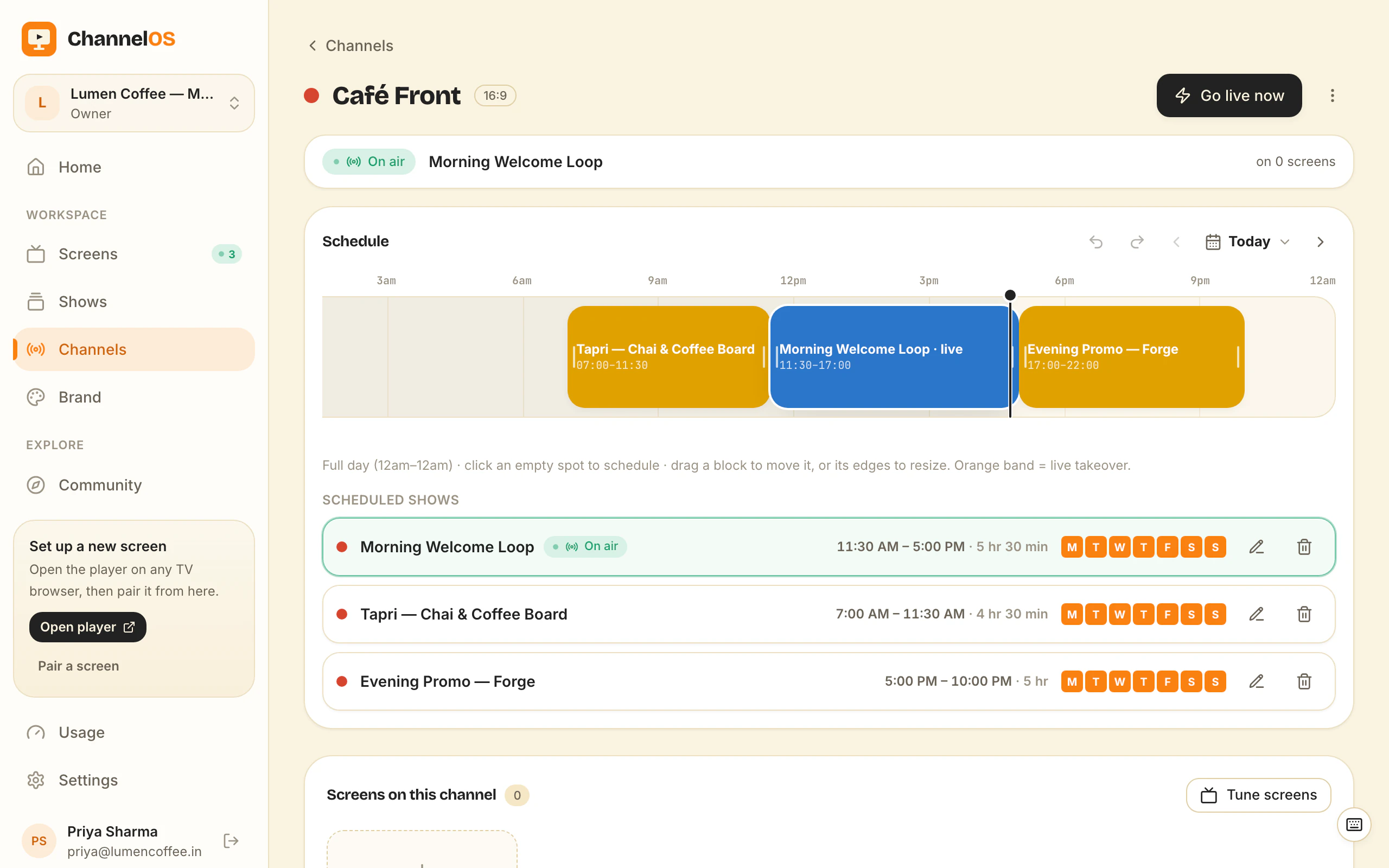
Channels solve that. A channel is a named feed with a real daily timeline: you place the breakfast show until 10:30 and the lunch show after it, once, and every screen tuned to that channel flips on its own clock. The schedule understands weekday versus weekend, so a later weekend changeover is just a second row, not a reminder in someone’s phone. A channel carries its own timezone too, so a second site in another timezone keeps its own morning.
Two operational details worth planning:
Flip the order point first. If your pre-sell and order-point boards are on separate channels, you control which one changes first — and you almost always want the order point leading by a minute or two. A pre-sell board advertising lunch to a driver the headset cannot yet sell lunch to is a conversation nobody enjoys at 10:29.
Keep a takeover for the unscheduled. The shake machine goes down, an item is 86’d, the lane has to run cash-only. A live takeover cuts in over whatever is scheduled on that channel, on every screen at once, and drops back to the normal schedule when you release it — so nothing permanent gets edited to say a temporary thing. There is a go-live-now for the opposite case, the promotion that is meant to start this minute.
Because a ChannelOS screen derives what it plays from the show plus the schedule plus the clock, there is no publish-and-wait step to get wrong. Fix a price on the phone at the counter and the board outside is already right.
Why it matters: the changeover is a schedule problem, and schedules do not forget at 10:30 on a Saturday.
Weather, glare and the parts of the day that move
Weather shows up in a drive-thru lane twice, and only one of them is a content feature.
The content half is easy: there is a live weather widget you can put on a board, along with a live clock, a QR code and a ticker line. Coffee on a cold morning and iced drinks on a hot afternoon are a normal seasonal schedule — build two shows, put them on the channel with date ranges, and fire a takeover on the freak day. What ChannelOS does not have is a rule engine that swaps content when the temperature crosses a threshold. If you want that today, you are scheduling it by hand or by season.
The physical half is the one that bites. A lane faces one direction, so for perhaps forty minutes at dawn and again at dusk the sun sits at exactly the angle the driver’s eye is at — and those forty minutes are usually inside the breakfast rush. Anti-reflective glass, a sun hood and the mounting angle do more there than any design decision, and a high-contrast board with heavy type survives it better than a delicate one.
The hardware we do not sell you
Here is the part to be straight about, the same way we are about indoor screens in no media player required.
ChannelOS removes the media player and the per-device licence. It runs as a web page in the display’s own browser — Android TV, Google TV, webOS, Fire TV, a Chromebox, or a small PC in kiosk mode — so whatever device is already driving that panel can run your boards if it can run a modern browser. You open one URL on the screen, scan the code from your phone, and it is paired.
ChannelOS does not remove the panel. An outdoor drive-thru board is a capital purchase: a high-brightness display, often several thousand nits against the 300 to 400 of an ordinary living-room TV, in a sealed, thermally managed enclosure with anti-reflective glass, on a footing that survives a delivery van. That comes from an outdoor-display supplier, quoted per lane, and no software subscription changes the number. A consumer TV in a plastic box outdoors washes out by mid-morning and cooks by August.
Two honest qualifiers in the other direction. A board under a deep canopy, or an indoor screen visible through window glass at the collection point, is a much softer requirement — an ordinary browser TV or a cheap stick usually does it, which is the case covered in signage without an Android player. And connectivity is a genuine trade: a browser-based board wants a working connection, and a lane on marginal Wi-Fi is exactly where a player box with a local cache does better. Run a wired connection to the enclosure if you possibly can.
What drive-thru digital menu boards cost
Your first screen is free forever. After that ChannelOS is per screen per month, with no per-device player licence, no setup fee and no seat charges — current rates are on the pricing page. A two-board lane is one free screen and one paid one; a second lane doubles the screens, not the work, because both lanes can tune into the same channel and change together.
Get the hardware quoted early and separately. It is bigger than the software line, it is a one-off rather than a monthly, and it belongs in a different conversation with a different supplier.
Getting the first board live
Start with the order-point board — it carries the prices and it is the one people complain about. Describe it in a sentence, or hand the AI your existing PDF menu and let it draft the slides, then take it the last stretch in the editor: price list as a table, each item grouped with its price, type pushed until it reads from where the car stops.
Then build the pre-sell board as a deliberately smaller thing — a few items, big — rather than a shrunken copy of the first one. Put both on a channel, set the breakfast changeover once, and keep the takeover for the shake machine.
No media player box, no per-device licence, and your first screen is free.
Frequently asked questions
- What is the difference between a pre-sell board and an order-point board?
- The pre-sell board is the first screen a car meets, before the speaker post, and it is read while the car is still rolling — so it carries a handful of items, big, to narrow the decision. The order-point board sits at the speaker where the car is stationary and the driver is talking to a headset, so it carries the complete priced menu with categories, sizes and any required nutrition detail. They are different content jobs and they usually want different shows, even though they can share one channel.
- How big does the text need to be on a drive-thru digital menu board?
- The working sign-trade rule of thumb is roughly one inch of capital letter height for every ten feet of viewing distance for comfortable reading. A pre-sell board read from around 25 feet by a moving driver wants headline type at about 3 inches and no more than a few words per line. An order-point board read from around 8 to 10 feet can go smaller for prices, but item names should still clear an inch. Measure from where the car actually stops, not from the drawing.
- Do I need a special outdoor screen for a drive-thru menu board?
- Yes, if the board faces open sky or direct sun. A normal indoor TV runs around 300 to 400 nits and washes out in daylight; outdoor drive-thru displays are typically high-brightness panels of several thousand nits in a weatherproof, thermally managed enclosure with anti-reflective glass. That panel is a hardware purchase from an outdoor-display supplier — ChannelOS is the software that runs on it, and we do not sell the hardware. A board under a deep canopy or behind window glass indoors is a different story and an ordinary browser TV is usually fine.
- How do I switch a drive-thru board from breakfast to lunch automatically?
- Put the boards on a channel and daypart it. A channel is a named feed with a real daily timeline, so you set breakfast until 10:30 and lunch after it once, and every screen tuned to that channel changes on its own clock — including weekends, which can run a later changeover than weekdays. Nobody has to reach for a remote during the busiest hour of the morning.
- Can a drive-thru menu board show the order as it is rung up?
- Not with ChannelOS. An order-confirmation board mirrors the till, which means a live feed from the point-of-sale system, and ChannelOS does not integrate with a POS today. If order confirmation is a hard requirement, you want a dedicated drive-thru package from your POS vendor for that one screen. ChannelOS handles the pre-sell and order-point boards beside it.
- How much do drive-thru digital menu boards cost to run?
- With ChannelOS the first screen is free forever and additional screens are priced per screen per month — current rates are on the pricing page. Free screens show a ChannelOS banner along the bottom of the screen, and any paid plan removes it. There is no media player box to buy and no per-device licence, so the recurring software cost of a two-board lane is one paid screen. The larger number is the physical hardware: outdoor-rated displays and enclosures are a real capital purchase, quoted by an outdoor-display supplier, and no signage software changes that.
Your screen is two minutes away.
Open the player on a TV, scan the code, publish a show. Your first screen is free.
Free screens show a ChannelOS banner along the bottom of the screen, and any paid plan removes it.