Digital Signage for Office Lobbies, Meeting Rooms and Internal Comms
Digital signage for office reception screens, meeting-room boards and internal comms — running in the TV's own browser, with no player box, no APK and no per-device licence.
Digital signage for office buildings is the least glamorous screen job there is, and the one that fails most often. The lobby TV shows a welcome slide with last quarter’s logo. The floor screen loops a PowerPoint someone exported in March. The problem was never the hardware — it is that keeping those screens current is nobody’s actual job.
Three things change that: the TV itself is the player, so there is no device project, AI drafts the show so the first version exists before anyone opens a design tool, and a schedule decides what’s on screen, so the swap happens on the clock rather than when someone remembers.
What digital signage for office spaces actually has to do
Strip the category talk away and an office has four screen jobs, and they are not the same job.
Reception. A visitor stands at the desk for two minutes. The screen’s work is to say where they are, who they are meeting if that is public, where to sit, and what the Wi-Fi is. It is a first impression, and a stale one is worse than none.
Meeting rooms and floor screens. Outside a room, the useful information is what the space is called and what is happening in it today. On a floor, it is wayfinding, fire-assembly points, and the odd notice.
Internal comms. New starters, a policy change, a charity day, a safety reminder, the numbers leadership actually wants people to see. These are the messages that die in an all-staff email nobody opened.
Dashboards. A support queue, a sales board, a build pipeline. This one is genuinely different from the other three, and it is where ChannelOS is the wrong tool — the honest section on that is further down.
Why it matters: three of those four jobs are a slideshow that needs to stay current. Only the fourth needs an integration platform.
The reception screen, without a device project
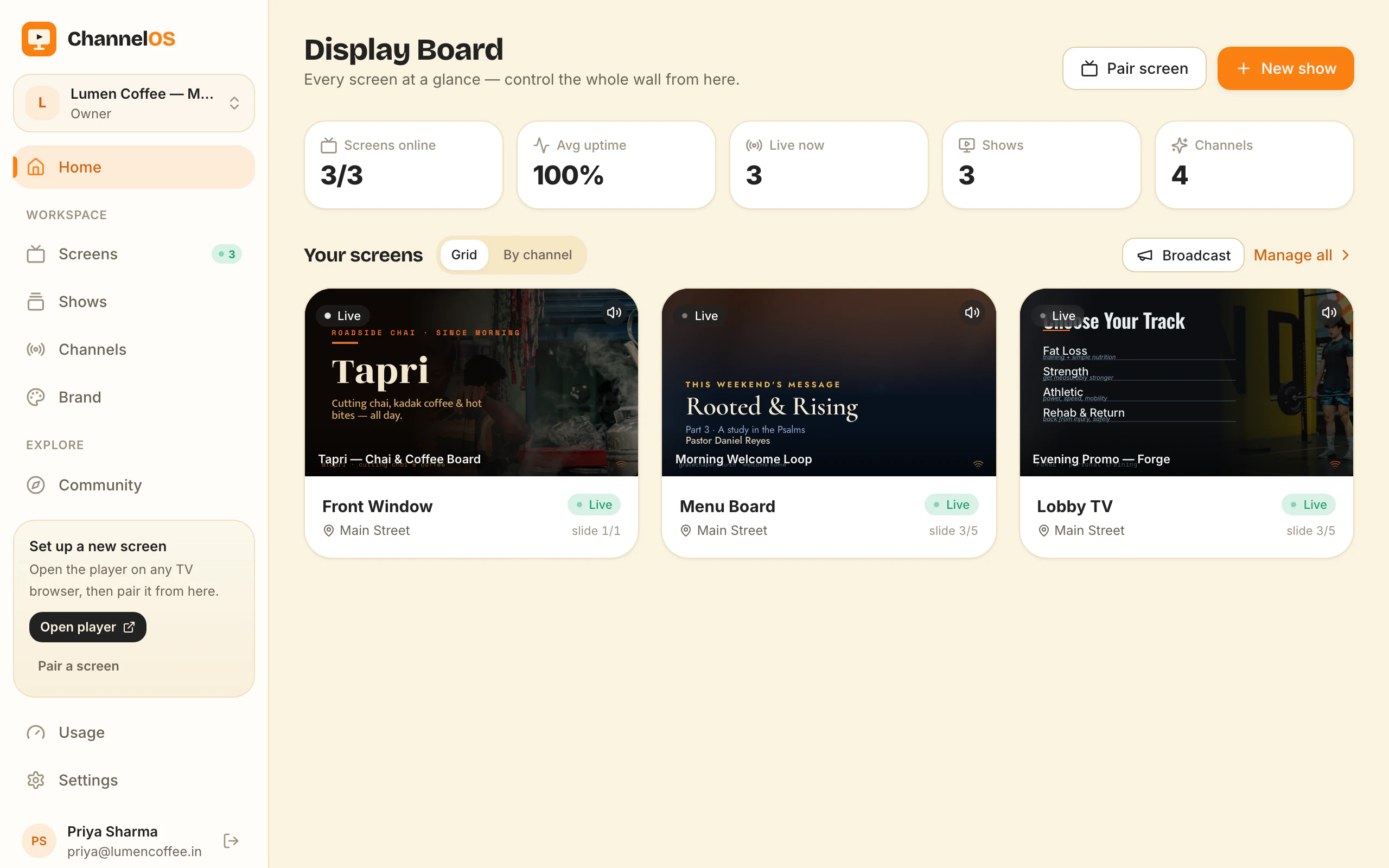
To get a lobby screen live you open one URL on the TV, scan the code that appears from your phone, and it is paired. That is the whole provisioning step. There is nothing to package for MDM, no media-player box to order, mount behind a wall-hung panel and keep a spare of, and no per-device licence to renew. It runs in the browser already built into the display: Android TV, Google TV, webOS, Fire TV, a Chromebox, or a spare laptop in kiosk mode. The reasoning behind that choice is in no media player required.
For offices specifically, the part that saves the most calendar time is what does not have to happen: no security review of an installed application, no image to maintain across a fleet, no ageing player estate to refresh in three years.
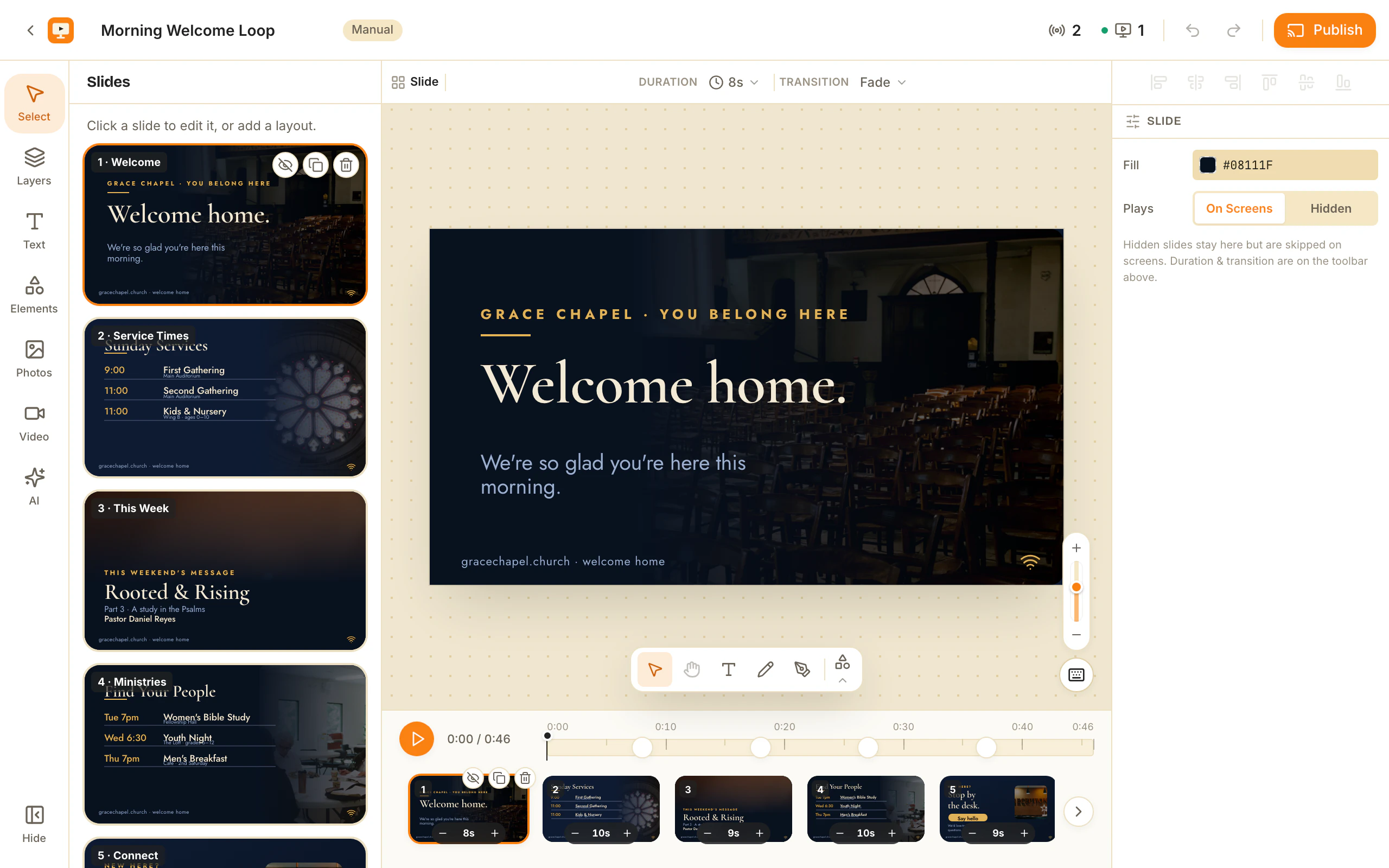
Building the show is the same shortcut. Describe the screen in a sentence — a welcome board for visitors with our name, the guest Wi-Fi and where to wait — and AI drafts a complete, on-brand, multi-slide show you can edit. Hand it your brand guidelines PDF, a floor-plan image, or the URL of your own careers page and it will read them for context while drafting. A brand kit keeps the fonts and colours right so the lobby screen does not look like a different company from the wall behind it. If you would rather start from a finished layout, the templates gallery has shows you can remix.
The editor is Canva-style, so the last ten percent is straightforward: free Pexels photos and video, one-tap background removal to lift a headshot off its original background, and live widgets — a clock, weather, a QR code pointing at the visitor form or guest Wi-Fi, and a ticker for a running line along the bottom.
Why it matters: the reason a lobby screen goes stale is friction at the start. Removing the device project and the blank canvas removes most of it.
Meeting rooms and floor screens, and one honest limit
A screen outside a meeting room can carry the room name, the day’s sessions as a table, a live clock and a ticker, all on a schedule that knows the difference between a Tuesday and a Saturday.
What it cannot do is read your calendar. ChannelOS has no Outlook or Google Calendar integration, so a room screen shows a scheduled show, not a live booking feed, and nobody books the room from the panel. If “Booked until 15:30 — next: design review” has to appear automatically, that is a room-booking product or an integration-led signage platform, and no amount of clever scheduling substitutes for it. Say no to that requirement early rather than half-solving it.
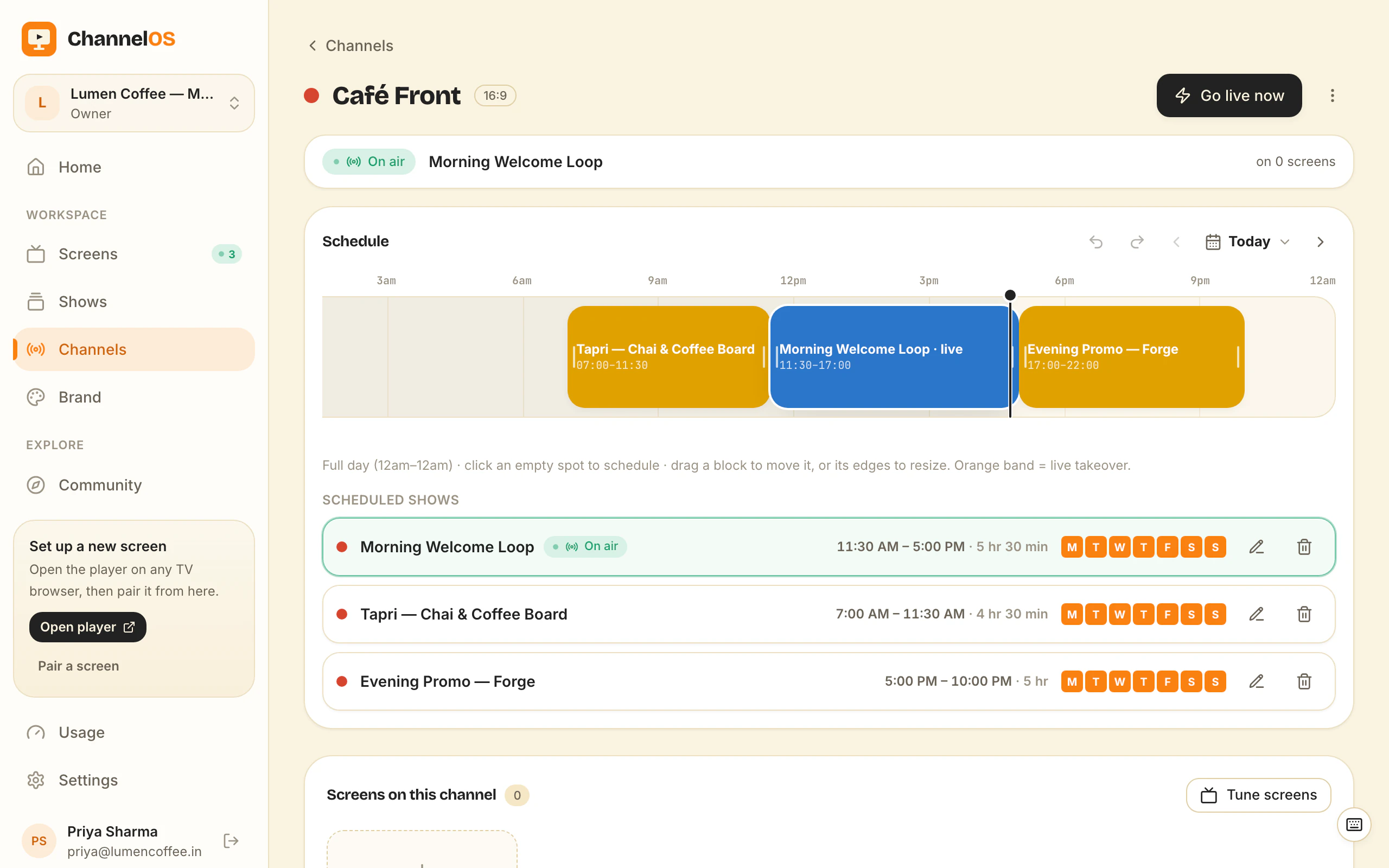
What scheduling does cover well is the predictable pattern. Channels give you a named feed with a real daily timeline: dayparting by hour and weekday, so the floor screen runs one thing during working hours and another after six, and reception runs a different board at the weekend without anyone touching it. When something unplanned happens — a fire drill, a site closure, a visitor group arriving early — a live takeover cuts in on every screen on that channel immediately, and the normal schedule resumes when you drop it. Nothing permanent gets edited to say a temporary thing. Managing many screens with channels goes through the model in detail.
Internal comms that people actually pass
Internal comms on screens works on a different mechanic from email. Nobody opens a screen; they walk past it. So the content has to be short, current and rotated, which is exactly the failure mode of the quarterly deck exported to video.
The practical loop is: one channel for the office, one show per theme — new starters, safety, the charity day, the number leadership cares about — and a schedule that rotates them. Because a screen derives what it plays from the schedule in real time, an edit is not a publish-and-wait step. You correct a name, a date or a number once and every screen in the building is right within seconds; there is no per-device sync to chase and no screen quietly stuck on the old version because it missed a push.
Multi-site offices copy rather than rebuild. Shows and channels export as portable files (.show.channelos.tv and .channel.channelos.tv) and import into another workspace, so a second office starts from the first one’s finished boards and changes only what differs.
Why it matters: the failure of screen-based comms is almost never the design. It is the one screen on the fourth floor still showing March.
Where ChannelOS is the wrong choice: dashboards and enterprise integration
This is the part most articles in this category skip, so here it is plainly.
ChannelOS does not embed third-party dashboards. There is no app library, no Power BI, Grafana, Salesforce, Zendesk or Jira tile, and no connector marketplace. Its live widgets are clock, weather, QR, menu and ticker, plus tables you fill in yourself. If the whole point of the screen is a metric that updates itself from another system, ChannelOS cannot do that job, and dressing it up as a limitation you can work around would be dishonest.
ScreenCloud and TelemetryTV are the right answer there, and they are good at it. Both are built for exactly this buyer: large app and integration libraries, dashboard embedding, device fleet management, and the enterprise administration a corporate IT team expects to see before it signs anything. If your requirements document has dozens of integrations on it, an operations centre wall, or a procurement checklist that starts with directory integration and device telemetry, you are their customer, not ours, and you will be happier there.
ChannelOS suits the other office. The one where the screens are somebody’s second job — an office manager, an EA, a marketing coordinator, a school or clinic receptionist — and where the requirement is “the lobby, the two floor screens and the canteen should look current and change themselves”, not “the wall must render our live pipeline”. That office does not need eighty integrations. It needs the screen to stop going stale, and it needs to not spend a fortnight getting an app approved to achieve it.
How much does digital signage for office screens cost?
Your first screen is free forever. After that it is per screen per month, with no per-device player licence, no setup fee and no seat charges — current rates are on the pricing page. Because the TV’s browser is the player, the hardware line is a display you probably already own, plus at most a cheap browser stick for an older panel.
| Traditional office signage | ChannelOS | |
|---|---|---|
| Getting a screen live | Order, provision and licence a player per TV | Open one URL on the TV, scan the code |
| IT involvement | App packaging, MDM, device fleet management | None — it is a web page |
| Building the show | Design it, or export a deck to video | Describe it — AI drafts every slide |
| Changing a notice | Re-export, re-push, wait for devices to sync | Edit once — every screen derives it in real time |
| Time-of-day changes | Someone swaps it | Dayparting, by hour and weekday |
| Live dashboards | Often supported via an app library | Not supported — use ScreenCloud or TelemetryTV |
One more trade worth naming: a browser-based screen wants a working connection. A player with local storage rides out a network outage better than a web page does, so a screen on flaky guest Wi-Fi is the case where dedicated hardware still earns its keep.
Get the lobby screen live
Pair the reception TV in about two minutes, describe the welcome board in one sentence and edit the draft AI gives you, then put the office screens on a channel so the content changes by hour and weekday without anyone remembering to do it.
No player box, no APK, no per-device licence — and your first screen is free.
Frequently asked questions
- What is digital signage for office use?
- Digital signage for office use means running reception welcomes, meeting-room information, internal announcements and wayfinding on the TVs already mounted around the building instead of printed notices or a static PowerPoint on loop. With ChannelOS the TV's own browser is the player, so a screen is paired by opening one URL and scanning the code from your phone, and its content is derived from a schedule rather than pushed as files.
- Do office screens need a media player box or an app installed?
- No. ChannelOS runs as a web page in the browser built into the TV — Android TV, Google TV, webOS, Fire TV, a Chromebox, or a spare laptop in kiosk mode. There is nothing for IT to package or approve through MDM, and no per-device licence to track. The practical requirement is a display that loads a modern web page and stays on the network.
- Can office signage show live meeting-room bookings from Outlook or Google Calendar?
- Not with ChannelOS. It has no calendar integration, so a meeting-room screen shows a scheduled show — the day's sessions in a table, a live clock, a ticker — rather than a live feed of who booked the room. If a screen must read room bookings from Outlook or Google Calendar and let people book from the panel, use a dedicated room-booking product or an integration-led signage platform.
- Can I put a live dashboard on the office wall with ChannelOS?
- No. ChannelOS does not embed third-party dashboards or BI tools. Its live widgets are clock, weather, QR, menu and ticker, plus tables you edit yourself. If the wall screen has to render a live Power BI, Grafana, Salesforce or support-queue dashboard, ScreenCloud and TelemetryTV are built for exactly that and are the honest recommendation.
- How do I change what the lobby screen shows at different times of day?
- Put the screens on a channel and use dayparting. A channel is a named feed with a real daily timeline, so a reception screen can run the welcome board through the morning, switch to a lunch or visitor board midday, and show the evening notice after five — by hour and by weekday, set once. For anything unplanned, a live takeover cuts in on every screen on that channel immediately and the normal schedule resumes when you drop it.
- How much does digital signage for office screens cost?
- The first screen is free forever with ChannelOS, and screens after that are priced per screen per month — current rates are on the pricing page. Free screens show a ChannelOS banner along the bottom of the screen, and any paid plan removes it. There is no player hardware to buy, no per-device licence and no seat charges, so the hardware side is a display you likely already own plus, at most, a cheap browser stick. Traditional platforms usually add a player device and a per-device licence per screen on top of the software fee.
Your screen is two minutes away.
Open the player on a TV, scan the code, publish a show. Your first screen is free.
Free screens show a ChannelOS banner along the bottom of the screen, and any paid plan removes it.