ChannelOS vs ScreenCloud: AI-first vs enterprise signage
ScreenCloud is an enterprise signage CMS with 80+ integrations. Most people weighing ScreenCloud alternatives want the same screens without the player app, the hardware or the per-screen minimum — an honest look at both.
ScreenCloud is a capable enterprise digital-signage platform. If you’re an IT or internal-comms team running signage across many sites and you want deep app integrations, live data feeds and role-based control, it does that job well.
ChannelOS is for the person on the other side of that rollout: one site, one or two TVs, and a message that changes faster than a procurement cycle. ChannelOS is AI-first, schedule-first and TV-first — you describe the screen and AI drafts the whole show, edit once and it airs everywhere, and the TV’s own browser is the player. If you’re weighing ScreenCloud alternatives, this is an honest look at where the two diverge — and where ScreenCloud is still the right call.
Do I need a media player or device for ScreenCloud?
ScreenCloud’s recommended path is an installed native player app — and often first-party hardware — while ChannelOS runs entirely in the TV’s own browser with nothing to install. ScreenCloud runs on Fire TV, Android, Windows, macOS, Chrome OS, webOS, Tizen and BrightSign, or on its own PIXI ($65) and ScreenCloud OS / Station P1 Pro ($199) players; a Web Player URL exists too, but the guided route is the dedicated Player app. ChannelOS has no player box.channelos.tv on the screen, scan the on-screen code from your phone, and you’re live in about two minutes.
Why it matters: the gap between “I have a TV” and “it’s showing my content” is a browser tab, not a hardware order or a per-device install.
Can AI build the whole show, or do I design every slide?
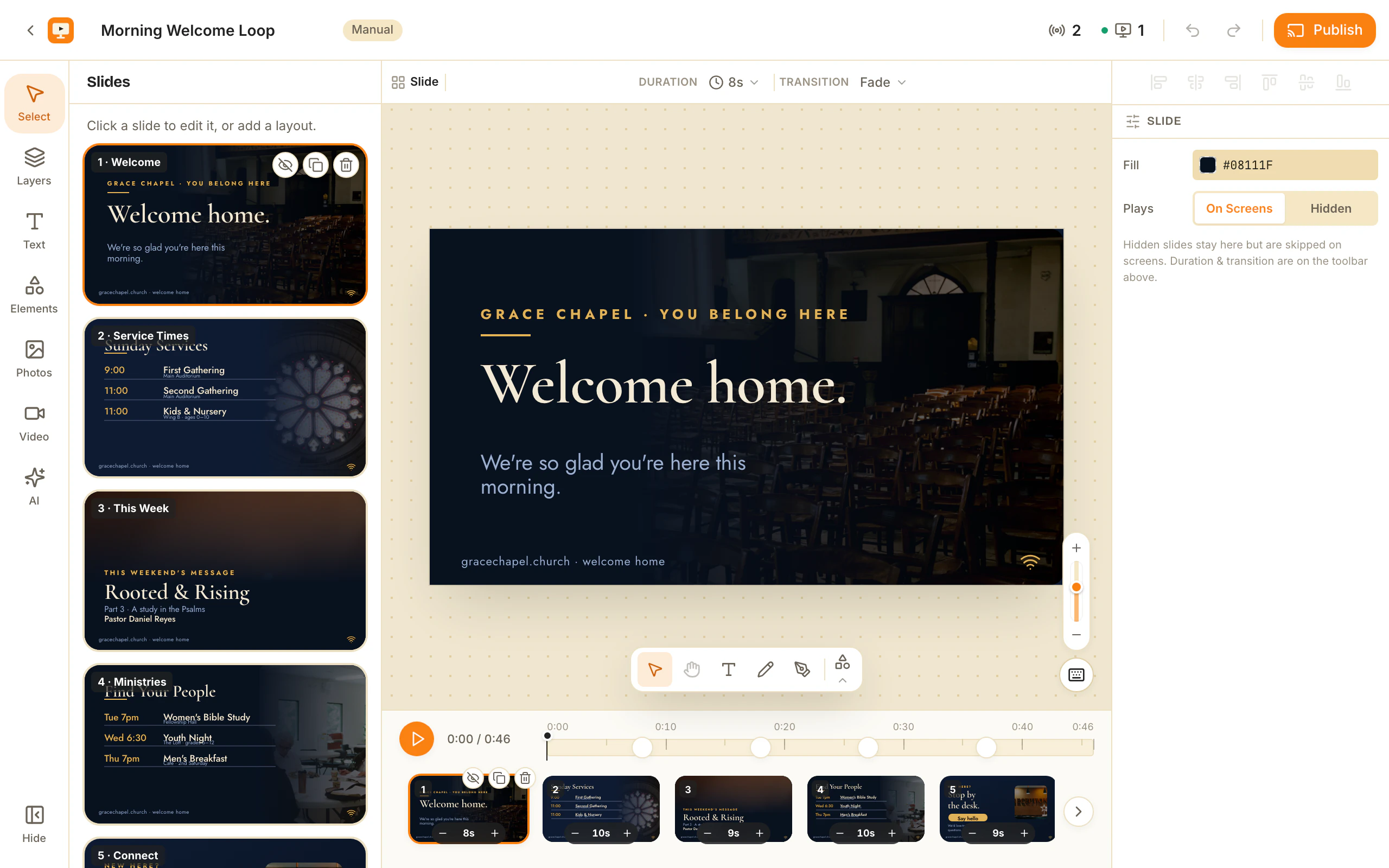
ChannelOS drafts the entire multi-slide show from a short description, while ScreenCloud has no generative-AI studio and expects you to design content manually. In ScreenCloud you build slides by hand in Canvas, its drag-and-drop design tool, using templates, Quick Post and 80+ integrations — reviewers explicitly call the absence of a native AI content-generation layer a gap versus newer AI-first tools. With ChannelOS you pick a subject, goal and look from chips (no prompt-writing), and AI drafts a complete, on-brand, multi-slide show; it can even read an attached PDF, image or webpage URL into slides. The output is a real, editable show in a Canva-style editor — every element selectable, with one-tap background removal and live clock, weather and QR widgets — not a flat locked export.
Why it matters: most people don’t have a designer. Description-first creation means the first on-brand draft exists before you’ve made a single layout decision.
How fast do changes reach every screen?
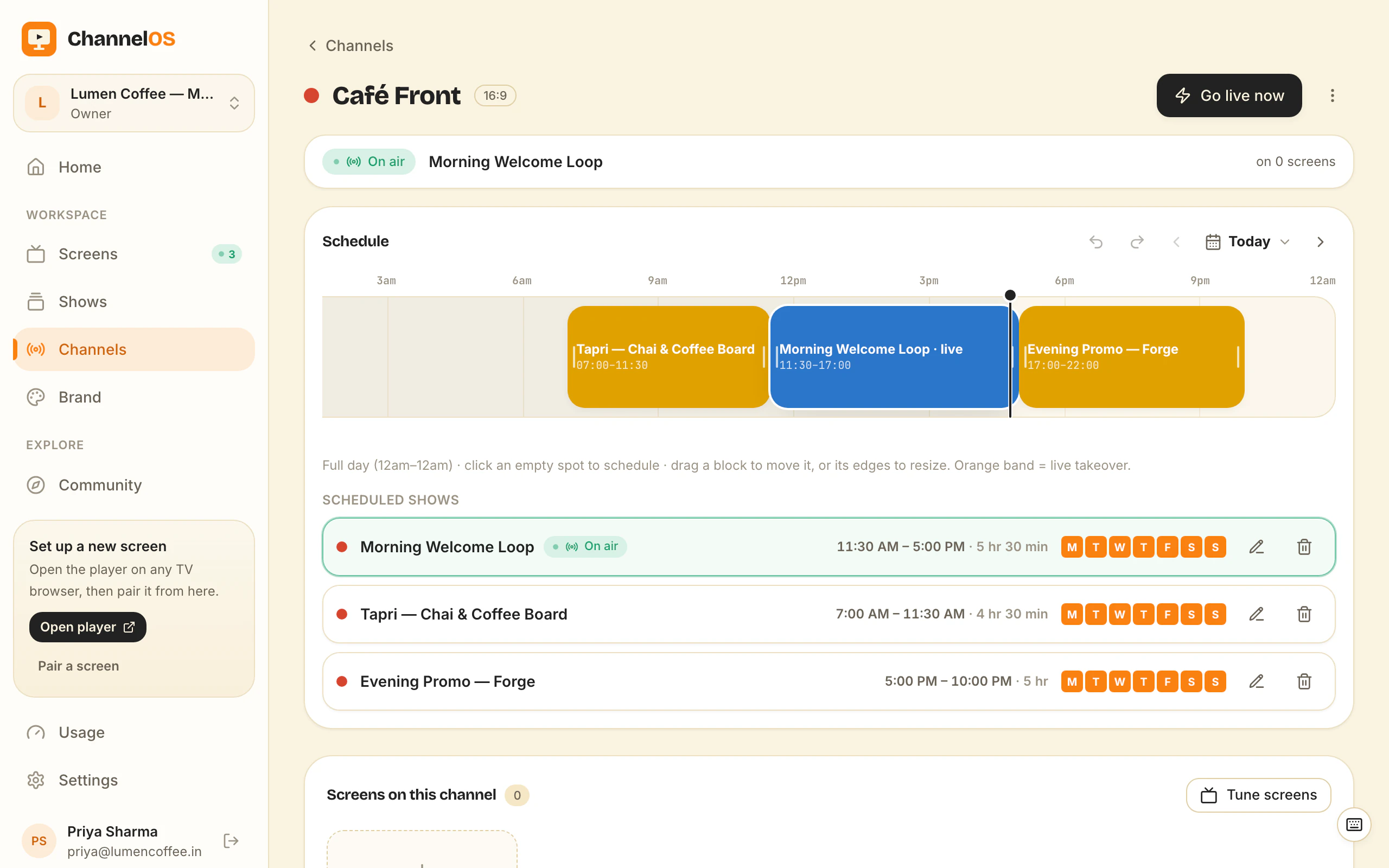
With ChannelOS you edit once and it airs everywhere instantly, because what a screen shows is derived from the show, the channel schedule and the clock in real time. ScreenCloud supports full scheduling and dayparting too — recurring windows, date ranges, media expiry and time-based playlist rotation — so both tools can run morning-vs-evening content set once. The difference is the publish step: ChannelOS has no publish-and-wait and no per-device sync, so a typo fix lands on every screen the moment you save. Both support dayparting; ChannelOS adds live takeover — drop an urgent message on every screen, then resume the schedule automatically.
Why it matters: a wrong price on the lunch menu is corrected on every screen instantly, with no re-publish and no waiting for devices to catch up.
What does ScreenCloud cost vs ChannelOS?
ScreenCloud has no permanent free tier and prices per screen from around $20/screen/mo, while ChannelOS gives you your first screen free and then a simple per-screen monthly price. ScreenCloud’s Core is ~$20/screen/mo on annual billing (some sources cite ~$24 monthly), Pro is ~$30/screen/mo annual, and Enterprise is custom with a reported 15-25 screen minimum plus onboarding — reviewers flag that per-screen cost scales linearly and gets expensive for large fleets. ChannelOS has no seats to count and no setup fees, and because there’s no dedicated player hardware to buy, total cost drops further.
Why it matters: you can prove ChannelOS works on a real TV for free before you pay for anything.
How ScreenCloud pricing works
ScreenCloud pricing is a per-screen subscription on tiers — Core, Pro, then a custom-quoted Enterprise plan — with the lowest rate on annual billing and a higher rate if you pay monthly. Enterprise is the tier that carries a minimum screen count and an onboarding component, which is why a five-screen site often can’t buy it. There is a trial but no permanent free tier, so the first screen costs money.
Two things about the shape of that model matter more than any headline number. It scales linearly — forty screens cost ten times what four do — and the subscription isn’t the whole bill, because a player app on dedicated hardware makes each box a separate capital line and one more device to license and replace. Price the hardware and the subscription together.
ChannelOS also prices per screen per month, with two differences: the first screen is free forever, and there is no device line at all. Current rates are on the pricing page; ScreenCloud’s own pricing page is the only reliable source for theirs, since signage pricing moves and the figures above were accurate when this was written.
Why it matters: the cost of signage is rarely the software line. It’s the software line multiplied by screens, plus a box behind each one.
Who should still choose ScreenCloud?
Choose ScreenCloud if you’re a mid-market or enterprise team whose signage depends on integrations, data and centralized control across many sites. Its genuine strengths are real: 80+ app integrations with dashboards and live data feeds for corporate comms and KPI/BI screens, hierarchical role-based permissions for centralized-yet-delegated fleets, broad hardware/OS flexibility so you can reuse existing devices or standardize on supplied boxes, and robust scheduling with recurring windows and media expiry. If those enterprise capabilities are the job, ScreenCloud is built for it.
Why it matters: the honest fork isn’t AI versus no-AI — it’s lightweight pair-and-publish simplicity versus integration-heavy enterprise control.
The five jobs, side by side
| The job | ScreenCloud | ChannelOS |
|---|---|---|
| Get a screen live | Install a player app (or use PIXI/SCOS hardware), register the device | Open one URL on the TV’s browser, scan the code — live in ~2 min |
| Make a show | Design manually in Canvas with templates and integrations | Describe it — AI drafts every slide, editable |
| Change what’s playing | Schedule and update via Channels/playlists | Edit once — it airs everywhere instantly |
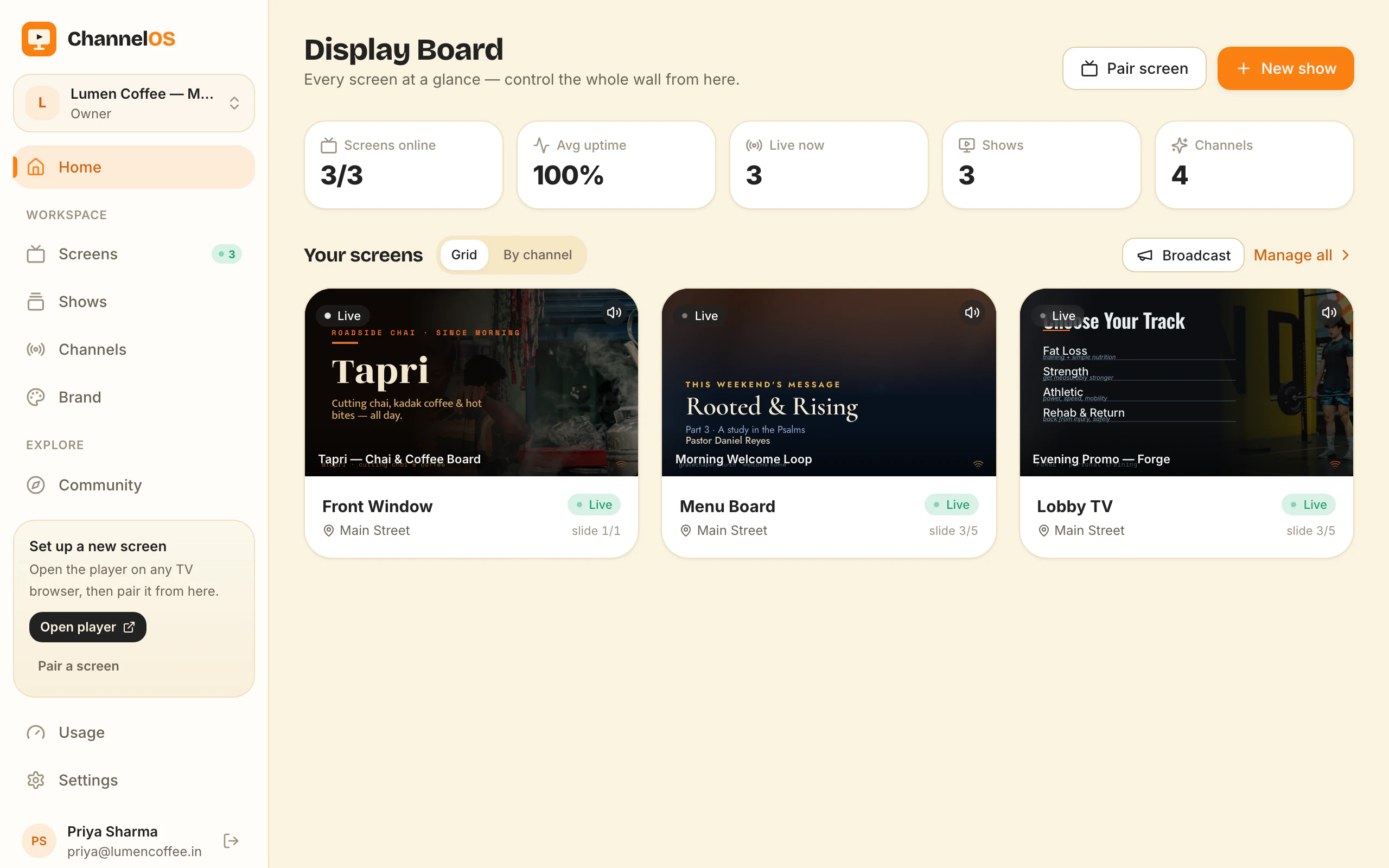
| Run the wall | Studio dashboards with role-based permissions | One live board: play · pause · blank · mute · next · hold |
| Setup before pixel one | Accounts, player install, integrations, roles | None — pair and publish in minutes |
Feature by feature
| Feature | ScreenCloud | ChannelOS |
|---|---|---|
| Media-player hardware | Recommended player app; sells PIXI/SCOS boxes | ✗ none — TV browser is the player |
| Free tier | ✗ trial only, no permanent free tier | ✓ first screen free, with a ChannelOS banner along the bottom of the screen |
| AI drafts the full show | ✗ manual design in Canvas | ✓ describe it, AI drafts the show |
| Browser pairing (no app on TV) | partial — Web Player exists, but app is recommended | ✓ scan a code, no install |
| Edit once, airs everywhere | partial — schedule, then publish/sync | ✓ derived in real time, no publish-wait |
| Dayparting / scheduling | ✓ recurring windows, date ranges, expiry | ✓ dayparting + live takeover |
| Pricing model | Per screen from ~$20/mo, Enterprise custom | Per screen, first screen free |
ScreenCloud alternatives: who should switch, and what you give up
Most people searching ScreenCloud alternatives aren’t unhappy with the software. They’ve hit one of three walls: a player app and a box to provision at every site, a per-screen price that scales linearly across a growing fleet, or an Enterprise minimum that prices out a five-screen deployment. The field is worth being honest about — Yodeck and OptiSigns are the mature player-based options, Xibo is the one to pick if you want to self-host, and we’ve laid the whole field out in the 2026 roundup. ChannelOS is the alternative that removes the player entirely rather than making it cheaper.
Switch if your screens live in places nobody is going to provision hardware for — a café, clinic, salon, gym, showroom, school foyer, church hall; if the person who updates the screen is the person behind the counter rather than IT; if your content is menus, offers, notices and opening hours rather than live dashboards; and if you’d rather prove it on a real TV before paying anything. The practical test is the pairing flow: open the player URL on the TV, scan the code, and that screen is running, with no media player behind it. Menu-led rooms can start from the free menu board maker or remix a layout from templates.
Don’t switch if screens are how your company reads its own data. If a dashboard from your BI tool, a Google Slides deck, a Salesforce leaderboard or a live ops feed has to appear on the wall, ScreenCloud’s integration catalogue is the product and there is no equivalent in ChannelOS. The same goes for hierarchical, delegated administration: if a regional manager needs to change only their own sites while head office keeps control of the brand layer, ScreenCloud models that and ChannelOS does not — a ChannelOS workspace is a workspace, not an org chart.
What you actually give up by switching is specific and worth naming: the 80+ app integrations and live-data widgets; role-based permissions across many sites; and a vendor relationship with onboarding, hardware supply and an enterprise support contract behind it. Those are real capabilities, not marketing.
What you get back is the removal of a whole layer: no per-device license, no publish-and-wait, and a first draft of every show written by AI instead of by you — the difference AI-first signage makes when you have no designer. For a fleet of ten identical café screens that’s a better trade. For a fleet of ten dashboards it isn’t.
Why it matters: the honest question isn’t which tool is better — it’s whether your screens are showing content or showing data.
So which should you choose?
Choose ScreenCloud if you’re an IT or internal-comms team running many locations and you need its integration ecosystem, live-data dashboards and role-based fleet control. That enterprise depth is real, and it’s what ScreenCloud is built for.
Choose ChannelOS if you want screens live fast, drafted by AI, and run from your phone — with no media player, and edits that air everywhere the moment you save. Your first screen is free. The test: get one screen showing today’s real content before your next team meeting. If it needs a project plan, you are ScreenCloud’s customer, not ours.
Frequently asked questions
- What's the main difference between ChannelOS and ScreenCloud?
- ScreenCloud is an enterprise signage platform built around 80+ app integrations, dashboards and role-based control, with content designed manually in its Canvas tool. ChannelOS is AI-first and schedule-first: you describe a screen and AI drafts the whole multi-slide show, then edit once and it airs everywhere. ChannelOS also runs in the TV's own browser.
- Does ChannelOS need a media player or device like ScreenCloud?
- No. ChannelOS runs as a web page in the TV's own browser — Android TV, Google TV, webOS, Fire TV, or a browser-on-a-stick — with no per-device license. ScreenCloud's recommended path is an installed player app per platform, and it also sells its own PIXI (~$65) and SCOS (~$199) hardware, though you can reuse a compatible device you own.
- Is ChannelOS cheaper than ScreenCloud?
- ChannelOS's first screen is free, then it's a simple per-screen monthly price with no seats or setup fees. Free screens show a ChannelOS banner along the bottom of the screen, and any paid plan removes it. ScreenCloud has no permanent free tier — Core starts around $20/screen/mo on annual billing (Pro ~$30), and Enterprise is custom with a reported 15-25 screen minimum. Removing dedicated player hardware lowers ChannelOS's total cost further.
- Who should still use ScreenCloud?
- Teams that need 80+ app integrations, live data and KPI dashboards on screen, hierarchical role-based permissions across many sites, or want to standardize a large fleet on supplied hardware will be well served by ScreenCloud. It's built for mid-market and enterprise IT and internal-comms teams rather than single-screen simplicity.
- What is the best ScreenCloud alternative?
- It depends which wall you hit. If you're leaving because of the player app, the hardware or the per-screen cost at small scale, ChannelOS is the most direct swap: it runs in the TV's own browser with nothing to install, AI drafts a complete multi-slide show from one sentence, and the first screen is free forever. Free screens show a ChannelOS banner along the bottom of the screen, and any paid plan removes it. If you still need a player-based platform with broad certified-device support, Yodeck and OptiSigns are the mainstream options, and Xibo is the one to look at if you want to self-host. If what you actually need is ScreenCloud's integration catalogue and role-based fleet control, no lighter tool will replace it — including ChannelOS.
- How hard is it to switch from ScreenCloud to ChannelOS?
- There is no automated import of a ScreenCloud account, so you rebuild your content — but faster than you built it the first time, because AI drafts each show from a sentence and can read a PDF, image or webpage URL for context. Pairing a TV takes about two minutes: open the player URL on the screen and scan the code from your phone. The low-risk path is to leave ScreenCloud running, pair one TV on your free ChannelOS screen, rebuild the board you change most often, and run them side by side for a week. Free screens show a ChannelOS banner along the bottom of the screen, and any paid plan removes it. There is nothing to uninstall from the TV afterwards, because ChannelOS never installs anything on it.
Your screen is two minutes away.
Open the player on a TV, scan the code, publish a show. Your first screen is free.
Free screens show a ChannelOS banner along the bottom of the screen, and any paid plan removes it.