ChannelOS vs OptiSigns: no player app, AI-drafted shows
Looking for an OptiSigns alternative? OptiSigns installs a player app per device; ChannelOS pairs a TV in its own browser, drafts the whole show with AI, and edits once to air everywhere.
OptiSigns is a capable, feature-broad digital-signage platform. It runs on cheap hardware you may already own — Fire TV Sticks, Android boxes, Raspberry Pi, Chromecast, Apple TV, Tizen and webOS displays — and pairs a large app marketplace with solid scheduling and proof-of-play reporting. For a signage team that wants maximum integration coverage at a low hardware cost, it does that job well.
ChannelOS is for the person on the other side of the app catalogue: you do not want a hundred integrations, you want today’s menu on the TV before lunch. ChannelOS is browser-based AI-first (AI drafts the whole show), and schedule-first (edit once, it airs everywhere). This is an honest look at where the two diverge.
Do I need a media player or device for OptiSigns?
OptiSigns needs a device running its player app; ChannelOS needs no app and no player box. With OptiSigns you install the native player app on each screen — a Fire TV Stick, Android box or tablet, Raspberry Pi 3+, Chromecast, or a Samsung Tizen / LG webOS commercial display — and it runs there. No proprietary box is required (that’s a real strength), and OptiSigns sells an optional pre-configured Android Player stick for around $79.99, but every screen still means installing and managing a player app.
ChannelOS makes the TV itself the player. You open play.channelos.tv in the TV’s own browser — Android TV, Google TV, webOS, Fire TV, a browser-on-a-stick, even a laptop in kiosk mode — scan the on-screen code from your phone, and the screen is live in about two minutes. no per-device license to track.
Why it matters: the cost and setup of adding a screen drops to a TV you already own — no player app to provision or keep updated on each one.
Can AI build the whole show, or do I design every slide?
With OptiSigns, AI helps design individual slides; with ChannelOS, AI drafts the entire multi-slide show. OptiSigns’ AI Designer turns a short prompt into professional single designs — it returns several layout options in under a minute that open in the normal editor. That’s genuinely useful, but each prompt yields individual designs, so you still assemble and sequence the full deck yourself. (OptiSigns’ other AI, Audience Intelligence, is a paid add-on that adapts content by demographics and weather via camera sensors — a different job entirely.)
ChannelOS is AI-first end to end. You pick a subject, goal and look from chips — no prompt-writing — and AI drafts a complete, on-brand, multi-slide show. It reads attached PDFs, images and a webpage URL straight into slides. The output is a real editable show in a Canva-style editor, not a flat export: every element is selectable, with one-tap background removal and live clock, weather and QR widgets.
Why it matters: most people don’t have a designer. Description-first creation means the whole show exists — sequenced and on-brand — before you’ve made a single layout decision.
How fast do changes reach every screen?
OptiSigns pushes updated playlists to each device; ChannelOS derives every screen from the schedule in real time, so one edit airs everywhere instantly. OptiSigns has robust scheduling and dayparting — you can schedule playlists by time of day, specific days and events, and higher tiers add auto power on/off — but content is distributed to the player apps on your devices.
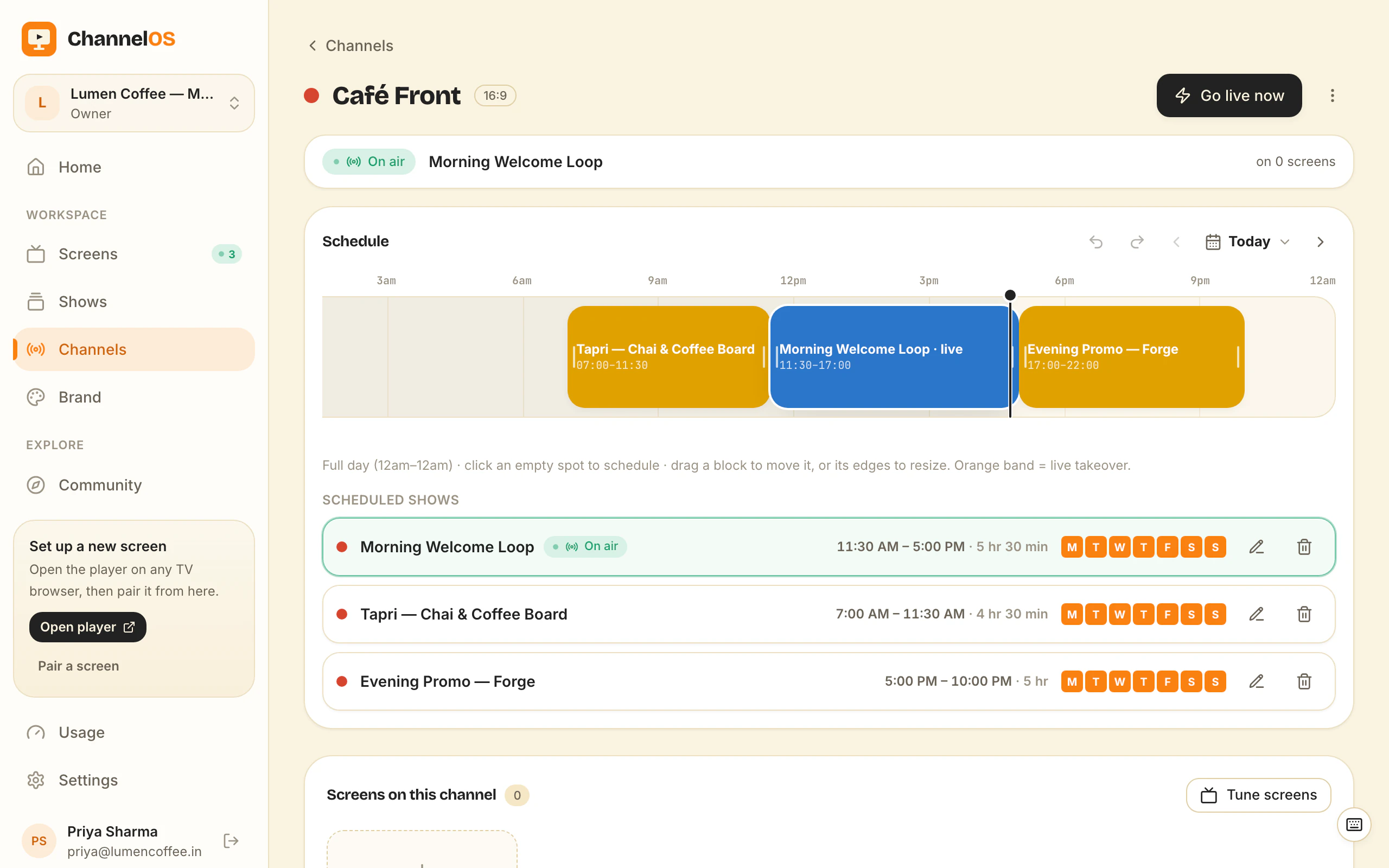
In ChannelOS, what a screen shows is derived from the show plus the channel schedule plus the clock, moment to moment. Edit once and it airs everywhere with no publish-and-wait and no per-device sync. Channels support dayparting (different content by hour and weekday vs weekend, set once) and live takeover — drop an urgent message on every screen, then resume the schedule.
Why it matters: a typo on the lunch menu is fixed on every screen the instant you save it.
What does OptiSigns cost vs ChannelOS?
OptiSigns offers a free tier for up to 3 screens then paid per-screen plans with add-ons; ChannelOS gives your first screen free then flat per-screen pricing. OptiSigns’ Free plan is $0 for up to 3 screens with 25 basic apps and 1GB storage, with OptiSigns branding shown on displays — a genuinely generous free tier. Paid plans are priced per screen, and several capabilities (AI Audience Intelligence, Video Wall, Background Music, Wireless Presentation) are separate paid add-ons, with the Enterprise tier requiring 25+ screens.
ChannelOS makes your first screen free, then charges per screen per month — no seats to count, no setup fees. Because the TV is the player, there’s also no player hardware to buy or an add-on stick to budget for.
Why it matters: with ChannelOS the per-screen price is the price; advanced capabilities don’t arrive as a stack of add-ons that inflate it.
OptiSigns pricing: how the model works
Rates move, so the number on their pricing page beats any number in a blog post — what’s worth understanding is the shape of OptiSigns pricing, because that’s what decides your real bill.
It has three parts. First, a per-screen monthly fee on a tiered plan, where the tier gates capability as well as screen count — the more capable tiers cost more per screen, and the Enterprise tier carries a 25-screen minimum. Second, add-ons billed separately: AI Audience Intelligence, Video Wall, Background Music and Wireless Presentation are not folded into the plan price, so a quote assembled from the base tier alone tends to under-read what you’ll actually pay. Third, hardware, which is easy to forget because it isn’t on the invoice — every screen needs a device running the player app, whether that’s a Fire TV Stick you already own or their pre-configured Android Player stick at around $79.99.
ChannelOS has one line: per screen, per month, first screen free forever, with no seats, no setup fee and no player device to buy. Current rates are on the pricing page.
What the OptiSigns free plan gives you
The OptiSigns free plan is genuinely one of the better ones in the category, and it’s worth being straight about that: $0 for up to 3 screens, with roughly 25 basic apps and 1GB of storage. Three free screens beats one free screen on raw count, and if you have three lobby TVs and simple content, it may be all you ever need.
The trade-off is what your customers see. The free tier displays OptiSigns branding on the screen, which is fine in a back office and less fine over a counter. You’re also on the basic app set, with the storage ceiling and no add-on capabilities.
ChannelOS’s free tier is one screen rather than three, and it carries branding too: free screens show a ChannelOS banner along the bottom of the screen, and any paid plan removes it. It is a screen with no expiry, so pair it and leave it running. If you want to see the output before you pair anything, the templates gallery and the free menu board maker both run in a browser tab.
Who should still choose OptiSigns?
Choose OptiSigns if you want its very broad app marketplace or already run a fleet of low-cost player devices. OptiSigns’ real strengths are concrete: a 100+ app integration library (Google Workspace, Microsoft 365, Power BI, Salesforce, Looker, social feeds, OptiSync dynamic data), broad hardware support that lets you reuse Fire TV Sticks and Raspberry Pis, and a mature operations feature set — split-screen zones, roles and approval workflows, proof-of-play reporting and remote troubleshooting. If you’re a signage or AV team running multi-location deployments that lean on those integrations and reporting, OptiSigns is a strong, mainstream choice.
Why it matters: the honest fork is integration breadth and device flexibility (OptiSigns) versus no hardware, AI-drafted shows and edit-once scheduling (ChannelOS).
An OptiSigns alternative that needs no player hardware
If you’ve landed here searching for an OptiSigns alternative, it’s usually for one of three reasons — and only two of them point at ChannelOS.
Switch if the player app is the thing you’re tired of. One to a dozen screens in a café, salon, clinic, gym, showroom or office lobby, and no IT person whose job it is to keep sticks provisioned and updated. ChannelOS makes the TV the player: you open a URL in the browser already built into an Android TV, Google TV, webOS, Fire TV, Chromebox or a laptop in kiosk mode, scan the code from your phone, and that screen is live. Nothing to sideload, nothing to license per device, nothing to re-provision when a stick dies.
Switch if your screens go stale. The second common reason is that nobody on the team wants to open the CMS, so the board still shows last month’s specials. Two things change that here: AI drafts a complete, on-brand, editable multi-slide show from one sentence — or from a PDF, an image or a webpage URL — so nobody starts at a blank canvas; and a screen derives what it plays from the schedule in real time, so an edit is on every wall without a publish-and-wait step. Dayparting by hour and weekday, live takeover and go-live-now are the same one schedule, not four workflows. (More on that in no media player required.)
Don’t switch for these. If you need proof-of-play reporting for advertisers or compliance, ChannelOS has no equivalent. Same for split-screen zones, roles and approval workflows, and the 100+ app marketplace — Power BI, Looker, Salesforce, Google Workspace, OptiSync dynamic data. ChannelOS has live widgets (clock, weather, QR, ticker, menu, tables), which is a different and smaller job than piping a BI dashboard onto a wall. And if you already run a working fleet of Fire TV or Raspberry Pi devices, a native player app buys you things a browser tab doesn’t — local media caching over a flaky connection and a device you can lock down. Migrating a fleet that already works saves nothing.
Why it matters: the honest test isn’t which platform has more features. It’s whether the player app and the app marketplace are load-bearing for you. If they aren’t, they’re the two things you’re paying for and maintaining.
The jobs, side by side
| The job | OptiSigns | ChannelOS |
|---|---|---|
| Get a screen live | Install the player app on a Fire TV / Pi / Android device | Open one URL on the TV — pair from your phone in ~2 min |
| Make a show | AI Designer drafts single layouts; you assemble the deck | Describe it — AI drafts the whole multi-slide show |
| Change what’s playing | Update playlists, push to devices | Edit once — it airs everywhere instantly |
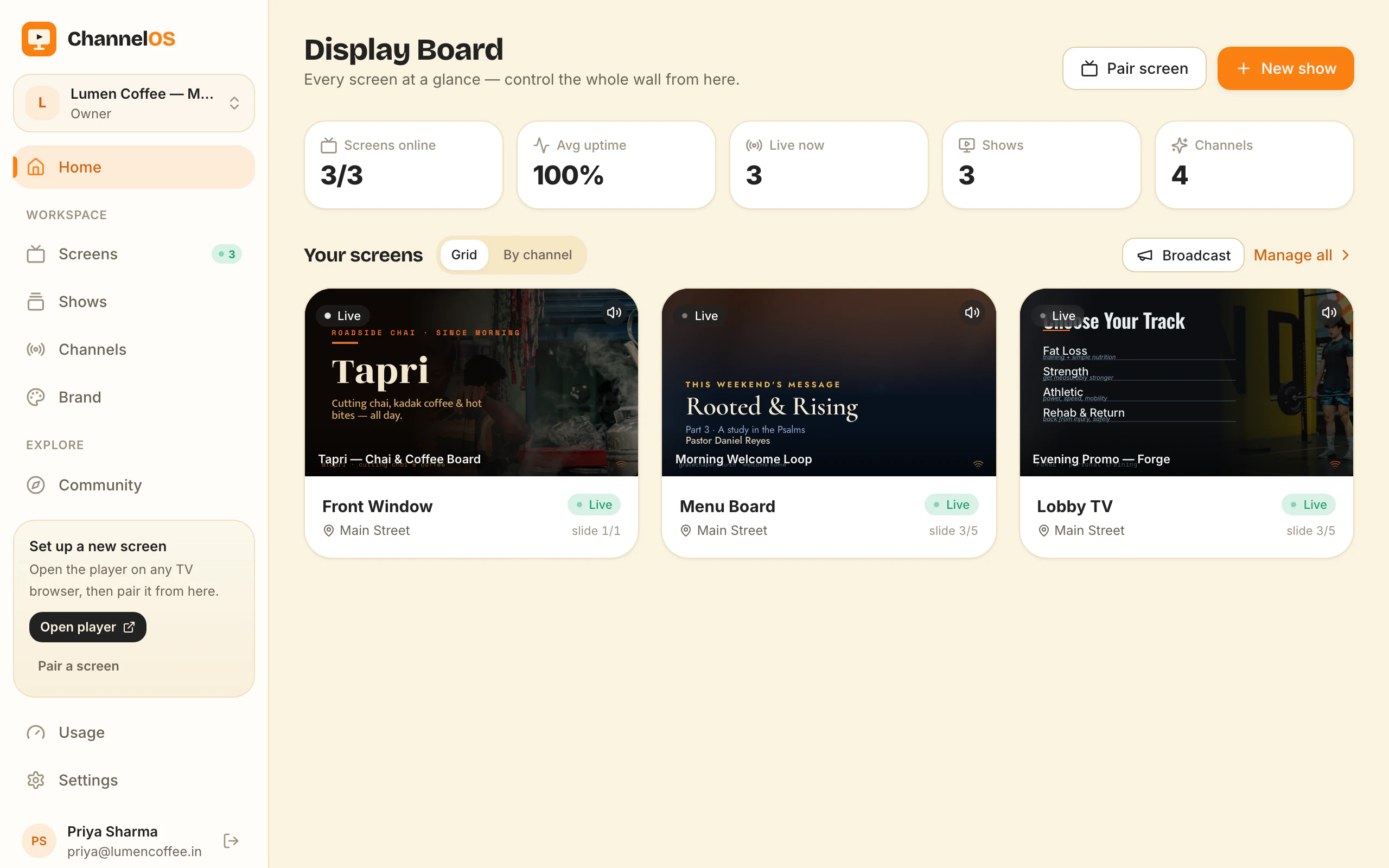
| Run the wall | Per-device dashboards, playlists and reporting | One live board: play · pause · blank · mute · next · hold |
| Setup before pixel one | Install player app per screen, optional hardware to buy | None — pair and publish in minutes |
Feature comparison
| Feature | OptiSigns | ChannelOS |
|---|---|---|
| Media-player hardware | Player app per device; optional ~$79.99 stick | None — the TV’s browser is the player |
| Free tier | ✓ up to 3 screens (with branding) | ✓ first screen free (with a ChannelOS banner along the bottom of the screen) |
| AI drafts the full show | ✗ single designs/layouts only | ✓ complete multi-slide show |
| Browser pairing (no app on TV) | partial — app-first, browser is one option | ✓ pair a URL, no app |
| Edit once, airs everywhere | partial — schedule/push to devices | ✓ derived from schedule in real time |
| Dayparting / scheduling | ✓ | ✓ |
| Pricing model | Per screen + separate add-ons | Per screen, no seats, no add-on stack |
So which should you choose?
Choose OptiSigns if you want the widest app and integration marketplace, proof-of-play reporting and approval workflows, and the flexibility to run signage on cheap Fire TV or Raspberry Pi devices you already have — and you have the resources to install and manage a player app on each screen.
Choose ChannelOS if you want a screen live in minutes, an AI-drafted show instead of a blank editor, and one live board where an edit airs everywhere at once. Your first screen is free. The test: describe your board in one sentence and see whether what comes back is close enough to edit rather than restart. If you would rather assemble it from apps and widgets, OptiSigns is deeper and you should buy that.
Frequently asked questions
- What's the main difference between ChannelOS and OptiSigns?
- OptiSigns is a device-app-first signage platform: you install its player app on a Fire TV Stick, Raspberry Pi, Android box or SoC display, and its AI Designer generates single images or layouts you then assemble by hand. ChannelOS runs as a web page in the TV's own browser, and its AI drafts a complete multi-slide show from one description.
- Do I need a media player device for OptiSigns?
- OptiSigns needs a device running its player app — typically a Fire TV Stick, Android box, Raspberry Pi, Chromecast or a Tizen/webOS commercial display, with an optional ~$79.99 pre-configured Android Player stick you can buy. ChannelOS needs no player box and no app: you open a URL on the TV you already own and pair it from your phone.
- Is ChannelOS cheaper than OptiSigns?
- OptiSigns has a genuine free tier for up to 3 screens (with OptiSigns branding shown), then paid plans priced per screen, with several capabilities (AI Audience Intelligence, Video Wall, Background Music, Wireless Presentation) sold as separate add-ons. ChannelOS gives you your first screen free (with a ChannelOS banner along the bottom of the screen, which any paid plan removes), then charges per screen per month with no seats and no setup fees. Compare current plans for your screen count.
- Who should still use OptiSigns?
- Teams that want a very broad app and integration marketplace — 100+ apps like Google Workspace, Power BI, Salesforce and OptiSync dynamic data — or that already run a fleet of Fire TV / Raspberry Pi devices and want proof-of-play reporting and approval workflows, are well served by OptiSigns. ChannelOS is for people who want a screen live in minutes with no app and an AI-drafted show.
- What is the best OptiSigns alternative?
- It depends on which part of OptiSigns you are replacing. If you need its 100+ app marketplace, proof-of-play reporting or split-screen zones, the honest answer is another full signage CMS such as Yodeck, ScreenCloud or Rise Vision — they compete on the same ground. If what you actually want is fewer moving parts, ChannelOS is the closest alternative in shape: it runs in the TV's own browser, AI drafts a complete multi-slide show from one sentence, and every screen derives what it plays from the schedule in real time, so an edit is live everywhere without a push. The first screen is free forever, so you can run it beside OptiSigns before deciding. Free screens show a ChannelOS banner along the bottom of the screen, and any paid plan removes it.
- How hard is it to switch from OptiSigns to ChannelOS?
- There is no importer for OptiSigns playlists, so you rebuild rather than migrate — but you rebuild from source material, not from scratch. AI drafts a complete show from a sentence, a PDF, images or a webpage URL, so a menu or notice board that exists as a PDF becomes an editable multi-slide show in one step. Pairing a TV takes about two minutes and needs no app, and because your first ChannelOS screen is free forever you can run one screen in parallel with your OptiSigns fleet, prove it on a real wall, and uninstall the player apps only once you are happy. Free screens show a ChannelOS banner along the bottom of the screen, and any paid plan removes it.
Your screen is two minutes away.
Open the player on a TV, scan the code, publish a show. Your first screen is free.
Free screens show a ChannelOS banner along the bottom of the screen, and any paid plan removes it.