Digital Signage for Church Lobbies: Service Times, Giving QR, Volunteer-Run
Digital signage for church foyers on the TVs you already own — no player box. AI drafts the announcement slides, a channel handles the weekly rhythm, and a volunteer can run it on Sunday.
Digital church signage is mostly a foyer problem: the service times changed, the poster on the noticeboard says the old ones, and the person who made that poster is on holiday. Put the same information on the TV already hanging in the lobby and it stops being a printing job — it becomes a two-minute edit on somebody’s phone between services.
Three things make that work in practice: the TV is the player, so there’s no box to buy or maintain; AI drafts the slides, so nobody has to be the church designer; and a channel handles the weekly rhythm, because a church calendar is the most predictable schedule any building has.
What digital signage for church buildings actually has to survive
Not a hardware review. A volunteer.
Church screens fail for a boringly consistent reason: the person who set them up was the one technical person, and the system needed that person every week. Six months later the lobby TV is showing an Easter graphic in July, or it’s on the input-select screen, or somebody unplugged the player box to charge a phone.
So the real requirements for a church are: anyone can change it, it changes everywhere at once, and it survives the week nobody touches it.
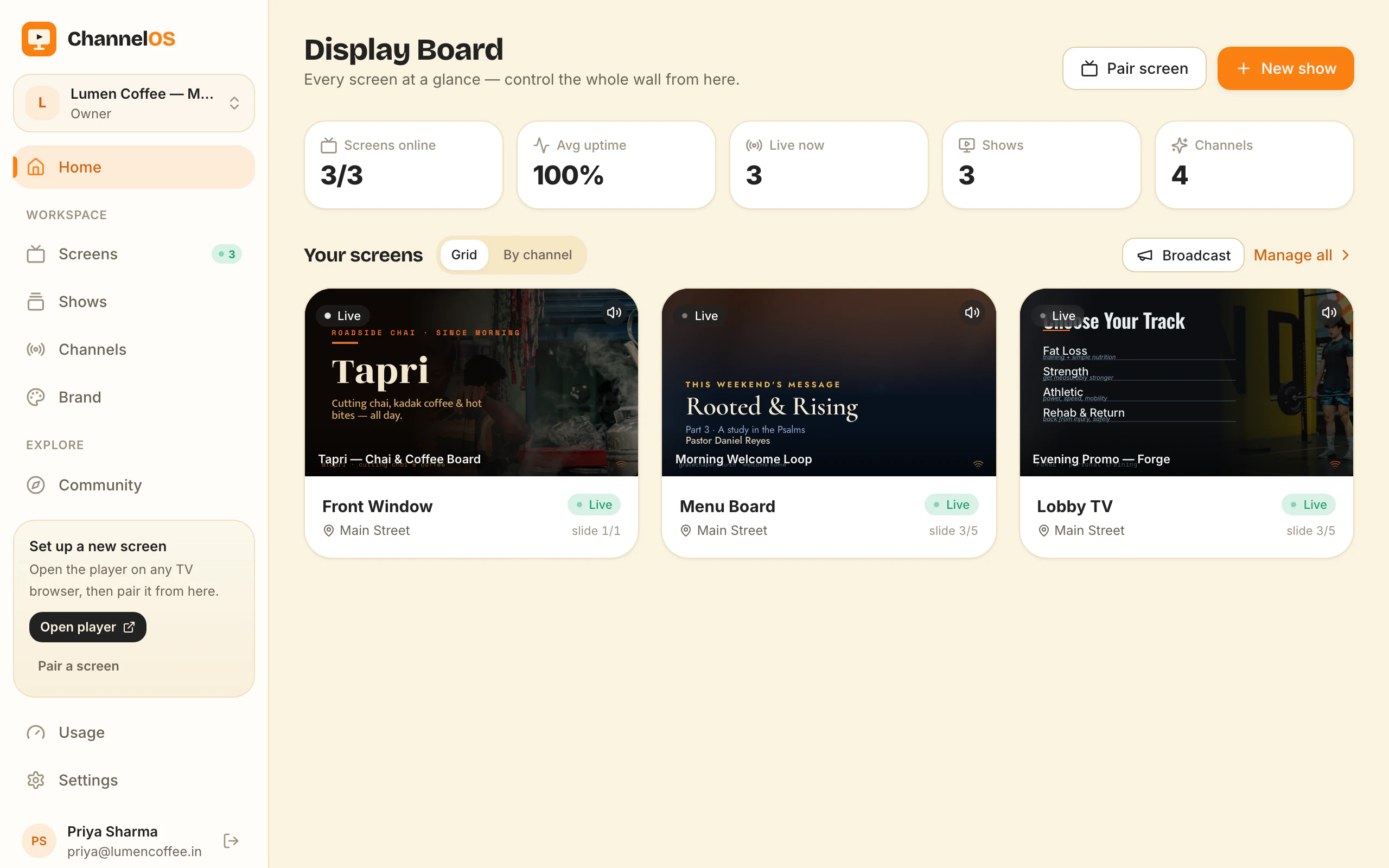
ChannelOS is built to those three. A screen is paired by opening one URL on the TV and scanning the code from your phone — no player device to provision, no licence key. What each screen shows is derived from the show plus the channel schedule plus the clock, in real time, so there is no re-publish step and no waiting for devices to sync. And the live board gives whoever’s on rota a real rendered preview of every screen in the building, with one-tap play, pause, blank, mute and next beside each one — so you can tell from the car park that the children’s-wing screen is alive.
Why it matters: the failure mode isn’t the design, it’s the maintenance. If a screen needs a specialist, it will eventually be wrong.
The lobby screen: welcome, service times, where to go
The foyer screen has one job for the first ninety seconds of somebody’s visit: tell them what’s happening now and where to stand.
That’s a short show — three or four slides — and it’s exactly the kind of thing you don’t want to build from a blank canvas. Describe it in one sentence and AI drafts the whole multi-slide show, on-brand and fully editable. Hand it your bulletin PDF, a photo of last month’s printed notice sheet or the URL of your church’s events page and it reads them for context, so the draft comes back with your actual service times and your actual event names rather than placeholder text.
The output is a real editable show, not a flat image: every heading, time and photo is a selectable element in a Canva-style editor. From there it’s the last ten per cent — swap in a free Pexels photo, lift a portrait of the speaker off its background with one-tap background removal, or add a live clock so a static welcome slide doesn’t look frozen. If you’d rather start from a finished layout, the templates gallery has shows you can remix and edit rather than build.
A worked example. The 9am service moves to 9:30 for the summer. You open the show on your phone, change one text element, and every screen in the building — foyer, corridor, coffee area, children’s check-in — is showing the corrected time within seconds. No reprint, no walking round with a USB stick, no “did that one update?”.
Why it matters: the reason the poster is out of date is never that nobody noticed. It’s that fixing it was a job.
Giving QR codes, connect cards and sign-ups
The giving prompt is the one slide where the mechanism matters more than the design.
ChannelOS’s QR is a live widget, not an image somebody exported once and pasted in. You type the URL of the giving page you already use — whatever provider that is — and the code is generated on the slide. Change the destination and every screen regenerates it. That single detail is what stops the classic failure of a printed giving QR: the code on the wall still pointing at a page that moved.
The same widget covers the other things a foyer asks people to do: a connect-card form, an event sign-up, a sermon-notes page, a volunteer rota, a WhatsApp or newsletter join link. One QR per slide, each with a plain-language line above it, and the show rotates through them rather than a wall of six codes nobody scans.
For anything with columns rather than headlines — a term timetable, room allocations for small groups, a rota of who’s serving when — use a table. It’s a first-class element you draw on the slide and edit cell by cell, resizing by dragging the dividers. A rota reads properly as a table and badly as a paragraph.
Why it matters: a QR that goes to the wrong page is worse than no QR. Making it a widget means the address is data, not a picture.
The weekly rhythm: dayparting a church channel
A church calendar suits scheduling better than almost any other building’s, because it genuinely repeats.
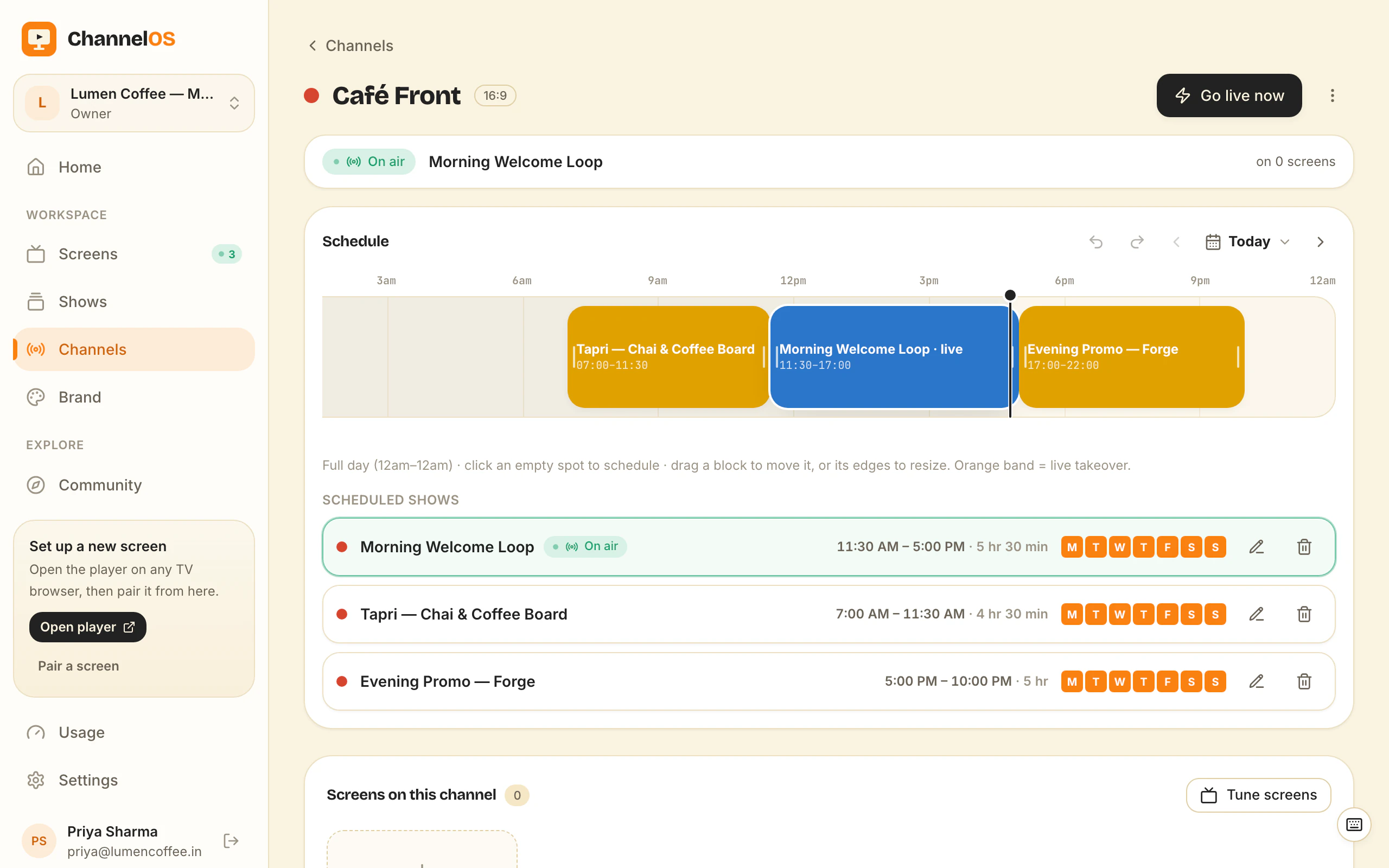
A channel is a named feed with a real daily timeline, and screens tune into a channel rather than being fed files one at a time. You set it once, by hour and by weekday:
- Sunday, 8:30–12:30 — welcome, service times, today’s readings, giving.
- Sunday, after the last service — next week’s events, the volunteer ask.
- Wednesday evening — small groups: which room, which study, who’s leading.
- Weekday daytime — the quiet loop: opening hours, the office phone number, the food-bank collection, a slow Pexels video and a weather widget so the room doesn’t look switched off.
Each screen changes on its own clock. Nobody arrives early to swap the board, and nobody has to remember on a Bank Holiday. Different screens can sit on different channels too — the children’s-wing TV runs check-in instructions while the foyer runs the main welcome — and the pattern scales the same way when a second site or a church plant is added. Channels and shows export as portable files (.show.channelos.tv and .channel.channelos.tv), so a second building starts from the first building’s finished shows and only changes what differs. More on that model in manage many screens with channels.
When the schedule can’t predict it — the 10:45 has moved to the hall, the car park is closed, the heating’s out — you fire a live takeover and it cuts in over every screen on that channel immediately, then drops away and lets the normal schedule resume. Nothing permanent gets edited to say a temporary thing, which is the mistake that leaves a “CAR PARK CLOSED” slide up for a fortnight.
Why it matters: the weekly rhythm is the whole point. A church screen that needs a human every Sunday has just invented a new job on the rota.
What it needs, and what it doesn’t
No media player box. No app sideloaded onto the TV. No per-device licence. ChannelOS runs in the browser already built into the screen — Android TV, Google TV, webOS, Fire TV, a Chromebox, or an old laptop in kiosk mode — which is usually a TV the church already owns and, at most, a cheap browser stick for the one that’s too old. The mechanics are in no media player required.
The first screen is free forever, no card; screens after that are per screen per month, with current rates on the pricing page. What you do need is a working internet connection at each screen, which is the honest trade for having no local player: a browser-based screen wants Wi-Fi that reaches the foyer.
Two more honest limits. ChannelOS is not presentation software — lyrics, sermon slides and live video in the auditorium belong to ProPresenter, EasyWorship or OpenLP, and ChannelOS neither replaces them nor integrates with them. It’s for the screens outside the room. And it doesn’t pull automatically from a church management system, so service times and events are typed or drafted from a document rather than synced from Planning Center. Platforms built around player hardware, such as Rise Vision, have long-standing church and school template libraries and offline playback if either of those is decisive for you. Weigh it honestly — our comparison posts name where each one wins.
If your building runs a café or coffee bar on a Sunday, the free menu board maker covers that screen too, and the same channel can carry it.
Get the foyer screen live before Sunday
Open a URL on the TV, scan the code from your phone, and it’s paired in about two minutes. Describe the welcome show in a sentence — or hand it the bulletin — and edit the draft rather than build one. Put it on a channel with your Sunday and midweek hours, and the screens run themselves the rest of the week.
Fix a service time once and it’s right everywhere. Move a room at 10:40 and a takeover says so on every screen by 10:41. And the first screen is free forever, with no card, so the cheapest way to test whether the foyer TV can do this is to pair it.
Frequently asked questions
- What is digital church signage?
- Digital church signage is any screen in the building that carries what a printed notice used to: service times, this week's announcements, the children's check-in, a giving prompt. The word covers both the display and the software that changes it. With ChannelOS the display is a television the church already owns, because the TV's own web browser is the player, so there is no media player box per screen and nothing to install. A volunteer edits the show once on their phone and every screen in the building corrects itself in seconds.
- What is digital signage for church use?
- Digital signage for a church means running service times, welcome messages, announcements and giving prompts on TV screens in the foyer, hallways and children's check-in instead of printed posters and a corkboard. With ChannelOS the TV itself is the player, so a volunteer edits the show once on their phone and every screen in the building corrects itself in seconds.
- Do we need a media player box for church lobby screens?
- No. ChannelOS runs in the TV's own web browser — Android TV, Google TV, webOS, Fire TV, a Chromebox or a laptop in kiosk mode. There is no player device to buy per screen and no per-device licence. You open one URL on the TV and scan the pairing code from your phone.
- Can we put a giving QR code on the church screen?
- Yes. The QR is a live widget, not a pasted image — you type in the URL of the giving page you already use and ChannelOS generates the code, so changing the destination changes the code on every screen. You can drop the same widget on a connect-card form, an event sign-up or a sermon-notes page.
- Can a non-technical volunteer run the church screens?
- That is the design target. Pairing a screen is opening a URL and scanning a code, editing is a Canva-style editor rather than a playlist tool, and the live board shows a real rendered preview of every screen with one-tap play, pause, blank and next. There is nothing to provision, nothing to sync and no publish-and-wait step to get wrong.
- How do we change the screens for Sunday versus midweek?
- Put the shows on a channel and schedule them by hour and weekday. Sunday morning runs the welcome and service-times show, Wednesday evening runs the small-groups show, and the quiet weekday hours run something calmer — each screen tunes into the right one on its own clock, set once. A live takeover cuts in over all of it when a room changes at the last minute.
- How much does digital signage for a church cost?
- The first screen is free forever with no card, and additional screens are priced per screen per month — current rates are on the pricing page. Free screens show a ChannelOS banner along the bottom of the screen, and any paid plan removes it. Because the TV's browser is the player, there is no player hardware to buy and no per-device licence, so a second or third screen usually costs a display you already own plus, at most, a cheap browser stick.
Your screen is two minutes away.
Open the player on a TV, scan the code, publish a show. Your first screen is free.
Free screens show a ChannelOS banner along the bottom of the screen, and any paid plan removes it.