Samsung MagicInfo alternative: run signage in any TV browser, no server, no integrator
An honest look at Samsung MagicInfo — what it genuinely does better, and what it asks of you first — plus a Samsung MagicInfo alternative that runs in any TV's browser, including a consumer Samsung set, with no MagicInfo server and no AV integrator.
Samsung MagicInfo is the signage software Samsung wrote for its own panels, and on those panels it is genuinely good. The trouble starts when the screen you actually want to use is the Samsung TV already hanging in the café, or when getting live means a server, a per-display licence and a visit from an AV integrator. This is an honest read on what Samsung MagicInfo does well, what it asks of you first, and where a browser-based alternative fits instead.
The short version: MagicInfo controls panels. ChannelOS puts content on screens. Those are different jobs, and most people only ever needed the second one.
What Samsung MagicInfo actually is
MagicInfo is a content management system tied to Samsung’s SMART Signage commercial display line — the panels with a Tizen player built into the display itself, so no external media box is needed. You upload media, build playlists, assign them to device groups, schedule them, and push out to the fleet. Alongside content it manages the hardware: power scheduling, brightness, input source, panel temperature and fault reporting, video-wall layout across a grid of displays.
It comes in more than one shape. There are on-premise server editions you install and maintain, a hosted option Samsung runs for you, and separate authoring tools for building the layouts. In practice most deployments arrive through a Samsung reseller or an AV integrator as part of a display purchase, with the licence attached per display.
That whole design assumes something specific: you are buying commercial panels. MagicInfo is not built for the Samsung TV you bought at an electronics shop, and a consumer set is not a supported device. If you already own SMART Signage panels, that assumption is fine. If your screens are ordinary TVs, it is the entire problem.
What MagicInfo genuinely does better
We will not pretend this is a one-sided comparison, because it isn’t.
Panel-level control. MagicInfo talks to the display, not just to the content on it. Turn the panel on at open and off at close, set brightness per group, switch the input, read the internal temperature, get told when a display faults. A web page in a browser cannot do any of that — a browser has no authority over the hardware it is running on. If your screens are outdoors, unattended, or in a building where nobody is going to walk over and press a button, this matters more than anything else on this page.
Video walls. Configuring a 3×3 grid of panels as one logical canvas, with bezel compensation, is native to MagicInfo and to Samsung’s hardware. Browser-based signage does not do video walls properly.
Enterprise deployment. Device groups at real scale, user roles and permissions, content approval workflows, an on-premise server for organisations whose security policy will not allow content to live in a vendor’s cloud. Corporate and government buyers often have that last requirement in writing.
It is Samsung’s own stack. If you have standardised on Samsung SMART Signage, the panel, the player and the CMS come from one vendor with one support contract. That is a real procurement advantage, and swapping the CMS out to save a licence line is usually a bad trade.
Why it matters: if you are managing hundreds of commercial panels with an AV team behind you, MagicInfo is the right answer and this article is not for you.
A Samsung MagicInfo alternative that runs in any TV browser
Here is the split, stated plainly. MagicInfo starts from the panel: buy the display, license it, stand up the server, then put content on it. ChannelOS starts from the screen you already have: open one URL in the TV’s browser, scan the code from your phone, and it is paired.
That covers a much wider set of hardware than a Samsung-only CMS can, deliberately. Android TV, Google TV, LG webOS, Fire TV, a Chromebox, a laptop in kiosk mode — and yes, a consumer Samsung TV, using the Internet browser built into the set. Browser availability varies by model and firmware, so if a particular TV has no usable browser, a cheap HDMI browser stick makes it one for less than the price of a licence. Nothing is sideloaded, nothing is provisioned, and there is no per-device licence to track. The mechanics are in no media player required, and the awkward-hardware cases are covered in signage without an Android player.
Nothing forces an either/or, either. Existing SMART Signage panels can stay on MagicInfo while the ordinary TVs — the one in reception, the one in the staff room, the one in the second branch that never got a project budget — run on a browser.
No MagicInfo server, no integrator visit
The gap that costs the most is rarely the software. It is the sequence in front of it: specify the panels, order them, get the licences, install or subscribe to the server, have someone configure it, then finally make a slide.
ChannelOS has no server for you to run and no installation step. The account is a web page, the TV is a web page, and pairing is scanning a code. There is nothing to patch, no VM, no firewall rule between the displays and a management host inside your network.
The honest counterweight: a browser-based screen wants a working internet connection. A Tizen panel with content cached locally rides out an outage better than a web page does. If your screens sit somewhere with genuinely unreliable connectivity, weigh that difference above everything else here — it is the one place where the panel-first design wins outright.
Why it matters: the reason a screen still shows last quarter’s content is almost never the panel. It is that changing it involved three people.
Building the show: an authoring tool versus a description
MagicInfo gives you an authoring tool and a media library. You design the layout, define the zones, upload the assets, assemble the playlist. It is a competent professional workflow and it assumes someone whose job includes doing that.
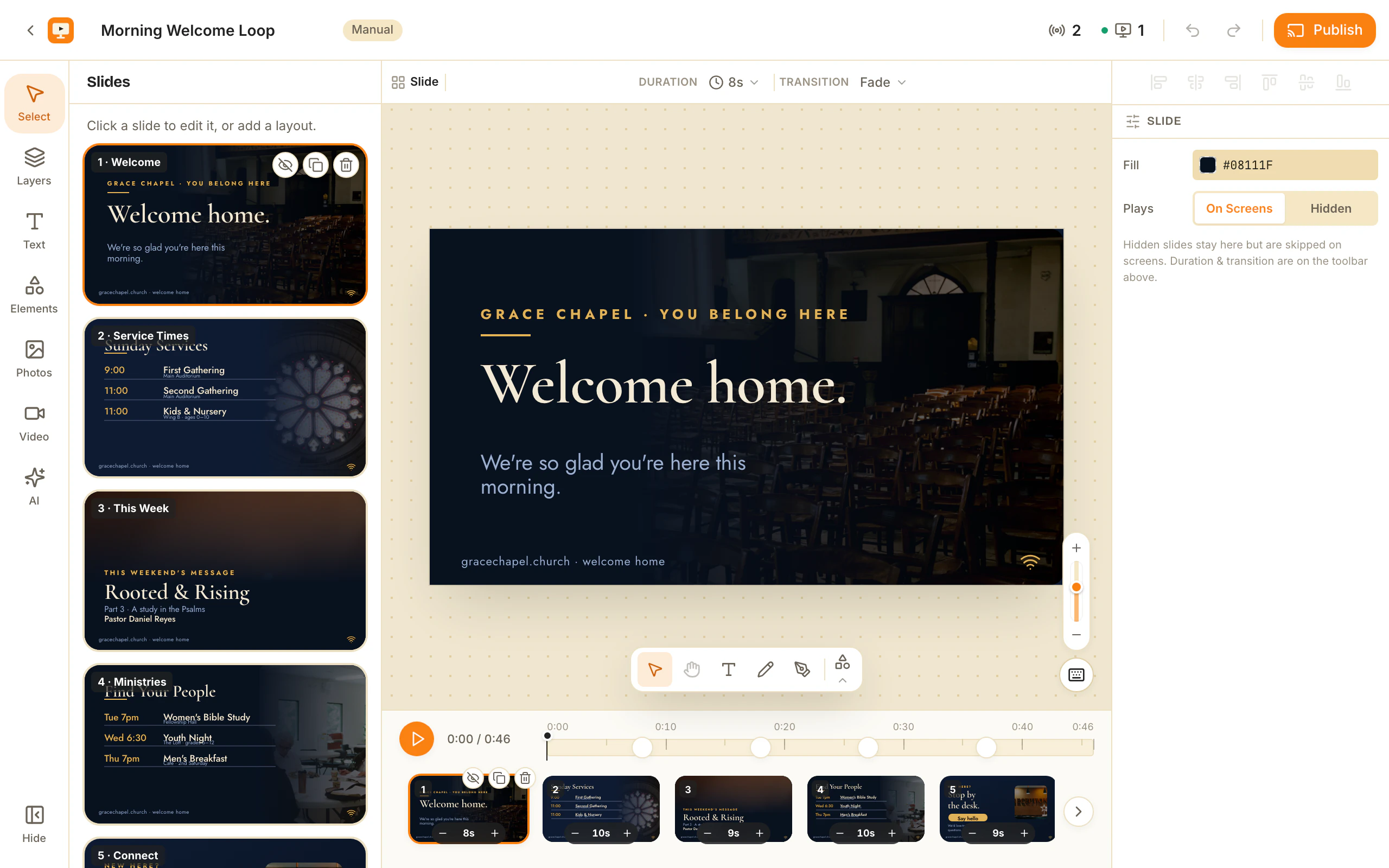
ChannelOS assumes the opposite — that nobody in the building is a designer. You describe the show in one sentence and AI drafts the whole thing: a complete, on-brand, editable multi-slide show. Hand it a PDF, an image or a webpage URL and it reads them for context, so an existing menu or price list becomes slides without being retyped.
What comes back is a real editable show, not a flat export. Every heading, price and photo is a selectable element in a Canva-style editor, with free Pexels photos and video, one-tap background removal, tables, groups, keyboard shortcuts, and live widgets — clock, weather, QR, menu, ticker — that keep a static board from looking frozen. If you would rather start from a finished layout, the templates gallery is remixable, and the free menu board maker covers 14 cuisines including pizzeria, sushi, bbq, cafe, bakery, bar-pub, indian and food-truck.
Scheduling works differently too. A channel is a named feed with a real daily timeline: dayparting by hour and weekday, live takeover for the thing the schedule could not predict, and go-live-now when something has to be on screen this minute. Because every screen derives what it plays from that schedule in real time, there is no publish-and-wait sync step — you fix a price once and every screen on that channel is already correct.
Side by side
| The job | Samsung MagicInfo | ChannelOS |
|---|---|---|
| Supported screens | Samsung SMART Signage panels (Tizen) | Any TV that loads a web page, plus a browser stick where it doesn’t |
| Getting live | Panels, licences, server or hosted tenant, usually an integrator | Open a URL on the TV, scan the code from your phone |
| Licensing | Typically per display | First screen free forever, then per screen per month |
| Building content | Authoring tool, layouts and zones you design | Describe it — AI drafts every slide, then edit |
| Changing what’s playing | Publish to devices, wait for sync | Edit once — screens derive it in real time |
| Panel control | Deep: power, brightness, input, diagnostics | None — a browser has no authority over the hardware |
| Video walls | Native, with bezel compensation | Not supported |
| Offline playback | Local cache on the panel | Needs a working connection |
Who should stay on Samsung MagicInfo
Stay if you have already bought SMART Signage panels and the panel-level control is doing real work — scheduled power, brightness by group, fault alerts, video walls. Stay if your security policy requires on-premise. Stay if an AV team already owns the fleet and it runs fine; removing a licence line is not worth rebuilding a working system.
Look elsewhere if the screens are ordinary TVs that MagicInfo will not adopt, if the server and the integrator are the actual blockers, if you run one site or a handful and the screens are somebody’s second job rather than anybody’s department, or if the reason the content is stale is that nobody has time to design the next version.
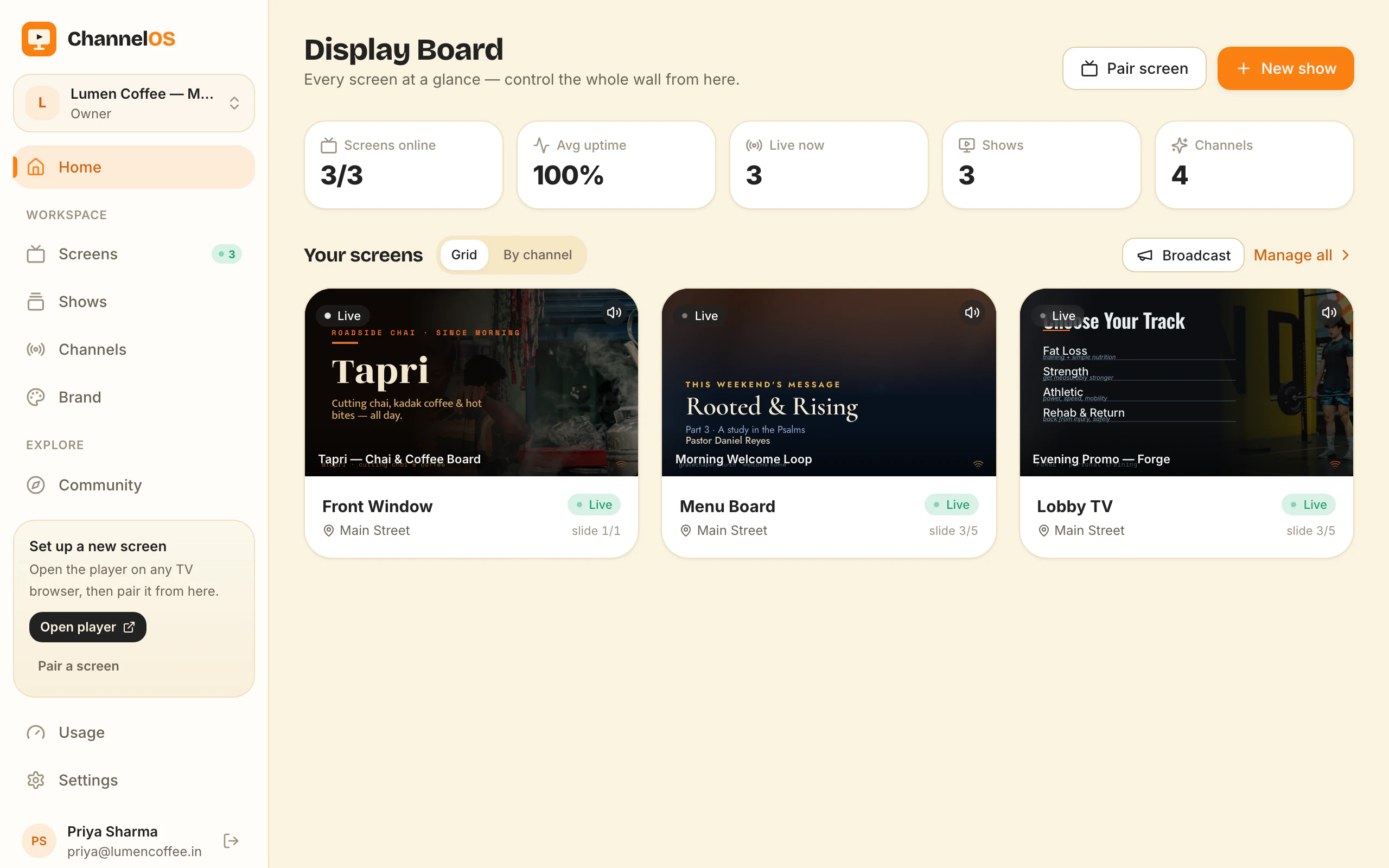
What you give up by switching, plainly: panel control, video walls, offline cache, and single-vendor support with Samsung. What you get: any screen becomes a screen, no server, no integrator, AI-drafted shows, one live board with a real rendered preview of every screen and one-tap play, pause, blank, mute, next and hold — and portable exports (.show.channelos.tv, .channel.channelos.tv) so a second site copies the first instead of rebuilding it.
Content does not migrate automatically — MagicInfo playlists do not export into ChannelOS. In practice people move one screen across, rebuild that show by describing it rather than redrawing it, and leave the panels alone until they are convinced. The same pattern we describe in the Yodeck comparison applies here.
Get one screen live and compare properly
The cheapest way to settle this is not a feature table, it is a TV. Open the URL on a screen, scan the code, describe the show you want and see what comes back — then decide whether the panel-level control you would be giving up is control you were ever going to use.
The first screen is free forever, no card. After that it is per screen per month, on the pricing page. No server, no per-display licence, no integrator.
Frequently asked questions
- What is Samsung MagicInfo?
- Samsung MagicInfo is Samsung's own digital-signage content management system, designed to run on Samsung SMART Signage commercial displays with the Tizen player built into the panel. It handles content upload, playlists, scheduling, device groups, video walls and remote panel control, and it is typically licensed per display, deployed either as an on-premise server or as Samsung's hosted service.
- Does Samsung MagicInfo work on a normal Samsung TV?
- No. MagicInfo is built for Samsung's SMART Signage commercial display line, not the consumer TVs sold in electronics shops. A consumer Samsung set is not a supported MagicInfo device, which is why people running a café, gym or clinic on ordinary TVs usually end up looking for something else.
- What is the best Samsung MagicInfo alternative?
- It depends on why you are leaving. If you own Samsung SMART Signage panels and need panel-level control — remote power scheduling, brightness, input switching, temperature and fault reporting, video-wall configuration — MagicInfo is still the best tool for those panels and nothing browser-based replaces it. If the panels are ordinary TVs, or the blocker is the server and the integrator rather than the display, ChannelOS is the closer fit: it runs in the TV's own browser, AI drafts a complete multi-slide show from one sentence, and the first screen is free forever. Free screens show a ChannelOS banner along the bottom of the screen, and any paid plan removes it.
- Do I need a MagicInfo server?
- For the on-premise editions, yes — MagicInfo Server is software you install, keep patched and reach from your displays, which in most deployments means IT involvement or an AV integrator. Samsung also sells a hosted option that removes the server. ChannelOS has no server to run at all: the TV opens a URL, you scan the pairing code from your phone, and the screen is live.
- Can I replace MagicInfo without buying new displays?
- Yes, and that is usually the point. ChannelOS runs as a web page, so any screen that can load a modern web page can be a signage screen — Android TV, Google TV, webOS, Fire TV, a Chromebox, a laptop in kiosk mode, or a Samsung TV using its built-in Internet browser. If a particular set has no usable browser, a cheap HDMI browser stick makes it one, and the existing Samsung SMART Signage panels can keep running MagicInfo alongside.
- How much does a MagicInfo alternative cost?
- ChannelOS gives you the first screen free forever and prices additional screens per screen per month, with no per-display licence, no server and no setup fee — current rates are on the pricing page. Free screens show a ChannelOS banner along the bottom of the screen, and any paid plan removes it. MagicInfo pricing is normally quoted per display through Samsung or a reseller, often bundled into a display purchase or an integrator's project cost, so the two are rarely a like-for-like line comparison.
Your screen is two minutes away.
Open the player on a TV, scan the code, publish a show. Your first screen is free.
Free screens show a ChannelOS banner along the bottom of the screen, and any paid plan removes it.