Cheap digital signage: where the money actually goes
Cheap digital signage is rarely about the software price. Here is the real cost structure — panel, player, licence, install, and the labour of changing it — and which lines disappear when the TV is the player.
Most people shopping for cheap digital signage compare monthly software prices, pick the lowest one, and are surprised by the total six months later. The software line is almost never the expensive part. The bill is five lines — the panel, the player, the licence, the install, and the labour of changing what’s on the screen — and the last one is the one nobody quotes for.
This is a look at the whole structure, so you can price your own setup before anyone sends you a quote. No prices here are invented; the point is which lines exist and which ones can be removed.
What cheap digital signage actually means on the bill
Cheap digital signage is a total, spread over the years a screen actually runs. Two setups with identical software costs can differ by a factor of several, because one of them buys a device per screen and pays somebody to keep the content current, and the other doesn’t.
The five lines, in the order you meet them:
| Line | Paid | Who pays it |
|---|---|---|
| The panel | Once per screen | You, or already paid — you own the TV |
| The player device | Once per screen, again when it dies | You |
| The per-device licence | Every month, per screen | You |
| The install | Once per screen, plus every move | You or an installer |
| Changing what’s on screen | Every time it changes, forever | Somebody’s hours |
1. The panel
The TV itself. In most rooms this line is already paid — there is a screen on the wall of the café, the gym, the clinic reception, the showroom. The mistake is treating a signage project as a reason to buy new panels. Commercial displays have genuine advantages (longer duty cycles, better warranties, portrait mode, brighter for window-facing positions), but a consumer TV that already hangs on your wall costs nothing more and will show a menu board perfectly well.
If you are buying, buy for the room and not for the software: brightness matters in a window, duty cycle matters if it runs 16 hours a day, and nothing else on a signage spec sheet changes what your screens cost.
2. The player device
This is where the structure starts to bite. Traditional signage assumes a small media-player box — a Raspberry Pi-class device, an Android stick, or a vendor’s own player — plugged into the TV’s HDMI port, one per screen. It downloads your content and plays it from local storage.
That design buys you two real things, and they are worth naming before the criticism. Offline playback: because the media sits on the device, a dropped connection doesn’t stop the screen. Hardware-level control: a box you own can be rebooted remotely, monitored and told to switch the panel on at open and off at close.
What it costs isn’t only the sticker price. It’s one box per screen, a thing to power and mount behind a wall-hung TV, a provisioning step before pixel one, a spare on a shelf for the night one dies, and a fleet that ages — a five-year-old player is a support ticket waiting to happen. Multiply by screen count and the hardware line tends to outgrow the software line.
3. The per-device licence
Most signage platforms charge per device, and the device is the player, not the screen. That is a monthly line that scales exactly with your screen count and never goes down. It is also the line that makes a “free” plan worth reading twice: free for one screen and per-device thereafter is a very different shape from free forever with a paid feature tier.
Open source removes the licence line but not the cost. Xibo and Anthias have no licence fee and you host the server yourself — which is real, ongoing work someone pays for in time, patching and backups. If you have an engineer who enjoys that, it is genuinely the cheapest option available. If you don’t, self-hosting is the most expensive thing on this page disguised as free. The honest roundup of signage tools covers who each one actually suits.
4. The install
Every player device needs somebody to physically be at the screen: mount it, power it, get it on the Wi-Fi, register it against the account, confirm it plays. For one screen in your own shop that’s an afternoon of your own time. For eleven screens across four sites it’s a scheduled job, a person, and travel.
And it repeats: a screen that moves rooms, a device that dies, a site that changes its Wi-Fi password — each is another trip.
5. The labour of changing it
The last line is the largest and is almost never on a quote: the hours, every month, that somebody spends deciding what the screen should say next and making it look right.
This is the line that kills signage projects. Not cost — attention. The screen goes up, looks great for three weeks, then the person who made it gets busy. Six months later it still shows the summer promo in November. The hardware works perfectly; the project failed anyway.
Price it honestly: hours a month, at what that person’s time is worth, times the years the screen runs. For most small operators it quietly dwarfs the software subscription.
Removing the player box changes three lines, not one
The interesting thing about the player device is not its price. It’s that lines 2, 3 and 4 are the same line wearing three hats — they all exist because there is a computer per screen.
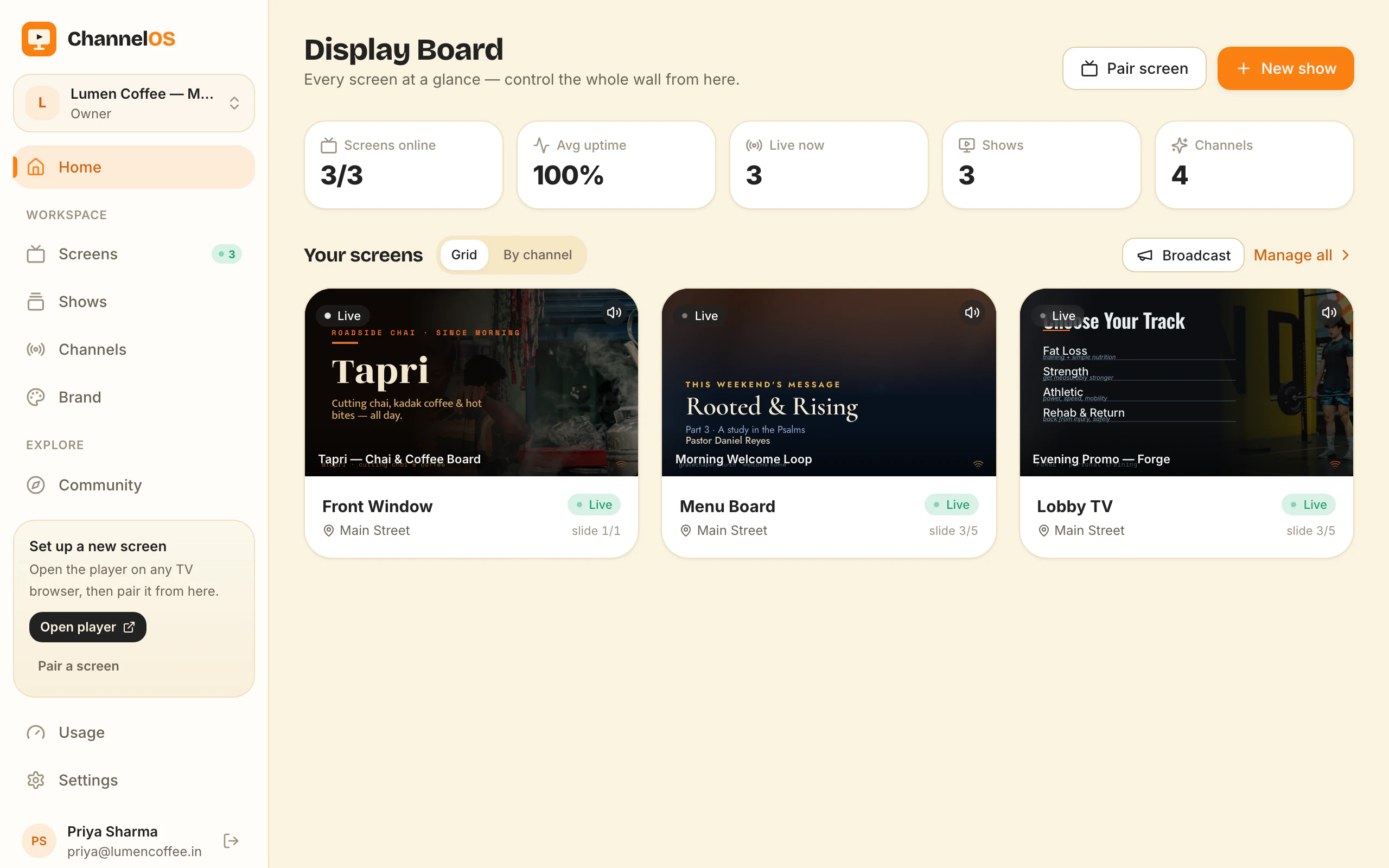
ChannelOS runs as a web page in the TV’s own browser: Android TV, Google TV, webOS, Fire TV, a Chromebox, or a laptop in kiosk mode. You open one URL on the TV, it shows a pairing code, you scan it from your phone, and that screen is live in about two minutes.
- Line 2 goes to zero. Nothing to buy, mount, power or keep a spare of. The mechanics are in no media player required.
- Line 3 goes to zero. There is no device to license, because there is no device. Pricing is per screen per month, first screen free forever — the current numbers are on the pricing page.
- Line 4 shrinks to opening a URL. No provisioning, no registration step. What you actually need is a TV with a browser, a phone, and an account.
The trade is real and worth stating plainly: a browser-based screen wants a working internet connection. A player with local storage rides out an outage better than a web page does. If your screens sit somewhere with genuinely unreliable Wi-Fi, that single difference outweighs every cost line above.
The design step is the line nobody quotes for
Line 5 is harder to remove than the hardware lines, because it isn’t a purchase — it’s attention. Two things reduce it.
Start from something finished. A blank canvas is what turns “update the screen” into a two-hour job. The templates gallery is remixable in one click, and the free menu board maker covers 14 cuisines — pizzeria, sushi, burgers, bbq, chinese, thai, italian, mexican, cafe, bakery, bar-pub, indian, food-truck and dessert — so a café starts from a finished board and changes the prices.
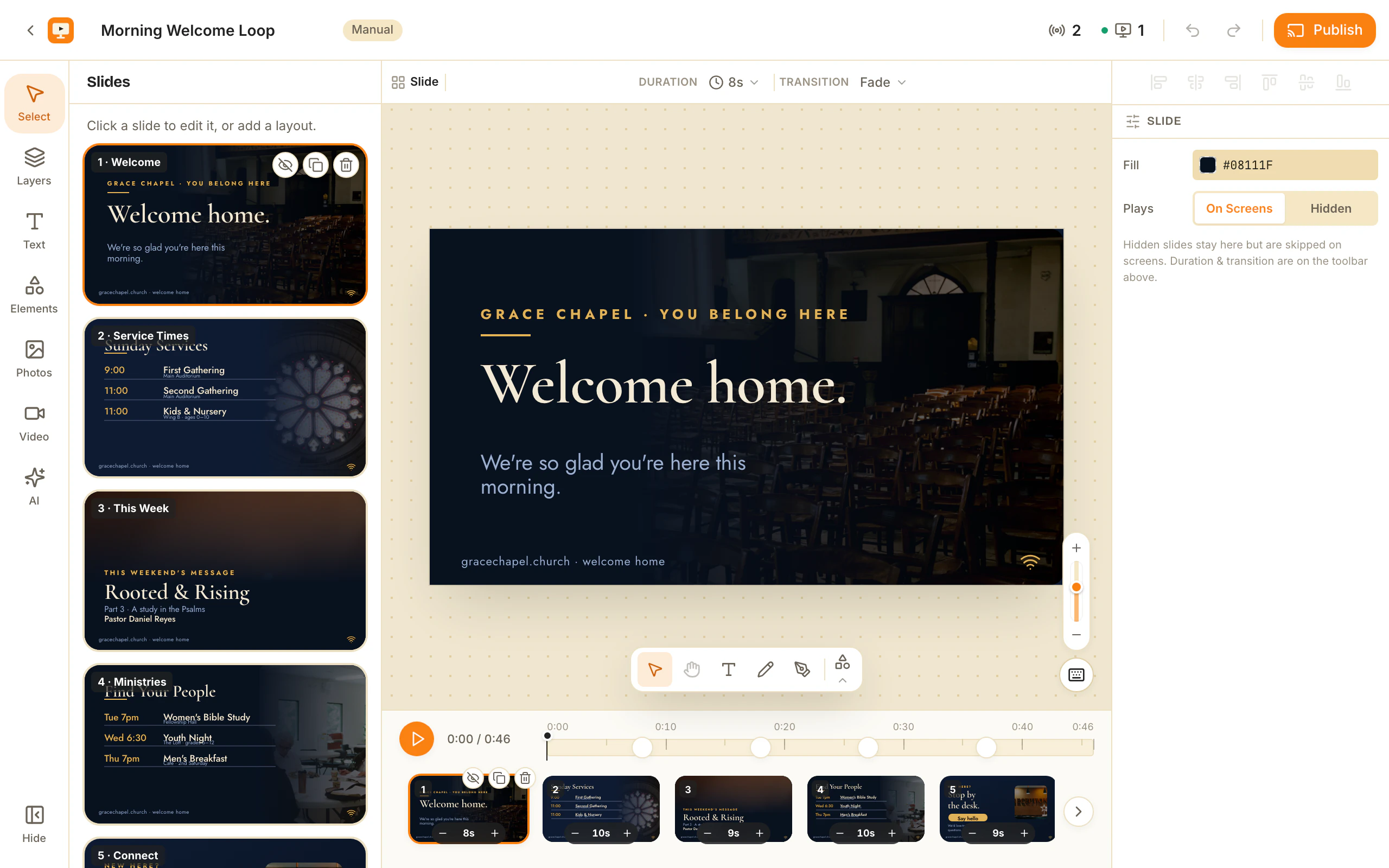
Describe it instead of designing it. In ChannelOS you write one sentence and AI drafts a complete, on-brand, editable multi-slide show. Hand it a PDF, an image or a webpage URL and it reads them for context — so the menu you already have as a PDF becomes slides without retyping it. The output is a real editable show, not a flat export: every heading, price and photo is a selectable element in a Canva-style editor with free Pexels photos and video, one-tap background removal, live widgets and tables.
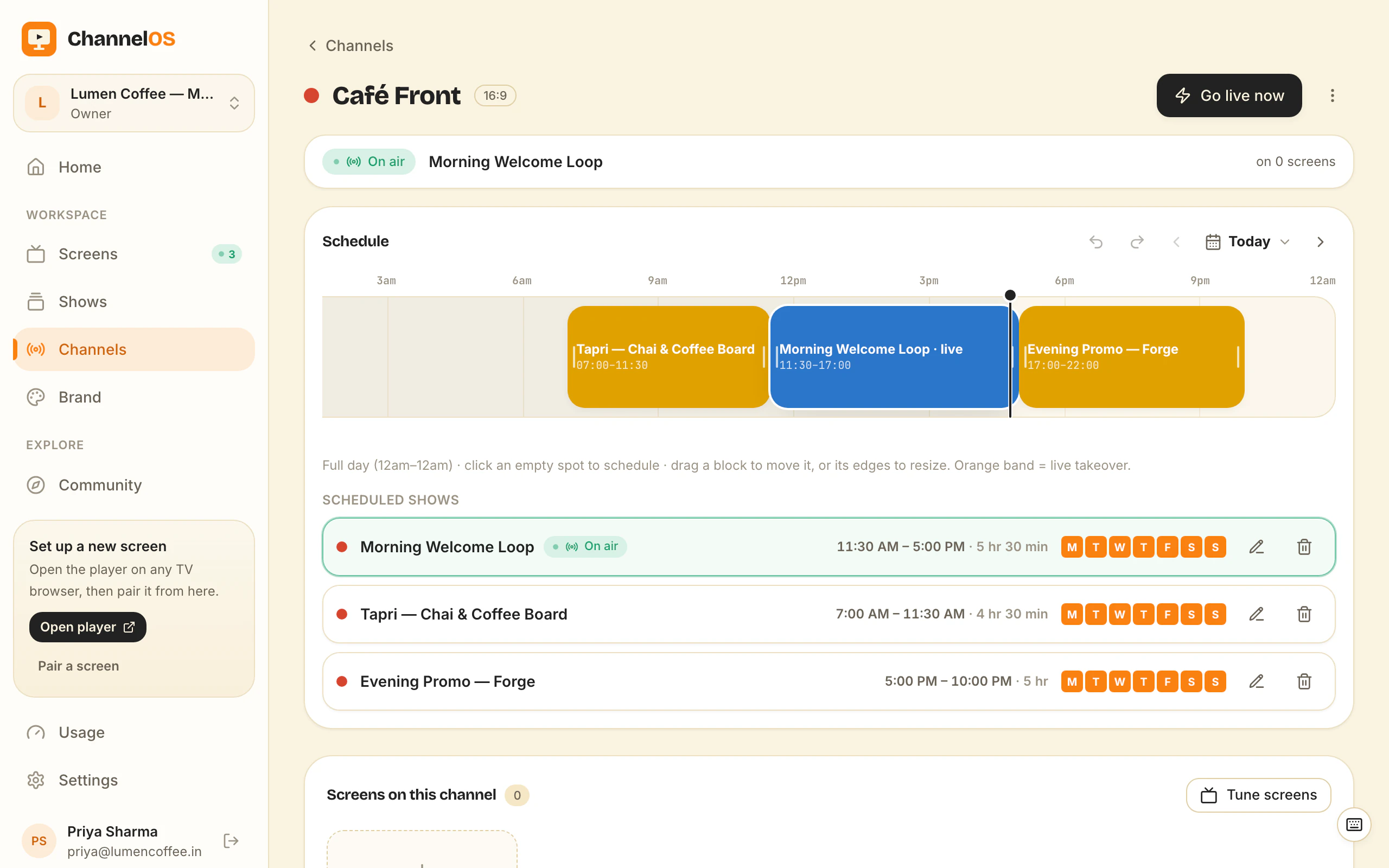
Two more things cut the same line. Edit once, airs everywhere: what a screen shows is derived from the schedule in real time, so there is no publish-and-wait sync step and no per-screen push. And dayparting on a channel means the breakfast board becomes the lunch board on the clock, by weekday and hour, without anybody remembering to swap it. The half hour a week that used to go on swapping screens goes to zero once, permanently.
Where cheap gets expensive again
Being honest about the cases where the removed lines were doing real work:
- Unreliable connectivity. A player’s offline cache is worth paying for. This is the strongest reason to buy hardware.
- Proof-of-play reporting. If you sell advertising slots on your screens, you have to evidence them. Traditional player-based platforms report on this; a browser-based screen doesn’t.
- Fleet-grade device control. Remote reboot, panel power scheduling, per-device telemetry. That needs a device.
- Very large fleets with an AV team. If the team and the process already exist, ripping out a working fleet to remove a licence line is not a good trade.
None of those make player hardware the default. They make it a decision with reasons, which is different from a decision made because the quote assumed one.
Pricing your own setup, before anyone quotes you
Write the five lines down for your actual situation.
- Panels — how many do you already own? That line is usually smaller than you fear.
- Players — one per screen, plus a spare, plus a replacement cycle. Or zero.
- Licences — per device per month, times screens, times twelve, times the years you’ll run it. Or zero.
- Install — hours per screen, plus travel, plus every future move.
- Changing it — hours per month times someone’s rate. Be honest here; this is the number that decides whether the screen is still current in a year.
Then compare setups on the total, not on line 3. Cheap digital signage is whichever column has the fewest lines with numbers in them.
Start with the free screen
The cheapest way to find out what your setup really costs is to run one. Open the pairing URL on a TV you already own, scan the code from your phone, describe the show you want and let AI draft it. No box, no per-device licence, no installer.
Your first screen is free forever — not a trial — so the whole exercise costs you the twenty minutes it takes to see your own content on your own wall. If it works, the second screen is per screen per month on the pricing page. If it doesn’t, you’ve spent nothing finding out.
Frequently asked questions
- What is the cheapest way to set up digital signage?
- Use a TV you already own and run the signage in the TV's own browser, so you skip the two biggest recurring lines — the media-player device and its per-device licence. With ChannelOS you open one URL on an Android TV, Google TV, webOS, Fire TV, Chromebox or a laptop in kiosk mode, scan the pairing code from your phone, and the screen is live. The first screen is free forever, so the cheapest possible setup is a TV you have plus an account. Free screens show a ChannelOS banner along the bottom of the screen, and any paid plan removes it.
- Is cheap digital signage software actually any good?
- Price and capability are not the same axis. Cheap software that still needs a player box per screen, a licence per device and an installer's afternoon is not cheap signage. Judge the total: hardware plus licence plus install plus the hours somebody spends redesigning the screen every month. The software line is usually the smallest number on the quote and the one most people shop on.
- Do I need to buy a media player for digital signage?
- No. Modern TVs ship with a browser, and a browser is enough to run a signage screen. ChannelOS is a web page the TV loads, so there is nothing to buy, mount, power, provision or replace behind the panel. Player boxes still earn their place where offline playback matters — the media sits on the device, so a dropped connection does not stop the screen.
- How much does digital signage cost per screen per month?
- It depends on how many of the five cost lines your setup carries. A traditional quote spreads a player device and an installation charge across the life of the screen and then adds a per-device licence every month. ChannelOS has no player and no per-device licence: the first screen is free forever and additional screens are per screen per month — current rates are on the pricing page. Free screens show a ChannelOS banner along the bottom of the screen, and any paid plan removes it.
- Is free digital signage software really free?
- Sometimes, with conditions worth reading. Open-source options like Xibo and Anthias have no licence fee but you host and maintain the server yourself, which is real work someone pays for in time. Hosted free tiers usually cap screens or features. ChannelOS's free screen is one screen, free forever rather than a trial, with a ChannelOS banner along the bottom of the screen that any paid plan removes, and the paid tiers start at the second screen.
- What are the hidden costs of digital signage?
- Three usually go unquoted: the install labour of mounting and provisioning a device behind each panel, the spare hardware you keep on a shelf for the night a player dies, and the design step — the hours per month somebody spends making the next version of the screen. The third one is the largest over a few years and is the reason so many screens quietly show last season's content.
Your screen is two minutes away.
Open the player on a TV, scan the code, publish a show. Your first screen is free.
Free screens show a ChannelOS banner along the bottom of the screen, and any paid plan removes it.