Digital signage templates in Canva and PowerPoint: where the handoff breaks
Canva and PowerPoint are genuinely good at making the picture. Neither one gets it onto the TV, changes it when the price changes, or knows it is Saturday. Here is exactly where the handoff breaks, and when you should keep using them anyway.
Search for a digital signage template and the three things autocomplete offers you are canva, powerpoint and free. That tells you something honest about where a lot of screens actually get made: not in signage software, but in the design tool the person already had open.
This post is about the seam. Canva and PowerPoint are genuinely good at making the picture. Neither of them is good at the part that comes after, which is getting the picture onto a TV, changing it when the price changes, and showing something different on Saturday. Below is exactly where that handoff breaks, what it costs per change, and the case for not bothering to switch.
If you want the from-scratch version instead, our guide to the digital signage template designer walks through building one layer by layer and publishing it.
Can I use Canva templates for digital signage?
Yes, for the design. Canva’s 16:9 presentation canvas is 1920x1080 pixels, which is a Full HD TV panel exactly, and the export gives you a PNG, a PDF or an MP4. If your TV plays JPEG or MP4 off a USB stick, that is a working screen this afternoon with no software bought.
What Canva does not have is any relationship with the TV. There is no pairing, no schedule, no way to see what is on screen right now, and nothing that will tell you the board on the wall is four weeks stale. It is a design tool, and it is honest about being one.
Can I use a PowerPoint template for digital signage?
Yes, and it will loop unattended. Slide Show, Set Up Show, “Browsed at a kiosk (full screen)”, with slide timings set, gives you a deck that runs forever without anyone touching a mouse. Save it as a .ppsx and it opens straight into the show.
The cost is a computer. A PC has to sit behind the TV running PowerPoint: awake, unlocked, not rebooting for an update, not showing a notification over the menu. That machine is also where the file lives, which is what makes the next section expensive.
What do Canva and PowerPoint actually do well here?
Both are better at pure layout than most signage editors, including ours. Canva’s stock library, brand-kit handling and photo editing are excellent, and everyone in the building already knows how to use it. PowerPoint has been on every office desktop for thirty years, handles tables and charts properly, and needs no account, no subscription and no approval to try.
Neither of those advantages is small, and neither is what breaks. What breaks is everything downstream of the export button.
What happens when you put a 1920x1080 export on a TV?
Two specific things, both checkable on your own wall.
Resolution. PowerPoint exports slide images at 96 DPI by default, and a standard widescreen slide is 13.333 by 7.5 inches, so you get 1280x720. That is already being stretched on a Full HD panel and stretched a long way on a 4K one. Canva’s 1920x1080 export is correct for Full HD and gets upscaled on 4K. Neither is a disaster, but soft type is the usual reason a board looks amateur next to the shop it is in.
Overscan. Some TVs crop a few percent off every edge of an HDMI input. Anything you placed flush to the edge of the slide is simply not on the wall. Keep a margin, or check the TV’s picture settings for a “Just Scan” or “Screen Fit” option.
Then there is the one nobody measures: type sized to look right on a laptop at arm’s length is unreadable from three metres. A board is read at walking distance, and that changes the design, not the file format.
Why is a PDF or a PPTX a poor fit for a screen that runs all day?
Because both are snapshots, and a screen is a continuous thing.
Most TVs’ built-in media players read JPEG and MP4 from a USB stick. Very few read PDF, and none run PowerPoint, so a PDF or a PPTX means a computer in the loop. More to the point, a file has no idea what day it is, which screen it is on, or that it is out of date. It cannot tell you it is stale, and it cannot fix itself. Every property that makes a file convenient to email is the property that makes it a poor board.
What happens when a price changes?
This is the whole argument in one question, so here it is drawn out.
In a file workflow the price lives inside an exported artefact, so correcting it means producing a new artefact and distributing it. In a live workflow the price is a text layer in a show the screens are already tuned to, so you change the layer. The screens derive it.
Menu boards are where this bites first, because prices move and items sell out mid-service. If that is the board you are making, the free menu board maker builds one in the browser without the design-then-export round trip at all.
Does anything in Canva or PowerPoint know it is Saturday?
No. Neither tool has any concept of a weekday or a time of day.
PowerPoint will auto-advance and loop, and Canva will autoplay, but “show the weekday timetable Monday to Friday and the weekend one on Saturday” is not something either can express. You can build it with two files and a scheduled task on the machine behind the TV. That is a small IT project, which is usually the exact thing someone was trying to avoid by opening Canva in the first place.
A scheduling layer built for screens treats it as one setting: each board gets its hours and its days on a channel, and the screen switches on its own clock. Nobody swaps anything at 4pm, because 4pm does the swapping.
What breaks when you have more than one screen?
The copies. One screen and a USB stick is a workable system. Three screens means three sticks, three walks and three chances to leave one on last month’s board, and there is no view anywhere that tells you which one you missed. The failure is silent, which is the worst kind for a thing hanging on a public wall.
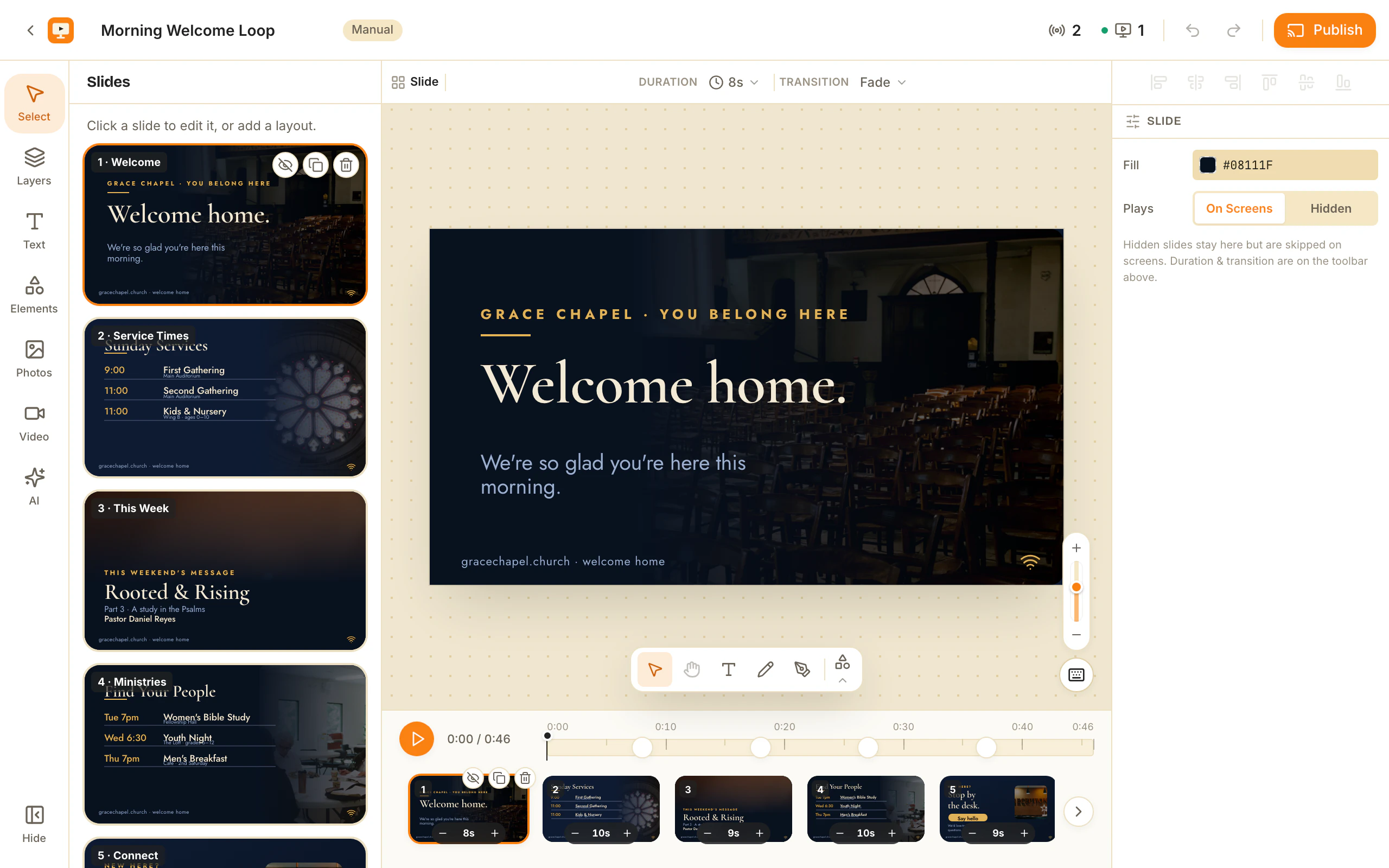
Anything that pairs screens instead of copying files inverts that: one show, many screens, and a live preview per screen so you can see the one nobody has walked past since Tuesday.
Canva vs PowerPoint vs ChannelOS: what does each one actually do?
| Canva | PowerPoint | ChannelOS | |
|---|---|---|---|
| Designing the board | Excellent, and you already know it | Solid, strong on tables and charts | Layer editor, plus an AI first draft |
| What you end up with | A file (PNG, PDF, MP4) | A file (PPTX, PPSX, PDF) | A live show, no file |
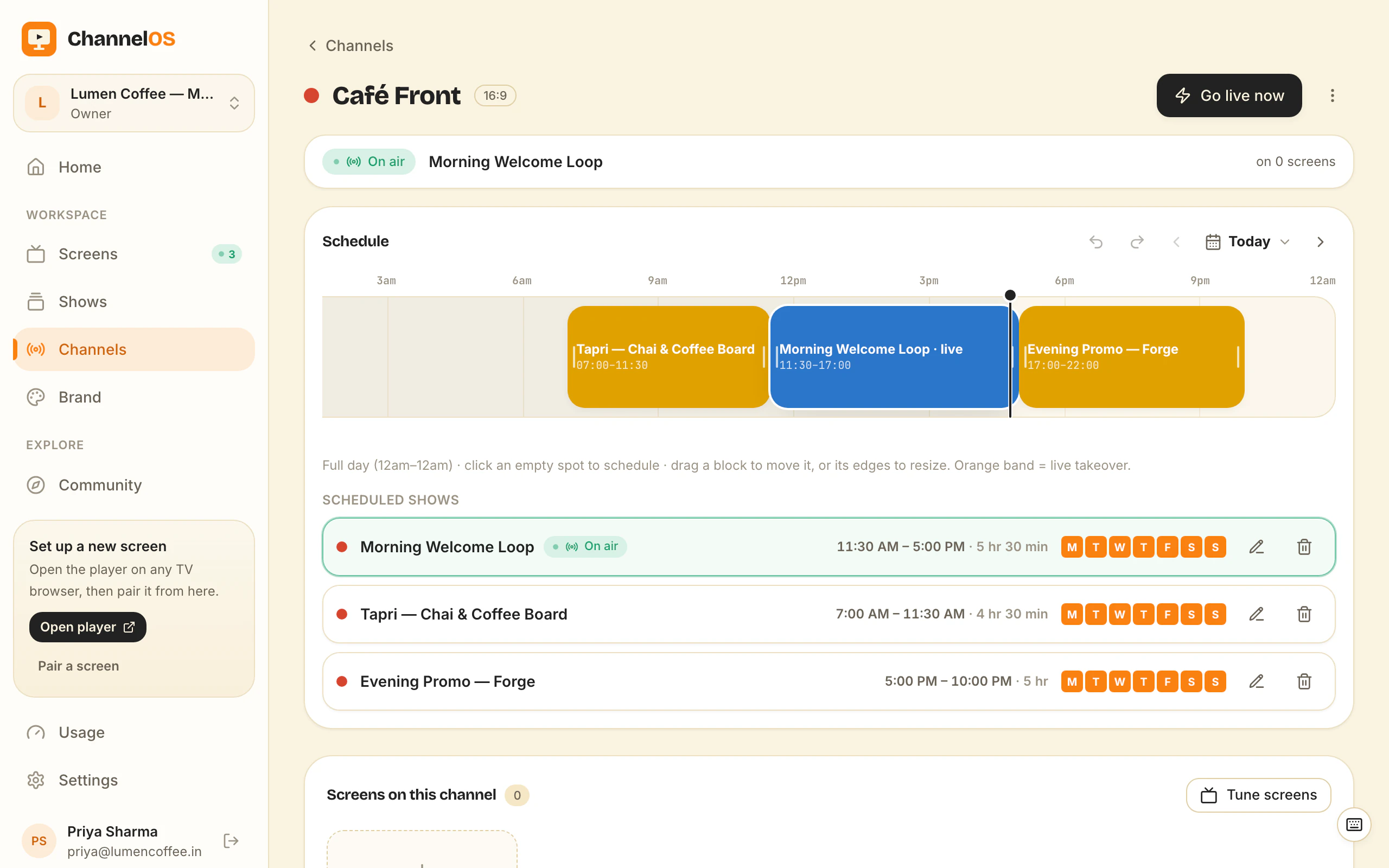
| Getting it onto the TV | You move the file | A PC behind the TV runs the deck | Pair the TV once, in its own browser |
| Changing one price | Edit, re-export, re-copy, reload | Edit, re-save, re-copy, restart | Edit the slide, screens derive it |
| A different board on Saturday | No | Only with scripting | Set the days on a channel, once |
| Ten screens | Ten copies of the file | Ten machines | One show, ten screens |
| A live clock or QR code | A picture of one | A picture of one, unless scripted | A live widget that keeps real time |
| Seeing what is on screen now | Walk over and look | Walk over and look | A live preview of every screen |
| Runs with no internet | Yes, from a USB stick | Yes, locally | No, it needs a connection |
That last row is the real trade and it is not in our favour. The TV’s own browser being the player is what removes the media-player box, and it is also what makes a working connection non-negotiable. The longer version of that argument, including where it does not hold, is in no media player required.
Can I bring my Canva or PowerPoint design into ChannelOS?
Export it as a PDF or an image, then attach it when you create a show. The AI reads the text, the headings and the colours and drafts an editable show from them.
Be clear about what that is. It is a redraw into real, movable layers, not a pixel-perfect import of your file. A .pptx will upload but is not read, so convert it first. If you would rather not redraw anything, the template gallery is full of finished boards you can remix in one click and edit as your own.
Who should ignore all of this and keep using Canva?
Plenty of people, and it is worth saying plainly.
- One screen, and you export about once a month. The whole cost of the file workflow is the repetition. Do it twelve times a year on one TV and there is nothing to fix. Canva is free and better at design than we are.
- The screen has no reliable internet. A browser-based player needs a connection. A file on a USB stick does not. If your unit’s line drops for hours at a time, buy a platform with a local-caching player box, such as Yodeck or Xibo, and do not let anyone talk you out of the hardware.
- You need proof of play, or offline logging. We do not do it. Do not buy us for it.
- The design work is the job and the screen is incidental. If you are producing artwork that also happens to go on a TV, stay in the design tool that produces the artwork.
The case for changing is narrow and specific: the board changes often, more than one person needs to be able to change it, or there is more than one screen. Below that line, the round trip through an export is cheaper than learning anything new.
Get a screen live, free
If the board does change often, the fastest way to judge this is against your own wall rather than against a table on our site. Open play.channelos.tv on the TV that is already in the room, pair it from your phone, and put a board on it. Get a screen live, free. The first screen is free forever and current rates for anything beyond it are on the pricing page.
Then change a price and watch whether you had to get up.
Frequently asked questions
- Can I use Canva to make a digital signage template?
- Yes, for the design itself. Canva's 16:9 presentation size is 1920x1080 pixels, which matches a Full HD TV panel exactly, and you can export the result as a PNG, a PDF or an MP4. What Canva does not do is run your screen. It has no pairing, no schedule and no idea what is on the TV right now, so once you export you are moving files by USB stick or cloud drive and reloading each screen by hand every time something changes.
- Can I use a PowerPoint template for digital signage?
- Yes, and it will loop. Set Up Show, then 'Browsed at a kiosk (full screen)' with slide timings, gives you a deck that runs forever without a mouse. The cost is that a PC has to sit behind the TV running PowerPoint, awake, unlocked and not installing updates, and that the deck is a file on that PC. Changing a price means editing the deck, saving it, getting the new file onto every machine and restarting the show on each one.
- Why does a Canva or PowerPoint export look soft on a TV?
- Usually resolution or overscan. PowerPoint exports slide images at 96 DPI by default, which for a standard 13.333 by 7.5 inch widescreen slide is 1280x720 pixels, so it is already being stretched on a 1920x1080 panel and stretched much further on a 4K one. Canva's presentation export is 1920x1080, which is correct for Full HD. Separately, some TVs overscan an HDMI input and crop a few percent off each edge, which is why text placed right at the edge of a slide disappears.
- Can I import a Canva or PowerPoint design into ChannelOS?
- Export it as a PDF or an image first, then hand that to the AI when you create a show. It reads the text, the headings and the colours and drafts an editable show from them. Be clear about what that is: a redraw into real layers you can then edit, not a pixel-perfect import of your file. A .pptx will upload but is not read, so convert it to PDF before you attach it.
- Can a Canva or PowerPoint slideshow change on its own by day of the week?
- No. PowerPoint can auto-advance slides and loop forever, and Canva can autoplay a presentation, but neither one has any concept of a weekday or a time window. Getting a different board on Saturday means a second file and a scheduled task on the machine behind the TV, which is a small IT project. A scheduling layer built for screens treats it as one setting: put each board on a channel with its own hours and days, and the screen switches on its own clock.
- What happens when a price changes on a Canva signage template?
- With a file-based workflow you open the design, edit it, re-export it, move the new file to the TV or the PC driving it, and reload the screen. That whole sequence repeats once per screen. With a live show the price is a text layer, so you edit it once and every paired screen derives the change without anyone touching the TV.
- When should I stick with Canva or PowerPoint instead?
- If you have one screen, you export a design roughly once a month, and walking a USB stick over is not a chore, keep doing that. Canva is free, you already know it, and it is a better pure design tool than any signage editor. The same goes if the screen has no reliable internet: a browser-based player needs a connection, and a file on a stick genuinely does not. Platforms with a local-caching player box, such as Yodeck or Xibo, are the right answer for a screen that has to keep running when the line drops.
Your screen is two minutes away.
Open the player on a TV, scan the code, publish a show. Your first screen is free.
Free screens show a ChannelOS banner along the bottom of the screen, and any paid plan removes it.