ChannelOS vs PosterBooking: a PosterBooking alternative that drafts the show for you
An honest ChannelOS and PosterBooking comparison — where PosterBooking's free tier genuinely wins, and where a browser-based, AI-first PosterBooking alternative gets a screen live faster.
PosterBooking is one of the few signage tools in this category with a free tier people actually use, and it deserves the credit: a small shop can put images and videos on a handful of screens without paying anything. Most people searching for a PosterBooking alternative aren’t unhappy with the price — nothing beats free — they’re stuck one step earlier, holding a screen and no slides to put on it.
ChannelOS is for the person one step earlier than that: you have the screen and you do not have the artwork, which is why the free tier’s screen count was never the thing standing in your way. This is an honest look at where the two diverge.
Getting a screen live
PosterBooking: install its player app on a device attached to the TV — an Android TV box, a Fire TV stick, a Raspberry Pi, a Chrome device — then register that screen against your account with a code.
ChannelOS: open one URL in the TV’s own browser. It mints a screen and shows a code — scan it from your phone.
Why it matters: this gap is narrower than with the hardware-first platforms, and we won’t pretend otherwise. PosterBooking already runs on cheap kit you may own. The remaining difference is the install step: on a smart TV with a working browser, ChannelOS skips it entirely, so there’s no APK, no sideloading and no stick to buy for sets that don’t have one.
Building a show
PosterBooking: upload images and videos, arrange them into a playlist, or point a screen at a web page or a Google Slides deck. The design happens somewhere else — Canva, Slides, a designer, a PDF export.
ChannelOS: describe the show and AI drafts every slide — on-brand, multi-slide, editable. Hand it a PDF, an image or a webpage URL and it reads that for context. Then take it the last 10% in a Canva-style editor with free Pexels photo and video, one-tap background removal, live widgets (clock, weather, QR, menu, ticker), tables and groups.
Why it matters: this is the real difference between the two products. PosterBooking assumes the content exists and gives you somewhere to schedule it. ChannelOS assumes it doesn’t. If you already have a finished 1920×1080 promo image, that assumption saves you nothing. If you have a PDF menu and no designer, it’s the whole job. More on that in AI-first digital signage.
Changing what’s playing
PosterBooking: replace the media in the playlist, and the player app pulls the new file down on its next sync.
ChannelOS: edit once and it airs everywhere. What a screen shows is derived from the show and the channel schedule, in real time — there’s no publish-and-wait step.
Why it matters: for a weekly poster swap, both are fine. It bites on the small correction — a wrong price, a wrong opening time — because with a playlist of flat images the fix isn’t in the signage tool at all. You reopen the design file, re-export, re-upload, wait for the sync. In ChannelOS the price is a text element inside the show, so you change the characters and every screen already shows it.
Running the wall
PosterBooking: a screen list with online status and playlist assignment per screen.
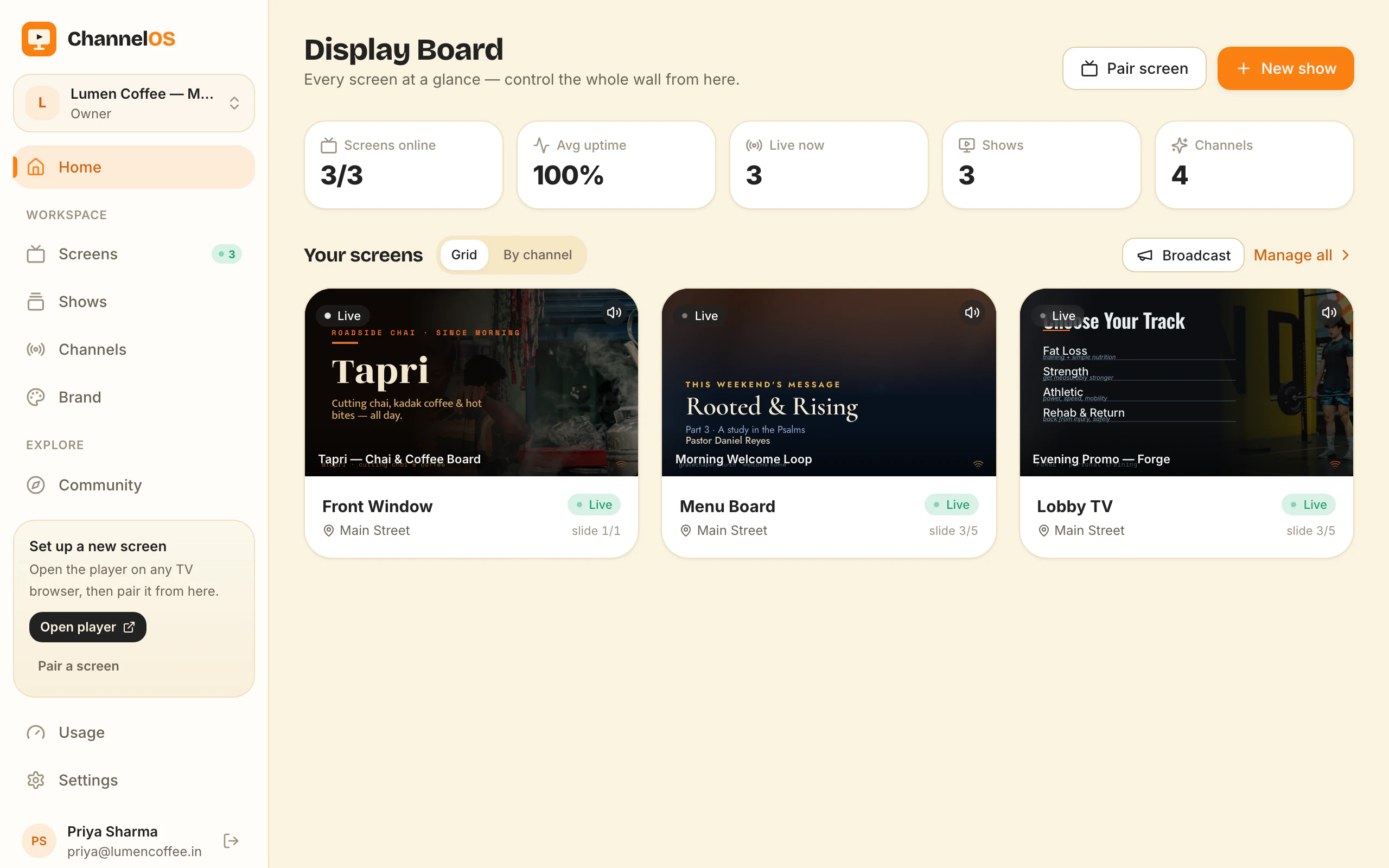
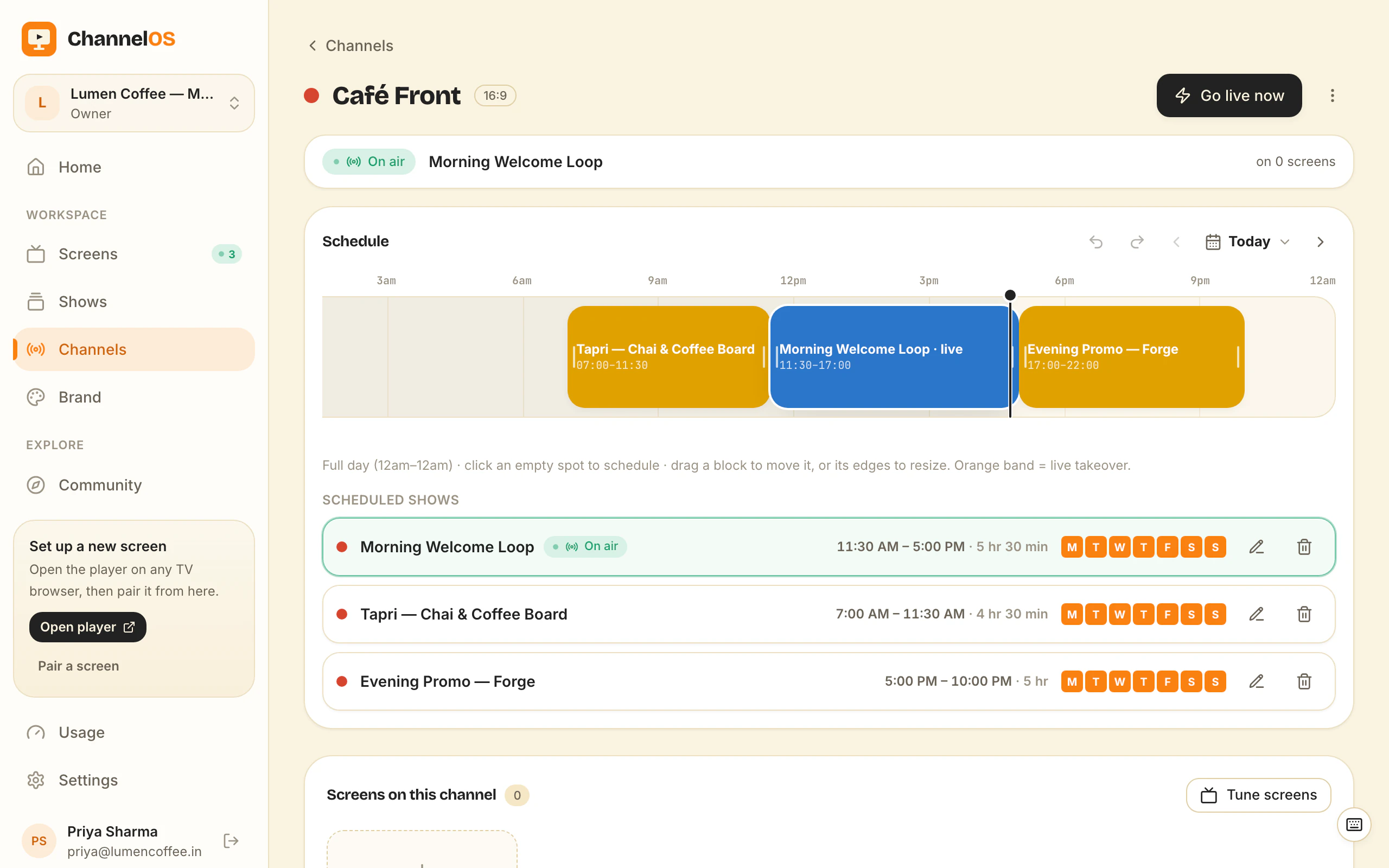
ChannelOS: one live board with a real rendered preview of every screen, pulsing live status, and one-tap controls — play, pause, blank, mute, next, hold. Channels give each group of screens a named feed with a real daily timeline: dayparting by hour and weekday, a live takeover for the thing the schedule couldn’t predict, and go-live-now.
Why it matters: a status dot tells you a screen is on. A rendered preview tells you it’s showing the right thing, which is the failure that actually happens — the screen in the back room still looping last month’s promo, online the whole time.
Setup before pixel one
| The job | PosterBooking | ChannelOS |
|---|---|---|
| Get a screen live | Install the player app on a device, register it | Open one URL on the TV — it mints a screen |
| Make a show | Upload artwork you designed elsewhere | Describe it — AI drafts every slide |
| Change what’s playing | Re-export, re-upload, wait for sync | Edit once — it airs everywhere |
| Time-of-day changes | Playlist scheduling | Channels: dayparting by hour and weekday, live takeover |
| Run the wall | Screen list with status | One live board with rendered previews |
| Free tier | Several screens, free | One screen free forever, with AI and the editor included and a small ChannelOS badge |
PosterBooking’s free tier, and what it actually buys you
The free tier is the reason PosterBooking shows up in these searches, so let’s be straight about it. Most signage vendors treat “free” as a 14-day trial with a card form at the end. PosterBooking’s covers more than one screen, indefinitely, and that is genuinely unusual — check their site for the current screen limit and which features sit behind a paid plan, because those move. If your job is “loop four images on three screens in a waiting room” and you already have the four images, that costs you nothing, and no honest comparison can beat nothing.
What it doesn’t cover is the part most people underestimate: making the four images. A free screen is only free if the content is already sitting on your laptop. In practice the cost reappears as an evening in Canva, a per-design fee to a freelancer, or — most often — the screen quietly showing something six weeks stale because nobody had time to redo it. That’s the tax the free tier doesn’t itemise.
ChannelOS makes the opposite trade, deliberately. One screen is free forever, not several — so on raw screen count PosterBooking wins and we’d rather say so than dress it up. What the free screen includes is the design work: AI drafting the whole multi-slide show, the editor, the Pexels library, widgets and templates. Free screens show a ChannelOS banner along the bottom of the screen, and any paid plan removes it. After the first screen it’s per screen per month, with the current rates on the pricing page. If you’d rather not start from a blank sentence, the templates gallery and the free menu board maker — 14 cuisines, from pizzeria to food truck — both hand you a finished board to edit.
A PosterBooking alternative that drafts the show for you
If you’re shopping for a PosterBooking alternative, the question that decides it isn’t feature count — it’s whether the thing standing between you and a good screen is somewhere to put the content or the content itself.
Switch if it’s the content. ChannelOS suits the single-site or few-site operator — a café, gym, salon, clinic, dealership, school reception, church hall — where the screens are somebody’s second job. You describe the show and AI drafts it, on-brand and editable, reading a PDF or a webpage URL if you hand it one. Switch if you want time-of-day to be automatic, too: a channel’s timeline swaps a breakfast board for a lunch board on the clock, weekday hours differing from weekend hours, rather than you remembering to change a playlist. And switch if you’d rather not install anything — on a smart TV with a browser there’s no app, no stick and no per-device licence. The mechanics are in no media player required, with the awkward-hardware cases covered in signage without an Android player.
Don’t switch if it’s the screen count. If you need five or ten screens on a zero budget and you already have the artwork, PosterBooking’s free tier is the better answer and we’d tell you the same in person. Don’t switch either if your screens sit on genuinely unreliable Wi-Fi — a player app with local storage rides out an outage better than a web page does. And don’t switch if you have an existing pipeline that works: a Google Slides deck someone already maintains, updated weekly, is a perfectly good signage workflow.
What you give up by switching, plainly: free screens beyond the first, the offline cushion of a locally cached playlist, and a Google Slides workflow if that’s how your content already gets made. What you get: nothing to install on most TVs, AI-drafted shows so the artwork stops being the bottleneck, real dayparting and takeover, and a schedule every screen derives in real time so there’s no publish-and-wait step.
Nothing migrates automatically. There’s no fleet to move, though — a screen crosses over in about two minutes, and rebuilding a show is usually faster than porting one, because you describe it rather than redraw it.
So which should you choose?
Choose PosterBooking if you have the artwork, want the most free screens you can get, and need somewhere cheap and dependable to loop it.
Choose ChannelOS if the artwork is the problem — if you want the show drafted for you, the schedule to change it on the clock, and the whole wall run from your phone. Your first screen is free forever, with a ChannelOS banner along the bottom of the screen that any paid plan removes. The test: three weeks from now, is the board still saying something true? That is the tax the free tier does not itemise, and it is the only number that matters.
Frequently asked questions
- What's the difference between ChannelOS and PosterBooking?
- PosterBooking is a low-cost player-app-based tool: you install its app on an Android TV, Fire TV stick or similar device and loop playlists of images, videos, web pages and Google Slides decks that you designed somewhere else. ChannelOS runs as a web page in the TV's own browser with nothing to install, and it builds the content too — AI drafts a complete multi-slide show from one sentence, which you then edit in a Canva-style editor.
- Is PosterBooking really free?
- Yes, PosterBooking's free tier is real and it covers more than one screen, which is unusual in this category and worth taking seriously. Check their site for the current screen limit and which features are held back for paid plans. The honest comparison is that PosterBooking gives you more free screens; ChannelOS gives you one free screen forever but includes the design work — AI drafting, the editor, Pexels media and widgets — rather than assuming you arrive with finished artwork. Free screens show a ChannelOS banner along the bottom of the screen, and any paid plan removes it.
- What is the best PosterBooking alternative?
- It depends on why you're looking. If you want more free screens than PosterBooking allows, you're comparing free tiers and most alternatives will be worse. If the thing actually blocking you is that nobody has made the slides, ChannelOS is the closer fit: AI drafts the whole multi-slide show from a sentence, a PDF or a webpage URL, and dayparting swaps what plays by hour and weekday. The first screen is free forever, so testing costs nothing. Free screens show a ChannelOS banner along the bottom of the screen, and any paid plan removes it.
- Do I need to install an app on my TV for ChannelOS?
- No. ChannelOS runs in the browser already built into the TV — Android TV, Google TV, webOS, Fire TV, a Chromebox, or a laptop in kiosk mode. You open one URL on the screen and scan the pairing code from your phone. There is no media player box and no per-device licence.
- Can I move my PosterBooking screens to ChannelOS?
- There is no automatic migration and no fleet to migrate: you open one URL in each TV's browser and scan a code, so a screen moves across in about two minutes. Your media doesn't transfer automatically — but you can upload the same images, videos or PDF you gave PosterBooking, describe the show and let AI draft the slides, or start from a template. Most people move one screen first and leave the others running until they're happy.
- Does ChannelOS work on the same cheap hardware as PosterBooking?
- Mostly, yes, and often on less. Anything that loads a modern web page can be a ChannelOS screen, including the Android TV or Fire TV stick you'd have installed PosterBooking's app on. The difference is that ChannelOS also runs directly on the smart TV's own browser, so on many sets there is no stick at all.
Your screen is two minutes away.
Open the player on a TV, scan the code, publish a show. Your first screen is free.
Free screens show a ChannelOS banner along the bottom of the screen, and any paid plan removes it.