Free plan

Free digital signage software that stays free.

Most free digital signage software is a countdown with the word free on the button. This isn't: your first screen on ChannelOS is free forever — no card, no watermark, no flip to paid when you add another. Here is exactly what that includes, and exactly where it stops.

1 screen · no card · no player box to buy

Never heard of digital signage? It is simpler than the name.

A digital sign is a television showing something useful instead of a channel. A menu. A price list. Today's offer. The class timetable. Whatever the people in that room need to read.

The software's only job is to let you change what is on that television without walking over to it. You change it on your phone, the television changes. That is the entire category.

Most companies who sell this will also sell you a small box to plug into the television, because that box is how their software gets onto the screen. ChannelOS does not need one. The television already has a web browser, and that browser is the player.

If you have a TV and wifi, you have everything.

What the free screen puts on the wall.

Every one of these is inside the free plan. Drawn by the same renderer a paired TV runs.

These are our own sample venues, not customers. We have not put words in anyone's mouth: the boards are real product output, the businesses are made up, and we will say so until there are real ones here to name. Type your own menu and watch this happen →

People run ChannelOS screens in cafés and restaurants, gyms and studios, clinics and waiting rooms, schools and colleges, events, hotels and shops. One TV or one standee is enough to start.

Two screens, two shapes, one place to change them. A TV on the wall, a standee by the counter. Each one is its own channel.

A café board on a TV, showing cutting chai, coffee and hot bitesA dental clinic waiting-room board on a TV, telling patients to check in at the front deskA gym board on a TV, showing the studio name and its personal-training lineA school board on a TV, showing that enrolment is open for the coming yearA festival board on a TV, showing three stages, two nights, the dates and the gate timeA boutique hotel welcome board on a TV
Tapri
Pouring today
Kadak Chai
₹20
Filter Coffee · ₹40
Bun Maska · ₹30
Counter open till 11 pm

For cafés · The drink list, with today's prices. Change one at the counter and the board changes.

Sign up with Google

One screen free for ever: 50 AI credits a month, no card.

What you get free

One whole screen, not a demo of one.

The free plan includes the making, not just the playing — which is the part most free tiers leave to you.

AI generation on the free plan runs on a monthly allowance rather than being unmetered — the current numbers live on the pricing page, so they can't go stale here.

In practice

What the free screen actually does.

Pair · two minutes

The TV is the player.

This is the line that decides whether a free plan is actually free: every other free tier in the category assumes a device attached to the screen — a Raspberry Pi, a stick, a box you buy and mount and eventually replace. If your TV has a browser, the hardware bill on your free screen is zero. More on that in do you need a signage player.
  • Open one URL in the TV's own browser
  • Scan the pairing code from your phone
  • No media player box, no per-device licence, no installer required
  • Works on Android TV, Google TV, webOS, Fire TV, a Chromebox, a laptop in kiosk mode
play.channelos.tv
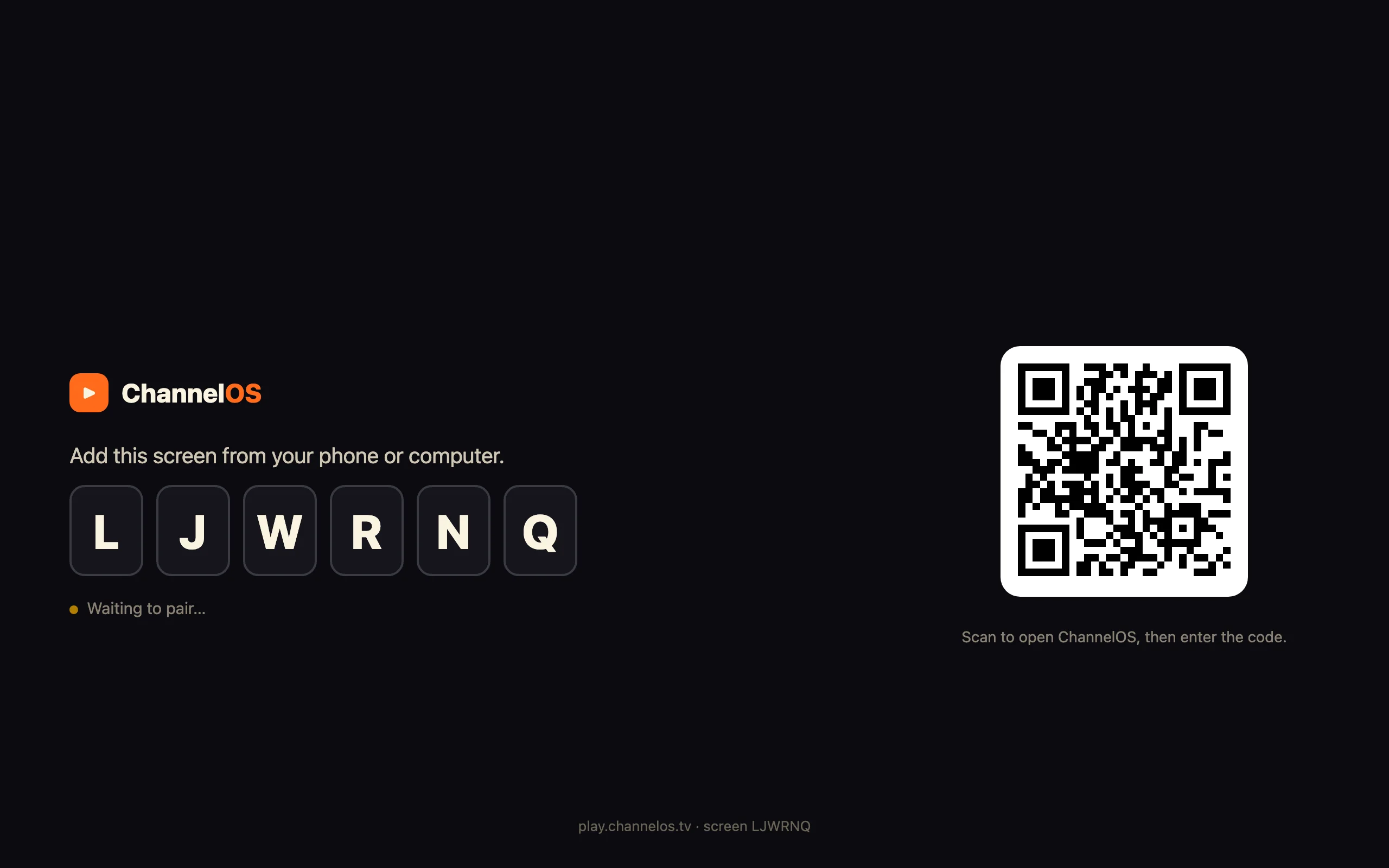
Pairing a TV in ChannelOS by scanning the on-screen code from a phone

Build · one sentence

The free plan includes the design work.

Anthias, Xibo and most hosted free tiers play whatever finished artwork you hand them. None of them makes it. That's the Tuesday nobody has made the slides — and why so many screens run last month's promo for a year. If you'd rather start from something finished, the template gallery and the free menu board maker (14 cuisines, from a café board to a food truck) both hand you a board to edit.
  • Describe it once — AI drafts a complete, editable multi-slide show
  • Feed it a PDF, an image or a webpage URL and it reads them for context
  • Finish it in a Canva-style editor with free Pexels photo and video
  • Tables, groups, keyboard shortcuts and live widgets — clock, weather, QR, menu, ticker
channelos.tv/app/shows/·/edit
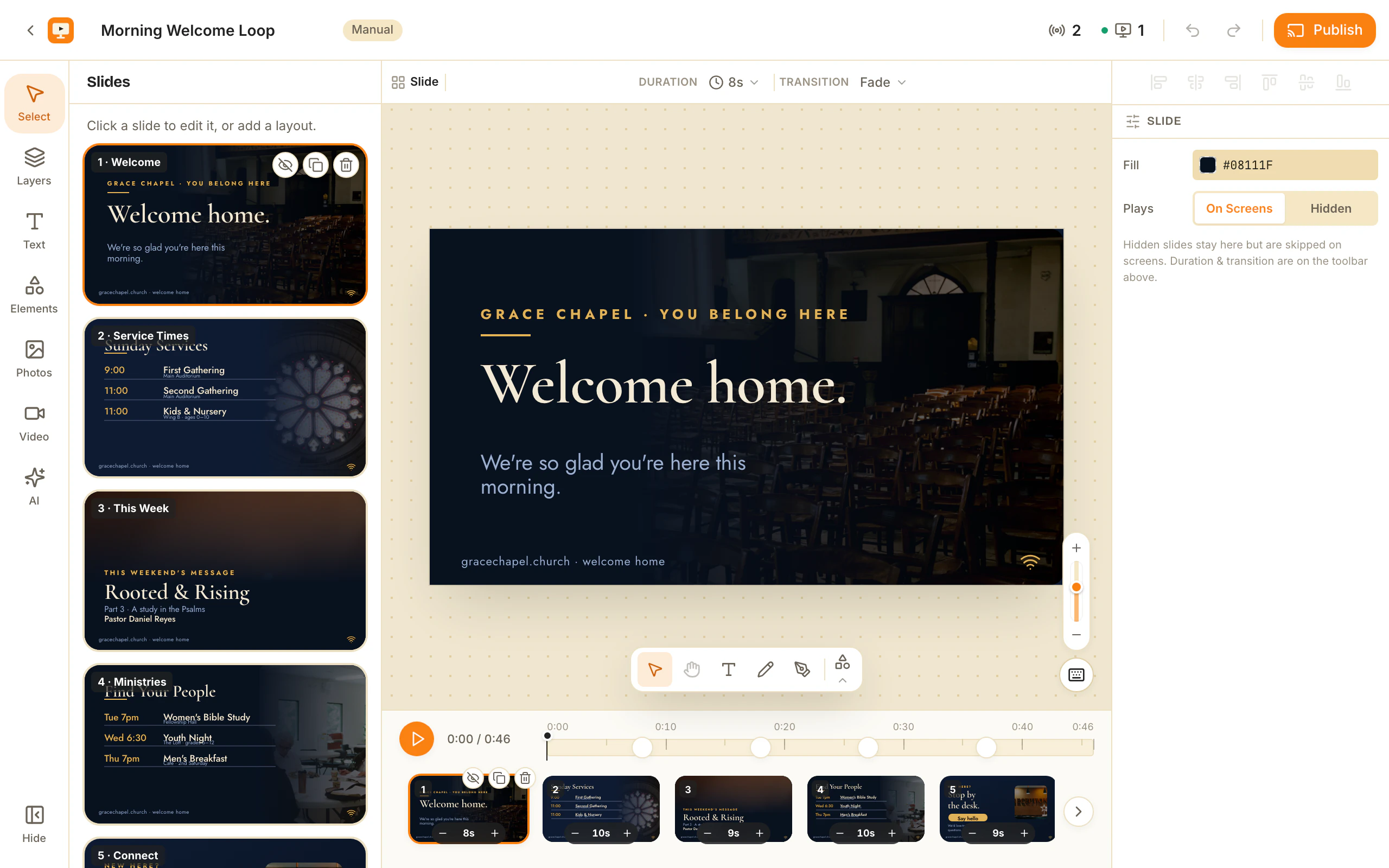
The ChannelOS slide editor with an AI-drafted show open on the canvas

The other half

What free does not include.

A free claim with the conditions hidden somewhere else isn't a free claim. So the conditions are here, on the same page as the word.

Not on the free plan Where it starts
A second screen Any paid plan — per screen, per month
Channels & dayparting (a weekly timeline, by hour and weekday) Solo and up
Live takeover — cutting in over the schedule Solo and up
One-tap background removal Solo and up
Brand kits Pro and up
More than one team seat Paid plans
Email and priority support Paid plans — free is community support

Two limits that aren't in the pricing table

A browser-based screen wants a working internet connection — a Raspberry Pi with local storage rides out an outage better than a web page does. And the TV needs a reasonably modern browser; a set from 2012 may not carry one. If your screens sit on genuinely unreliable Wi-Fi, a self-hosted player is the safer answer, and we'd rather say that now than after you've set one up.

What isn't a condition

No card to start. No trial clock. No watermark or vendor branding on the screen. No expiry on the free screen when you add paid ones, and no lock-in on the way out — every show and channel exports into one portable file, on the free plan too. Full plan-by-plan detail is on the pricing page.

Compared honestly

Free digital signage software vs open source: Anthias and Xibo.

Open-source signage is free in a different currency, and for some setups it's the better answer. Two of them are genuinely good, so here's the straight version.

Anthias — free software, paid in your own time

Formerly Screenly OSE. Flash it onto a Raspberry Pi, plug the Pi into the TV, manage a playlist of images, videos and URLs from the interface that Pi serves. It's genuinely simple, genuinely free of licence fees, and because everything sits on the Pi it keeps playing when the network wobbles — which a browser-based screen can't match. The bill is a Pi, an SD card and a mount per screen, no design tool at all, and one interface per screen rather than one view of the wall. Our longer take is in ChannelOS vs Screenly and Anthias.

Xibo — the deepest free CMS, if you'll run the server

The Xibo CMS is free and open source under AGPLv3, and it is not a toy: layouts with regions, real dayparting, DataSets, campaign scheduling. Feature for feature it outguns most paid tools. The cost is a web and database server you patch, back up and resurrect; layouts built by hand region by region; and the players — the Windows one is free, but the Android, Tizen and webOS players are licensed commercially per device, so an open-source CMS can still hand you a per-screen bill. Detail in ChannelOS vs Xibo.

Which way to jump

If you have a server, a technical person and real scheduling needs, take Xibo. If you have a Pi, one screen and you enjoy the tinkering, take Anthias. If you have a TV, no artwork and no time, a hosted free plan is the one that gets a board on the wall this afternoon — and ours costs nothing to test against either of them. There's a wider roundup, including the other hosted free tiers, in our honest guide to what's actually free.

When you'd pay

The four moments free runs out.

We'd rather you knew them before you start than discovered them on the day you need them.

  1. 1

    A second TV. The free screen stays free; screens two and up are per screen per month. That's the moment most people convert, and it's the honest one.

  2. 2

    The day needs a schedule. Breakfast board until 11, lunch menu after, a different plan at the weekend. Channels give a screen a real daily timeline with dayparting by hour and weekday — that layer is paid.

  3. 3

    Something has to cut in now. A live takeover airs over the schedule immediately and hands the day back afterwards. Also paid.

  4. 4

    You need the work to be portable. Export and import bundle a show or a channel — slides, media, fonts — into one file you can move or archive. Paid, and the reason there's no lock-in argument to have.

The numbers, the currency toggle and the full plan matrix are on the pricing page — we don't reprint prices here, because two copies of a price is how one of them ends up wrong.

Questions, answered.

Is ChannelOS free digital signage software, or a free trial?
It is a permanent free plan, not a trial. One paired screen is free forever with no card and no countdown, and it stays free when you add paid screens — you only pay from the second screen onwards. The free screen carries no vendor watermark. What it does not carry is scheduling: channels, dayparting, live takeover and one-tap background removal start on the paid plans.
What is the catch with the free plan?
Two things, stated plainly. First, the screen count: one, and a second TV means a paid plan. Second, the feature line: the free plan builds and plays a show on one screen, but the scheduling layer — channels with a daily timeline, dayparting by hour and weekday, live takeover — plus background removal and brand kits, sit on the paid tiers. There is no watermark, no card requirement and no trial clock.
Do I need to install an app on the TV for the free plan?
You do not have to. You open one URL in the browser already built into the TV — Android TV, Google TV, webOS, Fire TV, a Chromebox, or a laptop in kiosk mode — and scan the pairing code from your phone. There is no media player box to buy, and no per-device licence. If you would rather install something, we publish an Android TV app that does the same job on the same free screen. A browser-based screen does need a working internet connection, which is the one thing a self-hosted player with local storage handles better.
Is free digital signage software better than open source like Xibo or Anthias?
It depends on what you can afford to spend that isn't money. Anthias and the self-hosted Xibo CMS charge no licence fee for any number of screens, but you supply and maintain the server or a Raspberry Pi per screen, and neither makes the artwork — you still need something else to design the slides. A hosted free plan caps the screens instead and includes the making. If you have a technical person and real scheduling needs, Xibo is deeper for zero licence fee, and we would rather say so.
Can I use the free screen for my business?
Yes. The free screen is a normal commercial screen — a café menu, a clinic waiting room, a gym class timetable, a shop's rate list. It is not a personal-use-only tier and it is not restricted by what you display, within the terms.
What happens to my free screen if I cancel a paid plan?
The first screen stays. Cancelling stops the extra screens at the end of the period you have already paid for; nothing is deleted, and your shows, channels and media stay in your account. You can export a show or channel into one portable file at any time, on any plan including free.

Thirty more, in plain words, on the answers page →

Your first screen, free forever.

Open one URL on the TV, scan the code from your phone, and describe the board you want. Pay only when you add the next screen.

Sell it instead of buying it. The ChannelOS partner program pays 20% of what each business you refer pays us for their first 12 months, then 10% for as long as they stay. Free to join, nothing to stock.

See the partner program →